NOTE: Forces are transmitted through vehicle components such as axle shafts and trailer mounts. If the vehicle has been struck from behind, then all connected body components and mechanical components (such as transmission mounts) should be fully inspected. Electronic units should be inspected to ensure they are operating correctly.
It is also possible to determine the full extent of the damage, starting with the direction and magnitude of the impact forces. However, this requires extensive knowledge of the body structure.
If, for example, the impact is on the front left side member, the right side member, due to the rigidity of the body structure (the presence of a cross member), is usually also affected. Often the length of this side member will not change, but due to the rigidity of the body structure it may move from its original position (often only very slightly). If there are any deviations, this can usually be detected by checking the size of the gaps between the door and the wing or by checking for changes in dimensions.
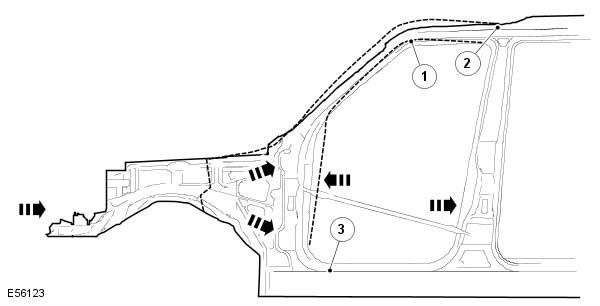
In the case of more serious impacts, the front of the body cannot absorb all the impact energy, and the area where people are located is also deformed. Here, the impact energy is transmitted through the side member to the "A" pillar (see diagram). This leads to deformation in the roof and door sill area.
The body reacts to side impacts in a completely different way, since there are practically no crumple zones here. Since the occupant area is extremely stable, there are relatively minor local deformations at the point of impact. However, the force of the impact is transmitted to the entire floor panel, which often ends with the car taking the shape of a banana.
The impact energy is transferred through the side member to the "A" pillar:
| Pos. | Spare part number | Name |
| 1 | - | Deformation zone - roof beam |
| 2 | - | Deformation zone - roof |
| 3 | - | Deformation area - door sill panel |
[The article is based on data from the website www.LRman.ru]
Comments on this article