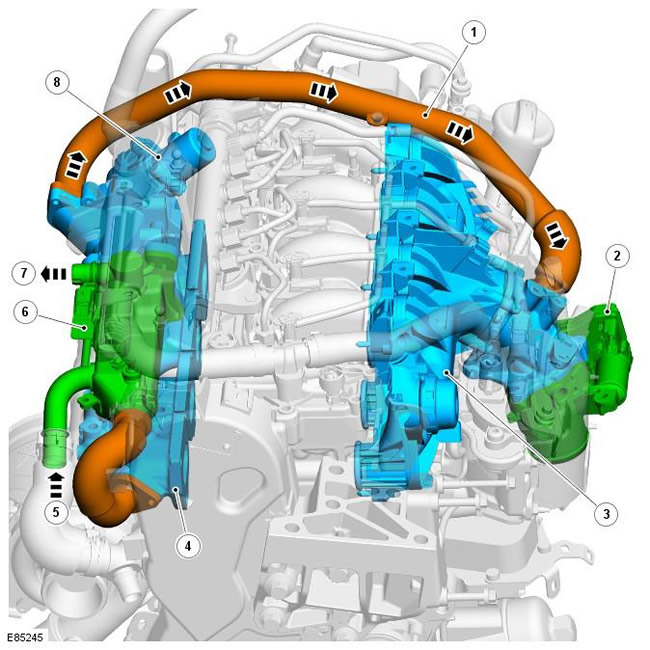
| Pos. | Spare part number | Name |
| 1 | - | Exhaust gas connection pipe - with flow direction indicated |
| 2 | - | Throttle body |
| 3 | - | Intake manifold |
| 4 | - | Exhaust manifold |
| 5 | - | Coolant inlet pipe |
| 6 | - | Exhaust Gas Recirculation (EGR) Heat Exchanger |
| 7 | - | Coolant outlet pipe |
| 8 | - | Exhaust Gas Recirculation (EGR) Valve and Actuator |
The reaction between oxygen and nitrogen at high temperatures produces harmful nitrogen oxides (NOx), which are a component of exhaust gases. Reducing the temperature in the engine combustion chamber, and therefore the amount of NOX produced, is achieved by recirculating part of the exhaust gases. Recirculated exhaust gases replace part of the air admitted to the engine, as this reduces the oxygen content in the cylinders and reduces the maximum combustion temperature by several hundred degrees.
To reduce the temperature and increase the density of the injected fuel charge, the recirculated exhaust gases pass through an exhaust gas recirculation (EGR) heat exchanger. The EGR heat exchanger uses coolant from the engine cooling system to reduce the temperature of the exhaust gases. The exhaust gases entering the EGR heat exchanger reach a temperature of approximately 500 degrees C. The EGR heat exchanger reduces the temperature of the gases to 250-300 degrees C before the gases exit it.
Operating principles
An electrically actuated valve mounted on the outlet side of the EGR heat exchanger and controlled by the powertrain control module (PCM) regulates the amount of exhaust gas recirculated into the air intake system. The PCM uses signals from various engine sensors and calculates a response based on an algorithm stored in software to control EGR. The PCM transmits this control signal to the valve actuator, which is controlled in closed loop by the mass air flow (MAF) sensor, which provides feedback to the PCM.
The article is based on data from the website: LRman.ru
Comments on this article