


Contents: General information ⇩ Front drive shaft ⇩ Rear Drive Shaft Assembly ⇩ Front shaft assembly ⇩ Rear shaft assembly ⇩ Thrust bearing assembly ⇩ Cardan joints ⇩
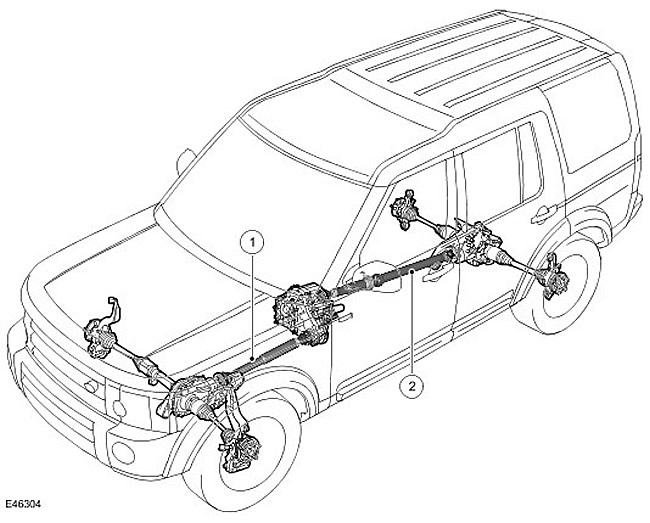
| Item name | Spare part catalog number | Description |
| 1 | - | Front drive shaft |
| 2 | - | Rear drive shaft |
General information
Drive shafts are used to transmit torque from the transfer case to the front and rear differentials.
The front drive shaft is a single piece that connects the transfer case to the front differential via constant velocity joints (CV joints).
The rear drive shaft consists of two parts and is supported by a central bearing due to its increased length. The rear drive shaft is connected to the transfer case via a constant velocity joint and to the rear differential via a cardan joint. These joints allow angular deflections of the drive shaft during acceleration and braking.
The front and rear drive shafts are non-serviceable and if faulty, the entire drive shaft assembly must be replaced.
Front drive shaft
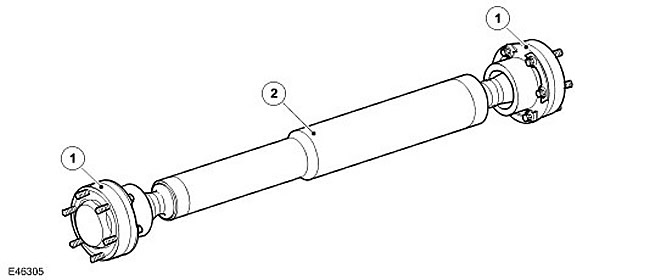
| Item name | Spare part catalog number | Description |
| 1 | - | CV joint |
| 2 | - | Front drive shaft |
The original article is located on LRman.ru
The front drive shaft is made from 1.7mm wall steel tubing. A CV joint is attached to each side of the drive shaft (see the Axle Joint section for more information on CV joints). The nominal overall length of the shaft is 713mm.
Each CV joint has 6 holes for mounting to the front differential primary flange and the front transfer case output flange. The CV joints are secured to the front differential and transfer case with 6 Torx bolts, set with sealant.
Under each pair of bolts there are compression washers. These washers are necessary to prevent compression of the CV joint mounting flange.
A protective cover is pressed onto the CV joint. The seal between the cover and the joint housing is ensured by an internal gasket, and with the front output flange of the transfer case - by an end plug and an internal gasket. This prevents dirt and moisture from getting inside. The CV joint allows movement of the drive shaft caused by small movements in the gearbox and transfer case supports.
Rear Drive Shaft Assembly
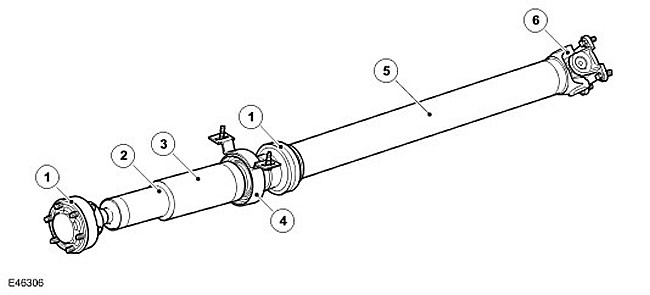
| Item name | Spare part catalog number | Description |
| 1 | - | CV joint |
| 2 | - | Deformable section |
| 3 | - | Front shaft assembly |
| 4 | - | Thrust bearing |
| 5 | - | Rear shaft assembly |
| 6 | - | Cardan joint |
The rear drive shaft assembly consists of the front and rear drive shaft assemblies and a centrally located support bearing. The nominal overall length of the rear drive shaft assembly is 1309 mm.
Front shaft assembly
The front shaft assembly has a deformable pipe element that regulates the "folding" of the drive shaft in an accident.
A CV joint is installed on each side of the front axle assembly (see the Axle Joint section for more information on CV joints).
Front CV joint (from the transfer case side) has 6 radially located holes for fastening to the rear output flange of the transfer case. The CV joint is fastened to the output flange with 6 Torx bolts screwed into threaded holes in the flange. Compression washers are installed under each pair of bolts. The rear splined shaft is engaged with the CV joint hub of the rear shaft, pressed in and secured with Locktite. A support bearing is installed on the machined surface of the shaft using a press fit.
Rear shaft assembly
The rear shaft assembly has at the rear (from the rear differential side) hookes type cardan joint.
The universal joint is welded to the rear shaft tube and is secured to the rear differential input shaft with 4 flange nuts. The opposite end of the rear shaft tube is welded directly to the CV joint housing.
Thrust bearing assembly
The support bearing assembly consists of a stamped steel housing, a rubber diaphragm, and a ball bearing. The diaphragm is secured in the housing. An internal metal ring mounted on a bushing allows the bearing to be pressed into it. The rubber bushing allows minor axis displacements and also serves to dampen vibrations. The support bearing assembly is secured with screws that pass through unthreaded holes in the bearing assembly and are screwed into nuts welded to the inside of the chassis crossmember.
Cardan joints
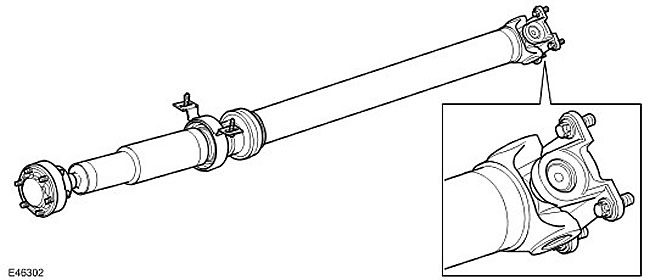
The Hookes type universal joint is used to connect the rear drive shaft assembly to the rear differential, allowing for angular deflection of the drive shaft during acceleration and braking.
The joint is attached to the primary shaft of the rear differential with 4 sealed flange screws. During manufacturing, the joint is lubricated and sealed for its entire service life.
Comments on this article