


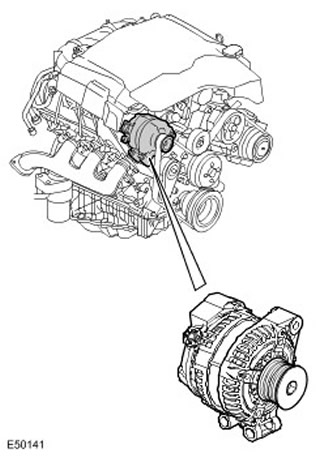
The generator is mounted on the engine cylinder block, on its right side, in front of the right cylinder head. The generator, manufactured by Denso, has an output current of 85/150 A. An eight-groove poly V-belt is used to drive the generator from the crankshaft pulley.
The generator pulley has a freewheel clutch, which allows reducing the reduced moment of inertia of the engine during deceleration.
The main components of the generator are the stator, rotor, rectifier and voltage regulator. The generator body has a three-pin connector C0053:
- Pin 1 - Reference voltage line to battery via battery junction box (BJB)
- Pin 2 - Pulse Width Modulation signal from the Engine Control Module (ECM) to the generator (generator control)
- Pin 3 - Pulse Width Modulation signal from generator to ECM (generator control)
The rotor consists of an excitation winding wound on a cast iron core and mounted on a shaft. The rotor core has projections on both sides that form the north and south poles when current flows through the excitation winding. The rotor is located inside the stator, and the rotor shaft is mounted on bearings that provide the smoothness of its rotation and absorb significant lateral loads created by the tension of the drive belt.
The stator has three windings made of copper wire. The three stator windings are connected in a "star" at a common point. The output current is fed into the electrical system from the free ends of the three windings. When the rotor rotates, alternating current is generated in the winding.
The rectifier converts the alternating current generated in the stator windings into direct current. (rectified) the current required to power the vehicle's electrical equipment. The rectifier is a series of semiconductor diodes mounted on a heat sink. The positive and negative sides have the same number of diodes, and an additional diode is installed in the voltage regulator to control the feedback on the battery voltage signal line. The rectifier also prevents the battery from discharging through the alternator when the alternator voltage is lower than the battery voltage.
To protect the battery, an "intelligent" regulator is used to control the generator output voltage. At low temperatures, the battery's ability to recharge is low, so the charging voltage must be increased as much as possible, but at high temperatures, the charging voltage must be reduced to prevent excessive gas formation in the battery and, as a result, loss of water from the electrolyte. The required generator output voltage is calculated by the EMS system, which is responsible for managing the generator. Conventional voltage regulators regulate based on the generator temperature, which means ignoring the battery temperature and long periods of recharging in a non-optimal mode. The new system allows the EMS to set the required voltage based on the battery temperature, the value of which is measured using various sensors, and the generator voltage precisely matches the battery requirements.
Fast acting transistor switches are used to regulate the voltage in the generator. In addition, the regulator transmits a pulse width modulation signal to the ECM, which is used to regulate the idle speed under different electrical loads.
Initially, at low generator speeds, the ignition switch power supply circuit supplies excitation voltage to the rotor winding using brushes and contact rings. As the generator speed increases, a self-excitation effect occurs in it.
The control signal for the battery charge indicator lamp is transmitted to the EMS and then via the CAN bus to the instrument cluster.
Load control system
The load control system includes a program stored in the Automatic Temperature Control (ATC) controller. For more information, refer to Control Components (412-04 Control Components).
The controller is designed to maintain battery charge during abnormal vehicle use. The load control system switches the multimedia equipment and air suspension to economy mode, and also regulates the operation of such consumers as seat heaters and window heaters so that the battery does not discharge to a level at which the vehicle cannot be used. The message center screen will display the message 'WARNING - LOW BATTERY' (warning - low battery).
(Information obtained from the website: «www.lrman.ru»)
Comments on this article