Arrangement of elements
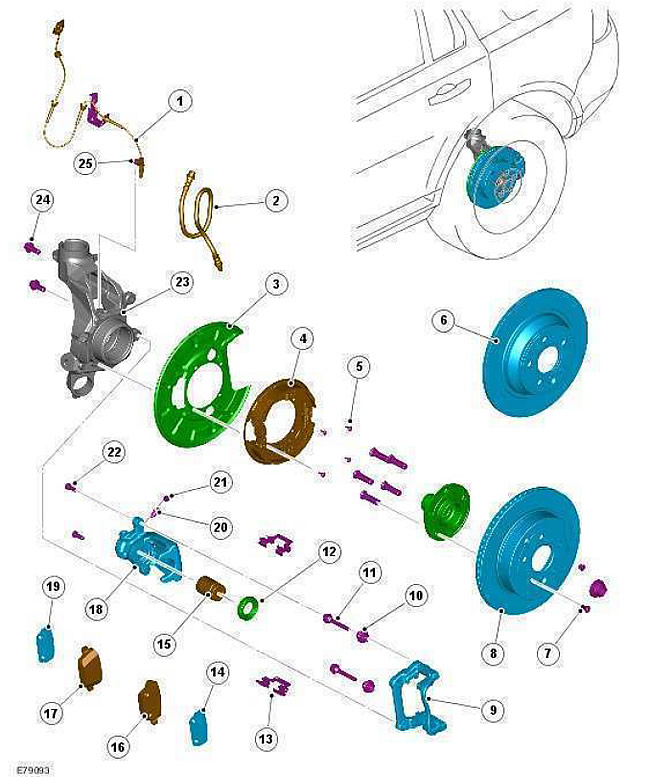
| Pos. | Spare part number | Name |
| 1 | - | Anti-lock Brake System (ABS) Sensor Wire |
| 2 | - | Flexible hose |
| 3 | - | Dust shield |
| 4 | - | Parking brake assembly |
| 5 | - | Dust shield mounting screw (4 pcs.) |
| 6 | - | Brake disc - monolithic (models with diesel engine TD4) |
| 7 | - | Brake disc mounting screw |
| 8 | - | Brake disc - ventilated (models with petrol engine i6) |
| 9 | - | Fixed holder |
| 10 | - | Rubber boot for sleeve bolt (2 pcs.) |
| 11 | - | Sleeve bolt |
| 12 | - | Caliper piston seal |
| 13 | - | Brake shoe mounting spring (2 pcs.) |
| 14 | - | External gasket that eliminates squealing |
| 15 | - | Caliper piston |
| 16 | - | Outer brake shoe |
| 17 | - | Inner brake lining |
| 18 | - | Sliding support |
| 19 | - | Internal lining to eliminate squealing |
| 20 | - | Caliper Pressure Relief Screw |
| 21 | - | Pressure relief screw cover |
| 22 | - | Sleeve bolt fastening screw (2 pcs.) |
| 23 | - | Left rear wheel hub support |
| 24 | - | Fixed holder mounting bolt (2 pcs.) |
| 25 | - | Anti-lock brake system (ABS) sensor mounting screw |
The rear brake assembly is equipped with a conventional ventilated or monolithic brake disc and a cast iron floating caliper with a single-acting piston.
Brake disc
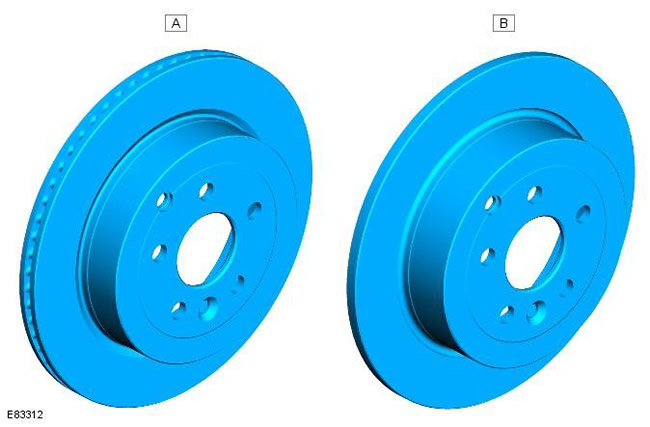
| Pos. | Spare part number | Name |
| A | - | Rear Brake Disc - i6 Petrol Car |
| B | - | Rear brake disc - vehicle with diesel engine TD4 |
The ventilated brake disc measures 302 x 20 mm and is installed on vehicles with a 3.2-litre i6 petrol engine. The solid brake disc measures 302 x 12 mm and is installed on vehicles with a 2.2-litre TD4 diesel engine. The brake disc is secured to the wheel knuckle hub with one screw and is also held in place by five wheel nuts.
The rear brake discs of both sizes are sufficiently cooled and have high thermal stability even under hard braking.
A solid brake disc is cooled by air flowing over the disc surfaces as the vehicle moves forward. A conventional ventilated disc is cooled by air being drawn through radial holes in the outer rim of the disc as the vehicle moves forward. The air cools the disc as it moves inward from the edge to the centre of the disc, and then out through holes around the disc's central cone.
The brake disc also houses the parking brake components. The inner diameter of the brake disc is 185 mm (7.28 in) and is machined, with a smooth surface forming the brake drum. The integrated brake shield and brake dust shield are mounted behind the brake disc. The brake shield contains the brake disc and also serves as a mounting location for the 2 parking brake shoes and working elements.
Through the hole in the dust shield and the brake shield, the parking brake cable passes to the inside of the brake disc and connects to the parking brake expander. A hole provided in the outer hub of the brake disc provides access to the hand parking brake adjuster. For more information, refer to the chapter: Parking brake (206-05 Parking brake and parking brake actuator, Description and principle of operation).
Assembled caliper
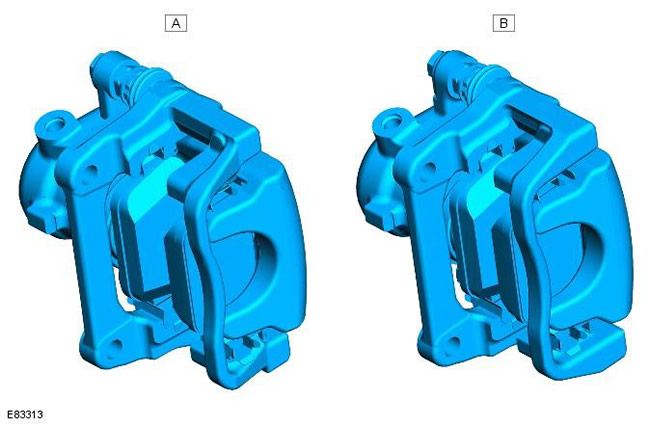
| Pos. | Spare part number | Name |
| A | - | Rear Brake Caliper - i6 Petrol Car |
| B | - | Rear Brake Caliper - TD4 Diesel Vehicle |
The caliper assembly includes a fixed support bracket and a floating caliper. The fixed support bracket is installed to cover the brake disc. The bracket is secured to the steering knuckle with two bolts. The fixed support bracket is used to accommodate two brake pads, which are installed on both sides of the brake disc.
The bracket has guide channels that allow the brake pads to move towards the disc.
NOTE: Two of the bolts in the fixed support bracket are pre-applied with thread locking compound that should not be used during servicing. New fixed support bracket bolts should be used and "old" bolts should be discarded.
A floating caliper is mounted above the fixed support bracket, inside which two brake shoes are held. The floating caliper is secured to the fixed support bracket by two bolts with bushings. It forms a hydraulic chamber, which contains a piston with a diameter of and an annular seal.
The floating caliper is connected to the brake system hydraulic drive by a flexible hose. It has a screw for releasing air during maintenance.
The two bushed bolts are machined to a high-quality surface and protected from dirt and moisture by a deformable rubber boot. The bushed bolts allow limited lateral movement of the floating calipers along the fixed support bracket.
The pressure adjusting shim is installed on the outer edge of each brake pad and improves the NVH (noise, vibration and harshness) characteristics of the brake components during system operation.
Between the fixed support bracket and the floating caliper, the upper and lower brake pad retaining springs are installed. The retaining springs are held in place by two bolts with bushings and maintain the force acting on the brake pads to prevent radial movement of the pads away from the brake disc. The brake pads are not equipped with pad wear sensors.
Brake dust shield
The brake dust shield and integrated parking brake shield is located between the wheel knuckle and the brake disc and is attached to the knuckle with four screws.
The brake dust shield faces the corresponding side of the vehicle and protects the brake components from stone impacts across the axle. The brake dust shield also prevents brake dirt and dust from spreading to other parts of the vehicle.
Comments on this article