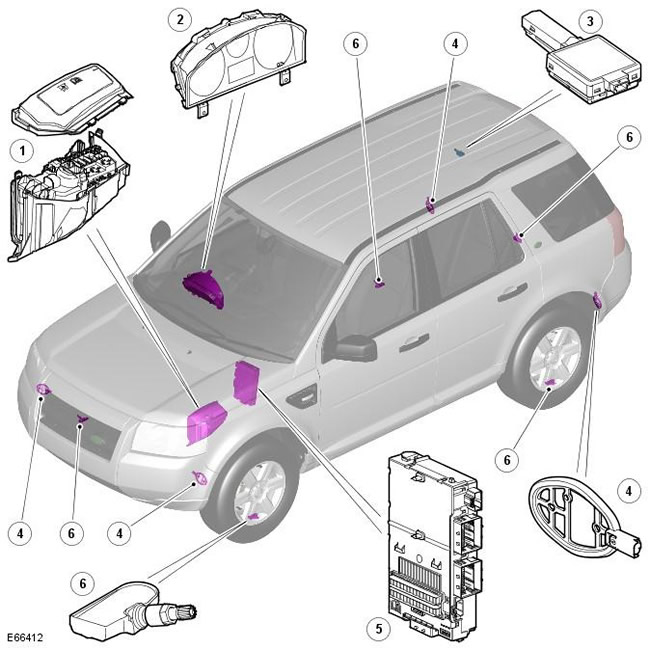
| Pos. | Spare part number | Name |
| 1 | - | Battery Distribution Box |
| 2 | - | Instrument panel |
| 3 | - | Radio frequency receiver |
| 4 | - | Activator |
| 5 | - | Central Junction Box (CJB) |
| 6 | - | Tire pressure sensor |
TPMS is a system that helps the driver maintain tire pressure at an optimal level. The TPMS system is included as standard in vehicles designed for North America (NAS) and as an option for other markets. The TPMS system offers the following advantages:
- Reduced fuel consumption.
- Maintaining good operational and dynamic characteristics.
- Reduces the risk of sudden flat tyres that can occur due to under-inflation.
- Compliance with applicable legal requirements.
CAUTION: TPMS is not a substitute for regular tire condition and tire pressure checks and should be considered as an additional tool to help maintain good tire condition.
The air pressure monitoring system measures the air pressure in each tire (including the spare tire, if necessary) and warns the driver if the air pressure in at least one tire goes beyond the set limits.
NOTE: When a tire "goes flat" it will usually cause a very rapid loss of pressure. The system is not designed to alert the driver of a "goes flat" tire because it cannot do so in such a short time. The purpose of the TPMS is to assist the driver in maintaining the correct tire pressure, thereby reducing the risk of a "goes flat".
The TPMS control software is located in the CJB. The software detects the following conditions:
- A drop in air pressure in a tire below the minimum value is an underinflated tire.
- Position of the tire on the vehicle.
The system includes a high-frequency receiver, 4 activators and 4 tire pressure sensors (5 if the sensor is installed on the steering wheel).
4 actuators are hardwired to the CJB. The actuators send low frequency signals of 125 kHz to the tire pressure sensors, which change the mode status in high frequency transmission based on these signals. The radio frequency signals of 315 or 433 MHz are received by a high frequency receiver located at the rear of the vehicle, under the roof lining. The radio frequency receiver is connected to the CJB via a Local Interconnect Network (LIN) bus. The high frequency signals received from the tire pressure sensors are transmitted to the CJB via the LIN bus, they contain identification data, pressure, temperature and acceleration information for each wheel and tire.
The TPMS software communicates with the instrument cluster via the medium-speed CAN bus to provide the driver with appropriate warnings. The TPMS software also indicates the status or malfunction of the TPMS system and components.
Comments on this article