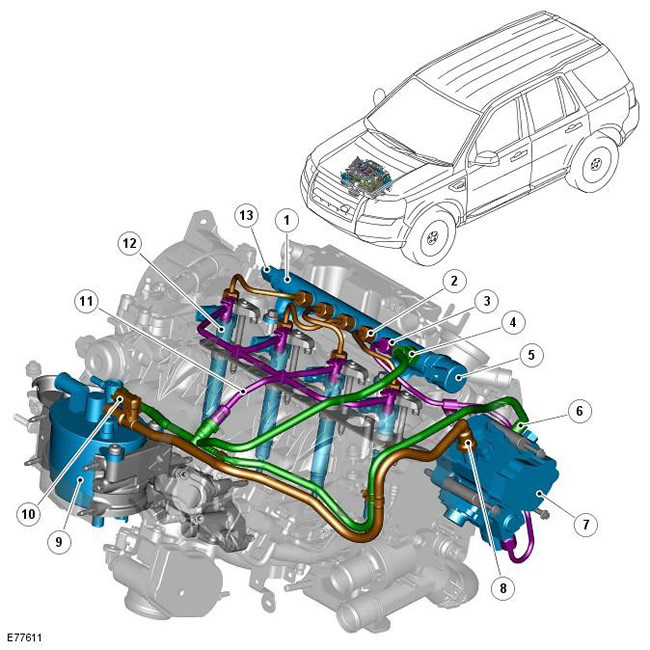
| Pos. | Spare part number | Name |
| 1 | - | Common rail fuel |
| 2 | - | High pressure pipe - from fuel manifold to injector (4 pcs.) |
| 3 | - | High pressure line - from pump to fuel manifold |
| 4 | - | Pipeline - Fuel Manifold Pressure Relief |
| 5 | - | Fuel Rail Pressure Check Valve |
| 6 | - | Hose - bypass, high pressure pump |
| 7 | - | High pressure fuel pump |
| 8 | - | Low pressure hose - from fuel filter to pump |
| 9 | - | Fuel filter assembly |
| 10 | - | Fuel temperature sensor |
| 11 | - | Pipeline - bypass, injectors |
| 12 | - | Nozzle (4 pcs.) |
| 13 | - | Fuel Rail Pressure Sensor |
The fuel supply and control system of the TD4 diesel engine ensures precise and instantaneous fuel supply to the combustion chambers. This ensures optimum dynamic characteristics and excellent engine response to driver commands under all driving conditions. The fuel system includes a Bosch common rail injection system, which is monitored and controlled by the (engine control module) (ECM), designed to precisely control the fuel supply strategy.
Fuel is supplied by a low-pressure and high-pressure fuel system. The low-pressure fuel system includes the following elements:
- saddle shaped fuel tank
- tank mounted fuel delivery module with integrated transfer pump
- fuel supply and return lines
- filter and water separator assembly
- connecting hose between fuel filter assembly and fuel lift pump
NOTE: The fuel lift pump is combined with the high pressure pump.
The remaining components of the low pressure fuel return circuit are the return line and the bypass fuel hoses from the high pressure pump, injectors and common rail. For more information, refer to the chapter: Fuel Tank and Lines - 2.2L Duratorq-TDCi (DW) Diesel (310-01 Fuel Tank and Lines, Description and Function).
The high pressure fuel system includes the following elements:
- high pressure fuel pump
- common rail fuel
- 4 piezo injectors with high pressure connecting pipes
- fuel pressure sensor
The fuel supply and control system provides injection pressures of up to 1800 bar (26,106 psi). Finer atomization of the injected fuel is provided by 7-hole piezo injectors, which are able to respond almost instantly to ECM commands, producing up to 5 individual injections per stroke.
The original text can be found at [www.LRman.ru]
The high-pressure fuel pump is mounted behind the cylinder head and is driven by the exhaust camshaft. The fuel lift pump is integrated with the high-pressure pump and is therefore also driven by the rotation of the exhaust camshaft. The lift pump creates a suction effect in the supply line to the fuel tank and pumps fuel out of the tank. The fuel passes through the fuel filter and is then supplied at the pressure created by the lift pump to the inlet port of the high-pressure pump.
The upgraded high-pressure fuel system features a pre-injection feature that occurs before the main fuel injection. This creates a stable flame front and a progressive increase in cylinder pressure, similar to the process that occurs in gasoline engines. This reduction in ignition delay between the moment of fuel injection and the moment of ignition ensures that fuel is injected during combustion, which increases power and reduces associated (noise, vibration and harshness) (NVH) and exhaust toxicity.
On models equipped with a diesel particulate filter, the high-pressure fuel system also provides post-injection of fuel into the combustion chambers. When a request is made for diesel particulate filter regeneration, the ECM allows the fuel system to deliver fuel after the combustion stroke and at the beginning of the exhaust stroke. This post-injection process ensures combustion of the fuel in the exhaust system and creates the high exhaust temperatures required for filter regeneration.
Comments on this article