Contents: Suction pump ⇩ Fuel Control Valve (VCV) ⇩
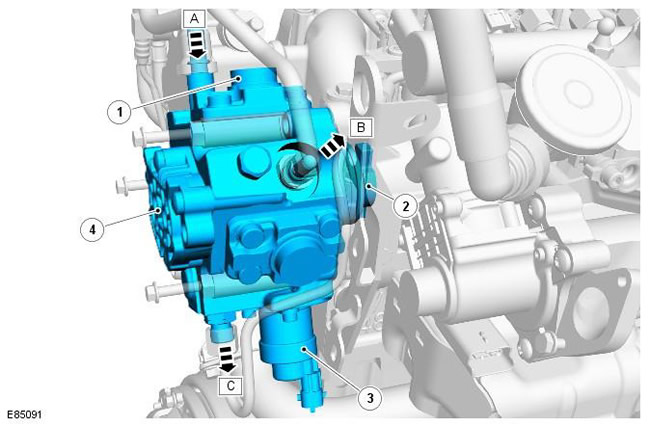
| Pos. | Spare part number | Name |
| A | - | Fuel supply line from filter to suction pump |
| B | - | Low pressure fuel return to filter |
| C | - | Supplying high pressure fuel to the fuel rail |
| 1 | - | High pressure plunger pairs (3 pcs.) |
| 2 | - | High pressure fuel pump drive shaft |
| 3 | - | VCV |
| 4 | - | Suction pump |
The high-pressure fuel pump is mounted behind the cylinder head (on the gearbox side) and is driven by the exhaust camshaft. The fuel pump is a 3-piston, radial plunger pump with plunger pairs evenly spaced around the circumference at an angle of 120 degrees to each other. The high-pressure outlet port from the plunger pairs connects to the annular circuit in the fuel pump and ensures the supply of fuel under constant pressure to the fuel manifold. The pump is capable of creating a maximum fuel pressure of 1,600 bar.
The high pressure pump includes the following elements:
- Three high pressure plunger pairs
- Built-in suction pump
- Fuel Control Valve (VCV)
The high-pressure fuel pump and the built-in suction pump are inseparable. The high-pressure fuel pump is not connected to the engine valve timing.
A controlled amount of fuel can be bypassed through the high-pressure pump and returned through the return fuel line to the fuel filter. The returned (bypassed) fuel provides cooling and lubrication of the internal components of the high-pressure fuel pump.
Suction pump
The fuel suction pump is mounted on the rear of the fuel pump. It forms a single unit with the high-pressure pump. The fuel suction pump is a gear-type pump. It is connected to the feed line of the fuel filter. The suction pump creates a vacuum (pressure below atmospheric) in the feed line leading to the fuel tank and draws fuel from the tank. The fuel passes through the fuel filter and is then supplied at the pressure created by the suction pump to the inlet port of the high-pressure pump.
The vacuum values for a normally operating suction pump are shown for the following engine operating conditions:
| Engine operating conditions | Vacuum created by the suction pump |
| Turning | -133±7 mbar |
| Full load | -267±133 mbar |
Fuel Control Valve (VCV)
The VCV is located on the high-pressure pump. It is located in the feed port between the high-pressure plungers and the suction pump. The VCV is a variable-position solenoid valve that is controlled by the ECM via a 12-volt pulse-width modulated (PWM) signal. The VCV controls the amount of fuel that is delivered by the suction pump to the high-pressure plungers.
When the high pressure fuel pump operates, fuel pressure is created when the VCV is open and the PCV, which is mounted on the fuel rail, is closed. The VCV and PCV valves can be in different positions and are used by the ECM to control fuel delivery and pressure in the fuel system.
In the fuel preheating phase, when the fuel supply temperature is less than 40°C, the ECM fully opens the VCV. The fuel supply and pressure are then controlled directly by the PCV under the control of the ECM.
The VCV is normally open when the solenoid valve is not receiving power from the ECM. The resistance value of the VCV solenoid coil is 2.8 ohms at 20°C. For more information, refer to the chapter: Electronic Engine Controls - 2.2L Diesel (303-14 Electronic Engine Controls - 2.2L Diesel, Description and Operation).
Comments on this article