Contents: Air suspension switch mode lamps ⇩ Road traffic mode ⇩ Off-road driving mode ⇩ Landing mode ⇩ Low speed mode at landing altitude ⇩ Warnings accompanying automatic…⇩
Using the suspension switch, the driver can manually select one of four modes:
- ON-ROAD mode (traffic on the road) - normal working height of the vehicle
- OFF-ROAD mode (off-road driving) - in this mode, a higher height is maintained compared to the road driving mode, which provides greater ground clearance, approach, departure and ridge clearance angles.
- ACCESS mode (boarding) - in this mode, a lower height is maintained compared to the road driving mode, which makes it easier for passengers to board and disembark.
- CRAWL mode (low speed movement at landing altitude) - in this mode the car can move at the landing height at low speed, which is convenient when entering a parking lot with a low roof, etc.
NOTE: Vehicle height cannot be changed if the air suspension control module receives a door open signal from the Central Junction Box (CJB).
An additional TRANSPORTATION mode is also available. (transportation), but it can only be selected using Land Rover approved diagnostic equipment.
An additional function allows the height of the vehicle to be raised and lowered from the outside when it is stationary. For example, this function makes it easier to secure a trailer. It is operated by buttons on the remote control when the ignition is off. The remote control can be programmed to perform a number of additional functions. For more information, see Handles, Locks, Latches and Entry Systems (501-14 Handles, Locks, Latches and Entry Systems)
If the air suspension control unit has determined that the vehicle has bottomed out and the wheels have lost traction, the control unit can temporarily increase and/or redistribute the volume of air supplied to the relevant air spring element(s) to improve traction. This mode is called extended mode and is indicated to the driver by flashing air suspension switch lamps and messages on the information display in the center of the instrument cluster.
If the air suspension control unit determines that the height or tilt adjustment is preventing the vehicle from moving forward or backward, the unit will enter a safe state and stop further adjustment of the suspension height.
When the air suspension control module detects a fault, it will reduce the functionality of the system depending on the type and severity of the fault. The control module will also store a fault code which can be read using Land Rover approved diagnostic equipment. In the event of a serious fault, the control module will attempt to restore the vehicle to a safe condition. The driver will be informed of the fault by the air suspension indicator, a message in the instrument cluster message centre display and an audible signal from the instrument cluster.
In the event of a minor malfunction that does not affect the safety of the vehicle, the air suspension control indicator on the instrument panel will light up yellow.; this means that the fault should be corrected at the earliest opportunity. If a more serious fault is detected at a speed of over 50 km/h, the indicator will glow red and the vehicle should be driven with extreme caution until the fault is corrected. When the indicator is on, the instrument cluster will sound an audible signal. When the vehicle speed decreases, the indicator changes to yellow and the audible signal is turned off.
Air suspension switch mode lamps
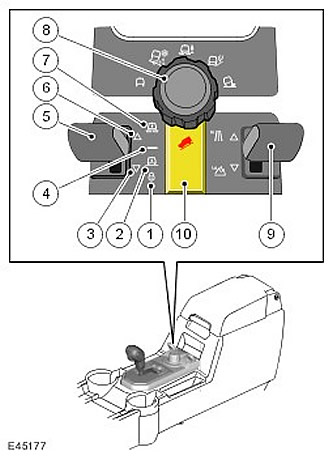
| Item name | Spare part catalog number | Description |
| 1 | - | Low altitude driving mode lamp |
| 2 | - | Landing mode lamp |
| 3 | - | Height reduction lamp |
| 4 | - | Road mode lamp |
| 5 | - | Air suspension switch |
| 6 | - | Height increase lamp |
| 7 | - | Off-road driving mode lamp |
| 8 | - | Terrain Response Rotary Switch |
| 9 | - | Transfer case range switch |
| 10 | - | Controlled Descent System (HDC)switch |
Road traffic mode
This mode corresponds to the normal height of the car body
Off-road driving mode
Off-road mode is activated only when the vehicle speed is less than 40 km/h. The vehicle is raised by 55 mm compared to on-road mode, which provides greater ground clearance, approach, departure and crest angles. If the vehicle speed exceeds 50 km/h, the air suspension control unit automatically lowers the vehicle to the height corresponding to on-road mode. At 40-45 km/h, a message appears in the message center display prompting the driver to reduce speed, otherwise the vehicle body height will be reduced.
NOTE: When some Terrain Response modes are selected with the transfer case in low gear, the suspension may automatically switch to off-road mode.
Landing mode
In the boarding mode, the height of the car body is reduced by 50 mm to simplify boarding, disembarking and loading. The boarding mode can be selected in advance while the car is moving. When the car slows down, the height of the car will be partially reduced; full reduction to the landing mode height occurs when the speed reaches 8 km/h. If the required speed is not reached within the specified time, the air suspension returns to the previously set vehicle height.
The landing mode can be selected at any vehicle speed. When the landing mode is selected, the response of the air suspension system depends on the vehicle speed:
- If the speed is higher than 20 km/h, the air suspension control unit will wait for the vehicle to slow down for one minute. The landing mode lamp and the height reduction lamp will flash while the air suspension control unit waits for the vehicle to slow down.; the road mode lamp will be on. If the vehicle speed does not decrease sufficiently, the request to enable the landing mode will be removed after 1 minute.
- If the vehicle speed is below 20 km/h, the air suspension control unit will partially lower the suspension and maintain this height for one minute. When the control unit partially lowers the suspension height, the on-road mode lamp goes out. The entry mode lamp and the height reduction lamp will light. When the partially lowered height is reached, the height reduction lamp will flash. If the speed does not decrease to less than 8 km/h within one minute, the entry mode request is cancelled.
- If the vehicle speed is lower than 8 km/h, the suspension will immediately lower to the landing mode height. The landing mode lamp and the height reduction lamp will light. When the landing mode height is reached, the height reduction lamp will go out.
The seating height can be selected within 40 seconds after the ignition is switched off, provided that the driver's door is not opened during this time.
The vehicle automatically rises from the landing mode when the speed exceeds 10 km/h. If the landing mode was selected from the off-road driving mode, the system returns to the off-road driving mode when the speed exceeds 10 km/h. In other cases, the system raises the suspension to the height corresponding to the on-road driving mode.
Select landing mode directly from off-road mode
If you press the air suspension switch in the off-road driving mode and then press it again before the height reduction lamp goes out, the control unit will lower the suspension to the landing mode height. The control unit will automatically return the suspension to the off-road driving height when the speed exceeds 10 km/h.
Low speed mode at landing altitude
In this mode, the car can move at the landing height. The height of the car is fixed at the level corresponding to the landing mode. This mode can be selected at a speed below 35 km/h. It allows you to increase the clearance from above when driving at low speed in low areas, such as parking lots.
When the vehicle speed exceeds 40 km/h, the low-altitude driving mode is switched off and the system sets the driving altitude to that of the road driving mode.
In this mode, the car can move at low speed with the suspension fixed at the landing height. This provides increased free space above the car roof, which is convenient, for example, when entering a low garage.
The "CRAWL" mode can be switched on at normal or low vehicle height (corresponding to "ACCESS" mode) at speeds up to 35 km/h by pressing the switch down for a long time. The entry mode and low vehicle height mode lamps will light up. When the control unit is in the low vehicle height mode, the road mode height will be automatically set when the speed exceeds 40 km/h. At speeds of 30-35 km/h, a message will be displayed on the message center display prompting the driver to slow down, otherwise the vehicle height will be increased. The low vehicle height mode can also be switched off manually by moving the switch up for 1 second. The low vehicle height mode lamp will go out.
Warnings accompanying automatic altitude change
If the suspension is in modes "OFF-ROAD", "ACCESS" or "CRAWL", the control unit will automatically change the suspension height if the vehicle speed exceeds the set value.
When the suspension is in the off-road or low-height mode, the control unit warns the driver that the vehicle speed is approaching the threshold. The instrument cluster sounds a warning tone, a message is displayed in the instrument cluster message center display, and the on-road mode lamp and the height increase or decrease lamp flash.
When the vehicle speed decreases, the speed warnings in the off-road driving mode and low altitude driving mode are cancelled.
Comments on this article