Contents: Soundproof casing ⇩ Compressor unit - sectional view ⇩ Control outlet valve ⇩ Exhaust valve ⇩ Electric motor ⇩ Compressor ⇩ Dehumidifier ⇩
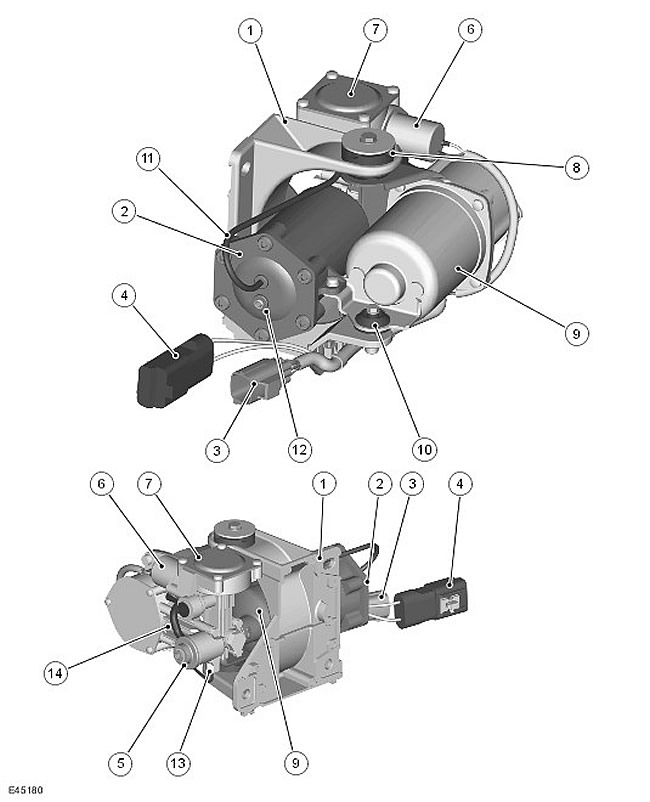
| Item name | Spare part catalog number | Description |
| 1 | - | Support bracket |
| 2 | - | Air dryer |
| 3 | - | Connector of the wiring harness of the control valve solenoid and temperature sensors. |
| 4 | - | Electric Motor Wiring Harness Connector |
| 5 | - | Intake port |
| 6 | - | Control outlet valve |
| 7 | - | Exhaust valve |
| 8 | - | Rubber vibration-isolating support (2 pcs.) |
| 9 | - | Electric motor |
| 10 | - | Rubber vibration-isolating support (1 pc.) |
| 11 | - | Control air tube |
| 12 | - | Supplying high pressure to the air suspension system |
| 13 | - | Compressor Cylinder Head Temperature Sensor |
| 14 | - | Compressor |
The compressor unit is mounted on the outside of the left chassis longitudinal beam, in front of the upper control lever. The unit is attached to the chassis longitudinal beam with three bolts and is covered with a noise-proof casing.
Soundproof casing
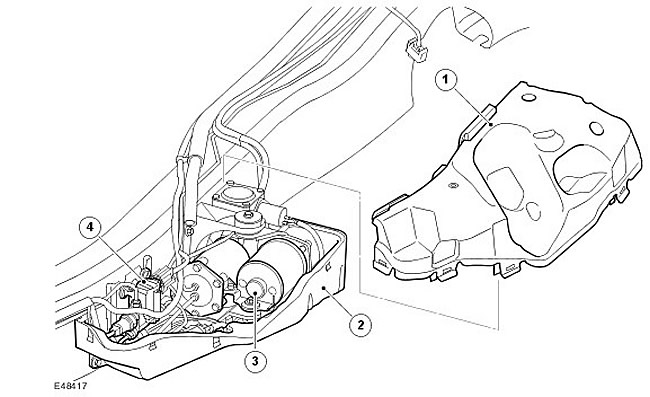
| Item name | Spare part catalog number | Description |
| 1 | - | Top cover |
| 2 | - | Bottom cover |
| 3 | - | Compressor unit |
| 4 | - | Receiver valve block |
The noise protection casing consists of two parts, upper and lower, inside which is the compressor unit. The noise protection casing is a plastic box with a coating of sound-insulating foam material to reduce the noise generated by the compressor unit. The receiver valve block is also located in the noise protection casing, in front of the compressor unit.
Main units and parts of the compressor block:
- Piston compressor
- 12V Electric Motor
- Control solenoid valve
- Exhaust valve
- Air dryer
In case of failure, the compressor unit is subject to repair, however, only the following components are repairable: air dryer, control outlet pipe and rubber supports.
The compressor unit is mounted on a bracket that is bolted to the chassis. The unit is attached to the bracket using flexible rubber vibration-insulating supports that prevent the transmission of noise to the chassis that occurs during the operation of the compressor unit.
To remove the compressor unit, there is no need to release pressure in the entire air suspension system. The front and rear valve blocks and the receiver valve block are in the normal position. (not under voltage) closed, which prevents pressure from escaping from the pneumatic elastic elements and receiver when the unit is disconnected.
There are conditions under which the compressor unit is prohibited from operating. It is important not to confuse these system prohibitions with malfunctions. A complete list of prohibitions for the compressor unit is provided in the "Air Suspension Control Unit" section of this chapter.
Compressor unit - sectional view
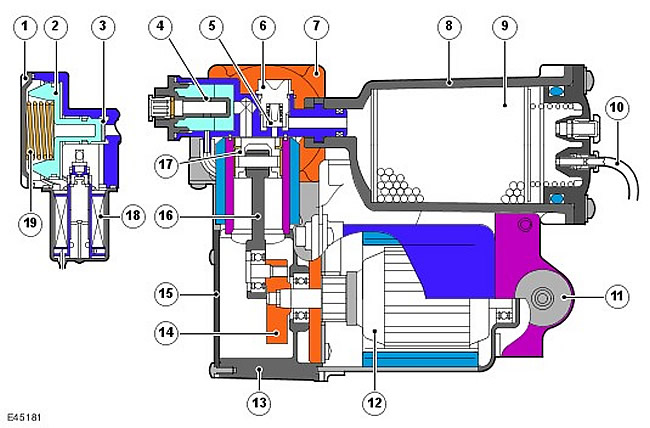
| Item name | Spare part catalog number | Description |
| 1 | - | Exhaust valve cover |
| 2 | - | Plunger |
| 3 | - | Valve seat |
| 4 | - | Muffler inlet |
| 5 | - | Discharge valve |
| 6 | - | Valve guide bushing |
| 7 | - | Cylinder head |
| 8 | - | Dehumidifier housing |
| 9 | - | Desiccant |
| 10 | - | Control outlet line |
| 11 | - | Rubber vibration isolator |
| 12 | - | Electric motor assembly |
| 13 | - | Carter |
| 14 | - | Crank |
| 15 | - | Crankcase cover |
| 16 | - | Connecting rod |
| 17 | - | Piston |
| 18 | - | Control outlet valve |
| 19 | - | Spring - safety valve |
Control outlet valve
The control electromagnetic release valve is connected to the pneumatic gallery after the air dryer. When the control valve is open, it controls the main release valve of the compressor. This allows air to be released from the elastic pneumatic elements when necessary.
When the electromagnet is energized, the air control charge moves the plunger of the release valve, allowing pressurized air to pass from the pneumatic elastic elements and/or the receiver through the receiver control valve into the compressor unit.
The electromagnet has a resistance of 4 ohms at 20°C (68°F).
Exhaust valve
The bleed valve has three functions. It works in conjunction with the control bleed valve to release air from the pneumatic springs and/or receiver as discussed above.
The valve also protects the system from excessive pressure. The valve is connected to the main pneumatic gallery, which is always under pressure from the pneumatic elastic elements or the receiver. The valve has a spring that limits the maximum working pressure at 370 lbf/in². (23.0-25.5 bar).
The minimum pressure in the system is also controlled by the release valve so that even when air is released, an excess pressure of 21 bar is maintained in the pneumatic elastic elements. This protects the pneumatic elastic element, ensuring its movement relative to the piston without deformation.
Electric motor
The 12V DC motor has a rated operating voltage of 13.5V. The motor drives a crank which has an eccentric pin to which the compressor connecting rod is attached.
The electric motor has a temperature sensor mounted on the printed circuit board of the brushes. The sensor is connected to the air suspension control unit, which monitors the temperature and can suspend the operation of the electric motor in case of overheating.
Compressor
The compressor contains a connecting rod with a piston driven by an electric motor, which moves in a cylinder with a cylinder head. The electric motor rotates the crank, which moves the piston up and down in the cylinder. When the piston moves up, the air in the cylinder is compressed and fed through the pressure valve and the dryer into the system.
Dehumidifier
The dryer is part of the compressor unit. The dryer contains a desiccant that controls air humidity. Before compressed air is supplied to the receiver and/or system, it passes through the dryer, which removes moisture from the air.
When air is released from the system, it also passes through the dehumidifier and, taking moisture from the desiccant, is released into the atmosphere.
The dehumidifier is an important component of the system, ensuring that the air in the system is dry. If there is moist air in the system, the moisture can freeze and cause the system to operate inefficiently or cause components and parts to fail.
Comments on this article