Contents: Calibration ⇩ Inputs and Inputs ⇩ Compressor unit relay ⇩ Systemic prohibitions ⇩ Compressor head temperature sensor ⇩ Compressor brush holder temperature…⇩
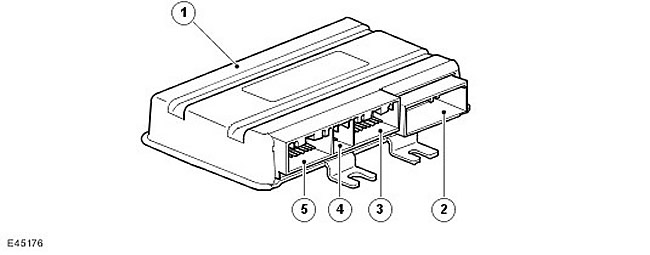
| Item name | Spare part catalog number | Description |
| 1 | - | Air suspension control unit |
| 2 | - | Connector C2321 |
| 3 | - | C2320 connector |
| 4 | - | Connector C2030 |
| 5 | - | Connector C0867 |
The air suspension control unit is located behind the instrument panel on the driver's side 'A' pillar. The control unit is secured to the 'A' pillar with one screw and two plastic clips.
Calibration
The calibration procedure is carried out using Land Rover approved diagnostic equipment which is used to read the position of each corner of the vehicle and write the parameters to the control module. Recalibration is only required if the air suspension control module is removed or replaced, the height sensor is removed or replaced, or the suspension arm to which the sensor is attached is removed or replaced. If a removed height sensor is refitted, a calibration must be performed to ensure system integrity.
If the compressor unit, receiver, valve block, shock absorber module or air line is removed or replaced, system calibration is not required.
Inputs and Inputs
The air suspension control unit has four connectors for input and output of signals.
The air suspension control unit receives signals from other vehicle systems via the CAN bus. The system uses data such as longitudinal acceleration, lateral acceleration, steering wheel angle and wheel speed to control the suspension in various driving conditions.
If one or more of these input signals are missing or fail, the system reacts differently: for example, if the signal from the steering wheel angle sensor is missing or fails, the air suspension control unit defaults the signal value to zero, which may lead to unnecessary body leveling operations.
Compressor unit relay
The compressor unit relay is located in the battery distribution block in the engine compartment. The relay is directly connected to the battery via a 10E (60A) fuse. The relay coil is connected to the air suspension control unit and is controlled by it. The air suspension control unit uses the relay to control the compressor.
When the compressor needs to be turned on, the air suspension control unit supplies voltage and ground to the relay coil, which closes the relay contacts. Due to this, the battery voltage is supplied to the compressor unit electric motor and the compressor via the fuse link and the relay.
In addition, battery voltage is supplied from the relay through a cable splice to the air suspension control unit and is used as a signal for the compressor unit to operate.
Systemic prohibitions
There are a number of conditions under which height changes are undesirable. To account for these conditions, certain system inhibitions are programmed into the air suspension control unit. If any of the following conditions are met, the air suspension control unit suspends height changes and corrections.
Compressor
The compressor is equipped with temperature sensors that protect it from overheating. If the compressor temperature exceeds the set values, the air suspension control unit prohibits the compressor from operating. These limit values are shown in the following table.
Compressor head temperature sensor
| Rise | Receiver | |
| Termination of work | 140°C (284°F) | 130°C (266°F) |
| Getting Started | 120°C (248°F) | 110°C (230°F) |
Compressor brush holder temperature sensor
| Rise | Receiver | |
| Termination of work | 140°C (284°F) | 130°C (266°F) |
| Getting Started | 120°C (248°F) | 110°C (230°F) |
Turn
When the air suspension control unit detects a centripetal acceleration of more than 0.2 d, it prohibits any height changes and adjustments. The prohibition remains until the centripetal acceleration falls below 0.15 d. The air suspension control unit receives centripetal acceleration data from the lateral acceleration sensor built into the ABS yaw rate sensor via the high-speed CAN bus.
Fast acceleration
When the air suspension control unit detects rapid acceleration (more than 0.2 d), it prohibits any changes and adjustments to the height. The prohibition remains until the acceleration falls below 0.15 d. The acceleration is calculated by the air suspension control unit based on the vehicle speed signal received via the high-speed CAN bus.
Fast slowdown
When the air suspension control unit detects rapid deceleration (less than -0.2 d), it prohibits any changes and adjustments to the height. The prohibition remains until the deceleration exceeds -0.15 d. The deceleration is calculated by the air suspension control unit based on the vehicle speed signal received via the high-speed CAN bus.
Jacking up a car
The air suspension control unit prohibits any height changes and adjustments if it registers one of the corners lowering too slowly for more than 1.2 seconds. A corner lowering too slowly is considered a sign that a jack is installed underneath it. In this case, the height of the corner does not change when air is released from the elastic pneumatic element, since the jack acts as a mechanical support. The prohibition remains as long as any of the following conditions are met:
- The air suspension switch is set to the up or down position.
- The vehicle speed exceeds 3 km/h for more than 45 s.
Opening the door
When any door is opened, the air suspension control unit stops any height changes. Body alignment continues even when the door is open by maintaining the body height in the event of a load change.
Comments on this article