Front height sensor
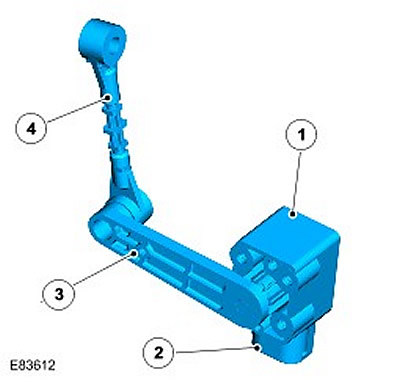
| Item name | Spare part catalog number | Description |
| 1 | - | Sensor housing |
| 2 | - | Electrical connector |
| 3 | - | Lever |
| 4 | - | Connecting rod |
Rear height sensor
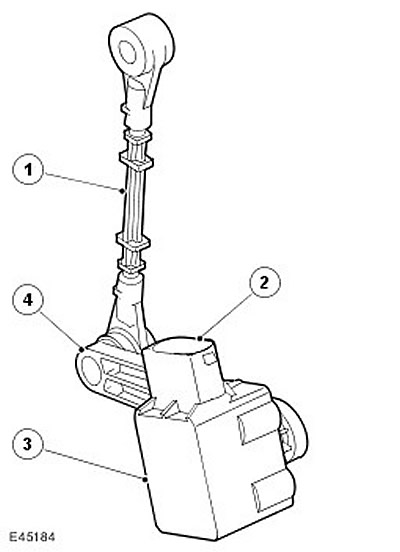
| Item name | Spare part catalog number | Description |
| 1 | - | Connecting rod |
| 2 | - | Electrical connector |
| 3 | - | Sensor housing |
| 4 | - | Lever |
Height sensors are mounted at each corner of the vehicle and provide suspension height monitoring. Each sensor housing is screwed to brackets on the chassis rails.
Each sensor has a housing containing a single-row rotary potentiometer, a lever and a connecting rod.
The sensor arm has a connecting rod that connects the sensor to the suspension control arm. The connecting rod is a repairable part and is tightly seated on the sensor arm and the suspension control arm.
The sensors are connected via electrical connectors to the air suspension control unit, which receives signals from all sensors and converts them into height values corresponding to the sensor positions.
The front and rear sensors are differentiated by the side of installation and are color coded for identification, which looks like this:
(The original article is located on: www.lrman.ru)
- Right front and rear - black lever
- Left front and rear - white lever
Calibration
The calibration procedure is carried out using Land Rover approved diagnostic equipment which is used to read the position of each corner of the vehicle and write the parameters to the control module. Recalibration is only required if the air suspension control module is removed or replaced, the height sensor is removed or replaced, or the suspension arm to which the sensor is attached is removed or replaced. If a removed height sensor is refitted, a calibration must be performed to ensure system integrity.
If the connecting rod is replaced, recalibration is not required, provided that the sensor housing has not been removed from the support bracket.
Comments on this article