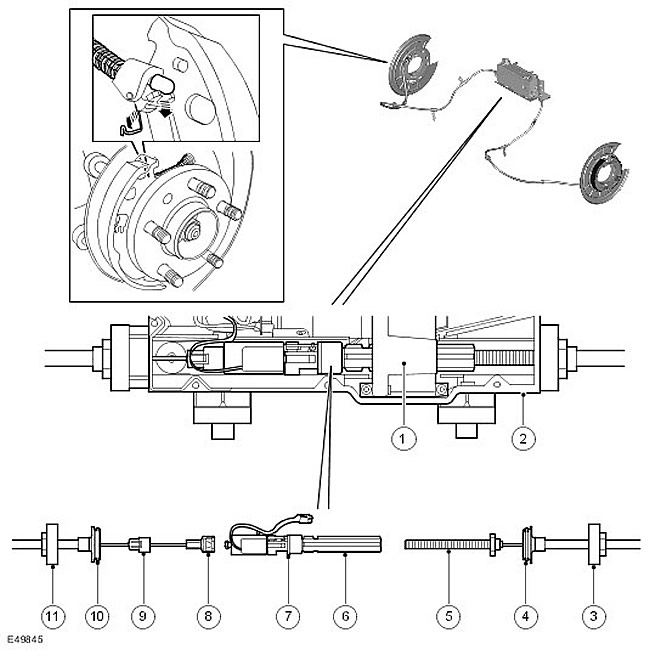
| Item name | Spare part catalog number | Description |
| 1 | Reducer | |
| 2 | Parking brake control unit housing | |
| 3 | Cable Nut | |
| 4 | Sealing cuff | |
| 5 | Threaded connector | |
| 6 | Splined shaft | |
| 7 | Force sensor | |
| 8 | Block | |
| 9 | Retainer cover | |
| 10 | Sealing cuff | |
| 11 | Cable Nut |
The brake cables are Bowden cables installed between the parking brake control unit and the drum brake mechanisms. Nuts on the ends of the outer cables secure the brake cables to the parking brake control unit and to the backing plate of the corresponding drum brake mechanism. In each drum brake mechanism, the inner cable passes through a guide spring and is attached to the brake shoe actuator lever by means of a nipple on the end of the cable. In the parking brake control unit, the two inner cables are connected together by means of a force sensor and a splined shaft.
The inner RH (right) brake cable is attached to the force sensor nipple by means of a "shoe" at the end of the cable.; the retainer cover holds the shoe in engagement with the fitting.
The inner LH (left) brake cable is attached to the splined shaft with a threaded connector (with LH (left) thread); the square flange at the end of the threaded connector is located in the housing of the parking brake control unit, which prevents the threaded connector from rotating with the splined shaft.
When the spline shaft rotates, the threaded coupling LH (left) of the brake cable is screwed into or out of the spline shaft, which changes the effective length of the inner cables and actuates the drum brake mechanisms. Since the spline shaft can move axially in the gearbox, the load on the inner cables of the two drum brake mechanisms is balanced.
Before disconnecting the drive cable, the power supply to the parking brake control unit must be switched off. Operating the parking brake switch with the brake cable disconnected may cause the actuator of the parking brake control unit to jam. In addition, the parking brake may not be released for 20 minutes after the ignition is turned off. Automatic re-engagement cannot be eliminated before this time has elapsed.
The original article can be found here: LRman.ru
Comments on this article