car logo Ford
car logo Volkswagen
car logo BMW
car logo Opel
car logo Audi
car logo Toyota
car logo Peugeot
English Русский
Български
Беларускі
Український
Српски
Hrvatski
Română
Polski
Slovenský
Magyar


Main
Freelander
Discovery
Range Rover
Defender
Contacts
Articles

Turn signal switch assembly (Discovery 3)

 
  • Main
  • Discovery
  • Discovery 3
  • Chassis
  • Steering column
  • Turn signal switch assembly
 
        0  
Contents: Direction indicators ⇩ Switching between low/high beam…⇩ Computer Functions Button (if…⇩
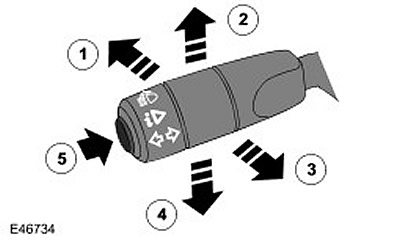
Turn signal switch assembly


Item nameSpare part catalog numberDescription
1-High beam
2-Right turn signal
3-High beam headlights alarm
4-Left turn signal
5-Computer Functions Button

The turn signal switch assembly is mounted on the left side of the housing and is secured to it with two screws. The switch is connected to the main wiring harness via a connector, which is located on the back of the switch. The switch controls the following functions:
  • Turning on the left/right turn signal
  • Switching between low and high beam headlights
  • High beam headlights alarm
  • Selecting computer functions (if available)

Direction indicators


The right-hand direction indicators are switched on by moving the lever up, and the left-hand direction indicators by moving the lever down. The switch locks the lever in the selected position until it is moved to the central position, in which the direction indicators are switched off. The switch has a "lane change" function, which allows the switch to be operated without locking, which is useful when changing lanes on the motorway and when overtaking. When the lever is released from the "lane change" position, the switch automatically returns to the central position. The left and right direction indicators are switched on by separate wires, which connect the switch to the Central Junction Box (CJB). When the switch is moved to a certain position, the corresponding circuit in the CJB is closed to earth via the switch. The CJB detects the closed circuit and switches on the relevant direction indicators until the switch is returned to the central position. The direction indicators are switched off either manually by the driver, or automatically when the steering wheel is returned to the central position.


Switching between low/high beam headlights and high beam signaling


To switch on the high beam headlamps, the switch is moved forward. The switch is latched in this position and the high beam headlamps remain on until the driver returns the lever to the rear. To switch on the high beam flasher, the switch is moved rearward. The switch contacts complete the circuit and the headlamps remain on as long as the lever is held in this position. In this position, the switch is not latched and the headlamps are switched off when the switch is released and returned to the off position. Separate wires are used for the high beam and high beam flasher positions, connected to the CJB and ground. When the switch is moved to a certain position, the switch contacts complete the circuit between the CJB and ground.

Computer Functions Button (if available)


This button is only available on vehicles with a high-level instrument cluster. The computer function button is located on the end of the selector lever. The button is a momentary switch that allows the driver to select information displayed on the instrument cluster message center display:
  • Travel distance
  • The distance a car can travel before the fuel remaining in the tank is completely used up.
  • Amount of fuel in the tank
  • Average fuel consumption
  • Fuel consumption for the entire period of vehicle operation
  • Average speed
  • Instantaneous fuel consumption

The button is connected to the instrument cluster and ground. When the button is pressed, the circuit is closed and the next trip computer reading is displayed on the instrument cluster. Repeated pressing of the button sequentially cycles the information displayed on the message center display. For more information, refer to the Information and Message Center (413-08 Information and Message Center).


This article is available at russian, bulgarian, belarusian, ukrainian, serbian, croatian, romanian, polish, slovak, hungarian
Article review: Saveliy Ushakov


Previous articles
Location of steering gear components and parts
Steering gear housing
Steering link end
Transverse steering rod
Steering column specification
Steering column element arrangement
Upper part of the steering column with mechanical adjustment unit
Upper part of the steering column with electric adjustment unit

Current article
Turn signal switch assembly

Next articles
Windscreen wiper control switch assembly
Ignition switch
Steering column lock and ignition switch housing
Left steering column multifunction switch
Ignition switch
Right steering column multifunction switch


Similar articles from Land Rover repair manuals:
• Side turn signal lamp Freelander 2 (2006-2014)
• Turn signal repeater lamp Freelander 1 (1997-2006)
• Combined turn signal/headlight switch Range Rover 3 (2001-2012)
• Side turn signal lamp Defender 2007+ (2007-2016)

Comments on this article


No comments yet


How much will 39 + 19 =


Discovery 3 
  • General information
  • Using the manual
  • Precautionary measures
  • Service Information
  • Technique
  • Health protection
  • Road test
  • Identification codes
  • Jacking and lifting
  • Maintenance - diesel
  • Maintenance - petrol
  • Chassis
  • Suspension
  • Front suspension
  • Rear suspension
  • Wheels and tires
  • Dynamic suspension
  • Cardan shaft
  • Rear drive axle
  • Front drive axle
  • Front axle axles
  • Rear axle axles
  • Brake system
  • Parking brake
  • Hydraulic brake
  • Vacuum brake booster
  • Anti-lock braking system
  • Steering
  • Steering column
  • Power unit
  • Petrol engine 4.0L
  • Petrol engine 4.4L
  • Diesel engine 2.7L
  • Engine cooling
  • Fuel supply
  • Drive units
  • Launch system
  • Ignition system
  • Emission reduction
  • Air filtration
  • Fuel vapor control
  • Electronic control part
  • Car gearbox
  • Clutch
  • All-wheel drive systems
  • Transfer case
  • Exhaust system
  • Fuel tank and lines
  • Acceleration control
  • Electrical equipment
  • Climate control
  • Instruments and control lamps
  • Battery and charging system
  • Information system
  • Lighting and headlights
  • Power distribution
  • Electronic Function Group
  • Body and coating
  • Body elements
  • Interior and body trim
  • Mirrors and glasses
  • Seats
  • Instrument panel and console
  • Handles and locks
  • Windshield wipers and washers
  • Sunroof and bumpers
  • Safety system
  • Body repairs
  • Repair of front end elements
  • Repair of back elements
  • Side panel repair
  • Frame and body mount

Discovery 1 
  • General information
  • Technical specifications
  • Introduction to manual
  • Troubleshooting
  • Power unit
  • Diesel engine Tdi
  • Petrol engine V8i (3.9 l)
  • Petrol engine V8i (4.0 l)
  • Petrol engine Mpi
  • Reducing harmful emissions
  • Fuel system Tdi
  • Fuel system MFi
  • Fuel system SFi
  • Fuel system MPi (MEMS)
  • Cruise control
  • Cooling system (Tdi)
  • Cooling system (V8i)
  • Cooling system (MPi)
  • Exhaust system
  • Transmission
  • Clutch
  • Manual gearbox R380
  • Manual gearbox LT 77
  • Transfer case LT230T
  • Automatic gearbox
  • Cardan shaft
  • Rear axle
  • Front axle
  • Chassis
  • Steering system
  • Front suspension
  • Rear suspension
  • Brake system
  • Wheels and tires
  • Body and interior
  • Passive safety
  • Doors, locks and windows
  • Exterior body parts
  • Interior trim details
  • Seats
  • Electrical equipment
  • Heating and ventilation
  • Air conditioning
  • Windscreen wipers
  • Starting and charging system
  • Equipment and devices
  • Lighting and headlights


LRman.ru © 2013-2026 | Mobile version | Free Lander | Discovery | Range Rover | Defender | Contacts | | Sitemap |
Car repair and service instructions Land Rover: Freelander, Discovery, Range Rover, Defender
We use cookies to make pages load faster and provide a more user-friendly experience 🍪