car logo Ford
car logo Volkswagen
car logo BMW
car logo Opel
car logo Audi
car logo Toyota
car logo Peugeot
English Русский
Български
Беларускі
Український
Српски
Hrvatski
Română
Polski
Slovenský
Magyar


Main
Freelander
Discovery
Range Rover
Defender
Contacts
Articles

Device and technical description 4.0L (Discovery 3)

 
  • Main
  • Discovery
  • Discovery 3
  • Power unit
  • Emission reduction
  • Device and technical description 4.0L
 
        0  
Contents: Location of EGR system components ⇩ EGR system ⇩ Engine crankcase ventilation system ⇩

Location of EGR system components
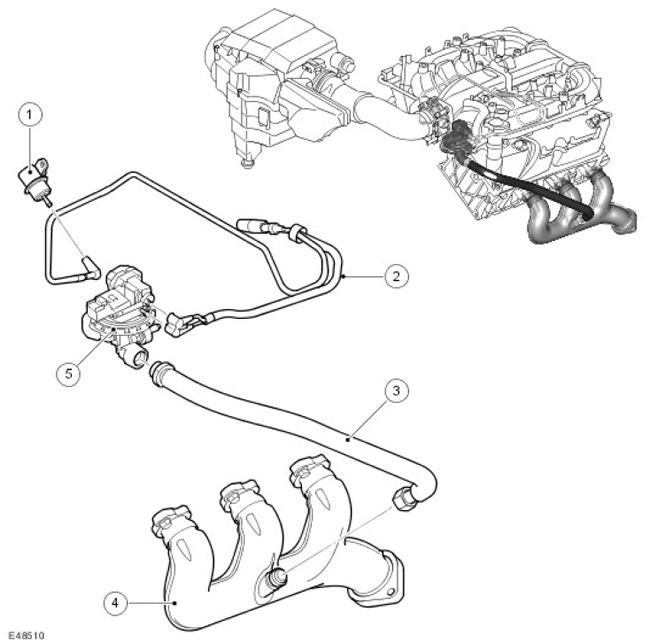

Location of EGR system components


Item nameSpare part catalog numberDescription
1-Fuel manifold damper
2-Vacuum control hoses
3-The pipe that connects the exhaust manifold to the exhaust gas recirculation (EGR) hose
4-Exhaust manifold
5-ESM valve

The exhaust emissions in the V6 gasoline engine are controlled by the engine control module (ECM). The exhaust emissions control system consists of:
  • EGR system
  • Crankcase Emission Reduction System

EGR system


ESM valve
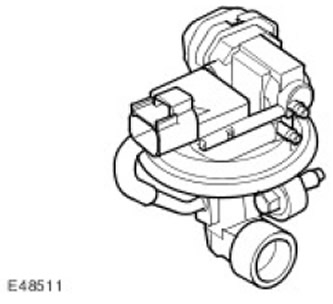

ESM valve


The EGR control unit (ESM) valve is located on the intake manifold and is connected to the exhaust manifold by a tube. The sensor is connected to the wiring harness via a 6-pin connector. The ESM valve is controlled by an electric actuator using pulse width modulation (PWM) signals. The ESM valve allows exhaust gases to recirculate and return to the engine. Since exhaust gases contain very little free oxygen, they are virtually inert. The exhaust gases replace air in the cylinder, which reduces the combustion temperature. A decrease in combustion temperature leads to a decrease in the formation of nitrogen oxides (NOx).


The ESM valve incorporates a differential pressure/manifold absolute pressure (DPFE/MAP) electronic feedback sensor. The pressure sensor monitors the pressure difference across the diaphragm in the ESM passage and transmits this data to the ECM. The pressure difference measured across the diaphragm is used to estimate the EGR flow rate. The electronic vacuum regulator (EVR) adjusts the vacuum signal to the ESM valve based on the electrical signal from the ECM. The ECM controls the ESM level using the feedback signal from the DPFE/MAP sensor. This creates a closed-loop control system.

Engine crankcase ventilation system


Location of components of the engine crankcase ventilation system
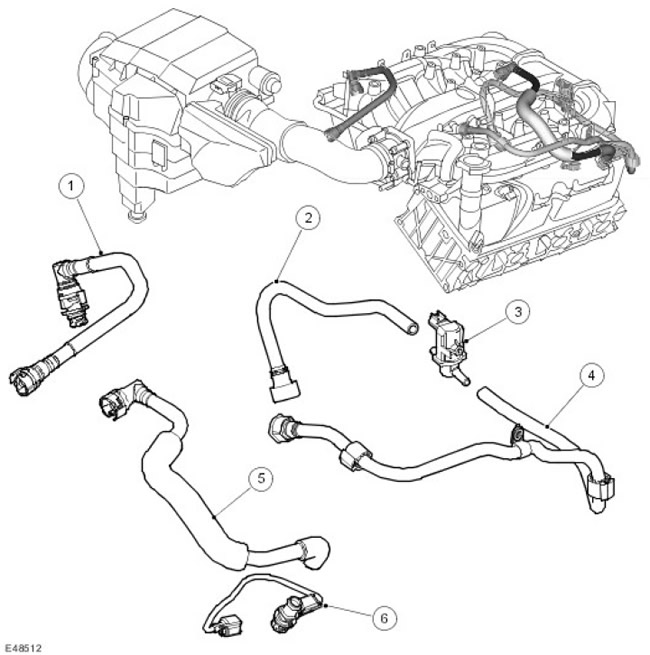

Location of components of the engine crankcase ventilation system


Item nameSpare part catalog numberDescription
1-Crankcase ventilation (CCV) hose and cam lock connector
2-The tube connecting the fuel vapor recovery system to the engine
3-Fuel Evaporative Emission System Valve
4-Crankcase ventilation (CCV) hose
5-Positive Crankcase Ventilation (PCV) Hose and PCV Valve
6-PCV Connecting Wire with Built-in Thermistor

Positive Crankcase Ventilation (PCV) Valve
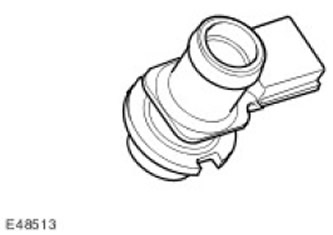

Positive Crankcase Ventilation (PCV) Valve


The forced crankcase ventilation system of the engine includes:


  • Positive Crankcase Ventilation (PCV) Valve
  • Positive Crankcase Ventilation (PCV) Hose
  • Crankcase ventilation (CCV) hose
The PCV valve is an electrically heated control valve that allows gas from the left cylinder head to flow into the air intake. Electrically heating the pCv valve allows it to remain operational in cold climates. Power for the PCV heater is supplied through the fuel pump relay. Therefore, the heater is always on while the engine is running. The current supplied is regulated inside the PCV.


This article is available at russian, bulgarian, belarusian, ukrainian, serbian, croatian, romanian, polish, slovak, hungarian
Article review: Saveliy Ushakov


Previous article
Specifications

Current article
Device and technical description 4.0L

Next articles
Device and technical description 4.4L
Device and technical description 2.7L
Diagnostics and testing 4.0L
Diagnostics and testing 4.4L
Diagnostics and testing 2.7L
Positive Crankcase Ventilation Valve 4.0L
Positive Crankcase Ventilation Valve 4.4L
Exhaust gas recirculation valve 4.0 L


Similar articles from Land Rover repair manuals:
• Technical rubbers Freelander 2 (2006-2014)
• Diagnostic device TESTBOOK Freelander 1 (1997-2006)
• Technical support Range Rover 3 (2001-2012)
• Description and technical data Defender 2007+ (2007-2016)

Comments on this article


No comments yet


How much will 11 + 24 =


Discovery 3 
  • General information
  • Using the manual
  • Precautionary measures
  • Service Information
  • Technique
  • Health protection
  • Road test
  • Identification codes
  • Jacking and lifting
  • Maintenance - diesel
  • Maintenance - petrol
  • Chassis
  • Suspension
  • Front suspension
  • Rear suspension
  • Wheels and tires
  • Dynamic suspension
  • Cardan shaft
  • Rear drive axle
  • Front drive axle
  • Front axle axles
  • Rear axle axles
  • Brake system
  • Parking brake
  • Hydraulic brake
  • Vacuum brake booster
  • Anti-lock braking system
  • Steering
  • Steering column
  • Power unit
  • Petrol engine 4.0L
  • Petrol engine 4.4L
  • Diesel engine 2.7L
  • Engine cooling
  • Fuel supply
  • Drive units
  • Launch system
  • Ignition system
  • Emission reduction
  • Air filtration
  • Fuel vapor control
  • Electronic control part
  • Car gearbox
  • Clutch
  • All-wheel drive systems
  • Transfer case
  • Exhaust system
  • Fuel tank and lines
  • Acceleration control
  • Electrical equipment
  • Climate control
  • Instruments and control lamps
  • Battery and charging system
  • Information system
  • Lighting and headlights
  • Power distribution
  • Electronic Function Group
  • Body and coating
  • Body elements
  • Interior and body trim
  • Mirrors and glasses
  • Seats
  • Instrument panel and console
  • Handles and locks
  • Windshield wipers and washers
  • Sunroof and bumpers
  • Safety system
  • Body repairs
  • Repair of front end elements
  • Repair of back elements
  • Side panel repair
  • Frame and body mount

Discovery 1 
  • General information
  • Technical specifications
  • Introduction to manual
  • Troubleshooting
  • Power unit
  • Diesel engine Tdi
  • Petrol engine V8i (3.9 l)
  • Petrol engine V8i (4.0 l)
  • Petrol engine Mpi
  • Reducing harmful emissions
  • Fuel system Tdi
  • Fuel system MFi
  • Fuel system SFi
  • Fuel system MPi (MEMS)
  • Cruise control
  • Cooling system (Tdi)
  • Cooling system (V8i)
  • Cooling system (MPi)
  • Exhaust system
  • Transmission
  • Clutch
  • Manual gearbox R380
  • Manual gearbox LT 77
  • Transfer case LT230T
  • Automatic gearbox
  • Cardan shaft
  • Rear axle
  • Front axle
  • Chassis
  • Steering system
  • Front suspension
  • Rear suspension
  • Brake system
  • Wheels and tires
  • Body and interior
  • Passive safety
  • Doors, locks and windows
  • Exterior body parts
  • Interior trim details
  • Seats
  • Electrical equipment
  • Heating and ventilation
  • Air conditioning
  • Windscreen wipers
  • Starting and charging system
  • Equipment and devices
  • Lighting and headlights


LRman.ru © 2013-2026 | Mobile version | Free Lander | Discovery | Range Rover | Defender | Contacts | | Sitemap |
Car repair and service instructions Land Rover: Freelander, Discovery, Range Rover, Defender
We use cookies to make pages load faster and provide a more user-friendly experience 🍪