car logo Ford
car logo Volkswagen
car logo BMW
car logo Opel
car logo Audi
car logo Toyota
car logo Peugeot
English Русский
Български
Беларускі
Український
Српски
Hrvatski
Română
Polski
Slovenský
Magyar


Main
Freelander
Discovery
Range Rover
Defender
Contacts
Articles

Description and operating principle of the generator (Freelander 2)

 
  • Main
  • Freelander
  • Freelander 2
  • Electrical equipment
  • Battery and alternator
  • Description and operating principle of the generator
 
        0  
Description and operating principle of the generator


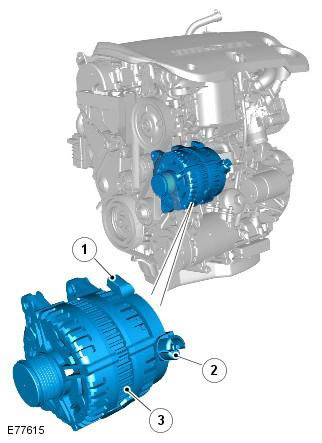
Pos.Spare part numberName
1-LIN bus (Local Interconnect Network)
2-Positive battery connection
3-Generator

A single self-exciting alternator is located in front of the engine, on the left side of the cylinder block. Two alternator options are available for the TD4 engines, depending on the vehicle equipment. One alternator is rated at 90/150 amps, the other at 115/180 amps. The higher rated alternator is used in cold climates, on vehicles equipped with a heated windshield and an electric auxiliary heater. For more information, refer to the chapter: Auxiliary Electric Heater (412-02 Additional Climate Control, Description and Function).

The alternator pulley is equipped with a freewheel clutch to improve NVH (noise, vibration and harshness) characteristics and extend the service life of the accessory drive belt. The freewheel clutch ensures that the belt passes over the pulley without slipping, and prevents the alternator from moving the belt when the crankshaft speed changes due to the high rotational inertia of the alternator internals.

The generator includes the following main elements:
  • Stator
  • Rotor
  • Rectifier
  • Voltage regulator

The stator consists of a flat core into which the stator wires are pressed.


The excitation winding is located on the generator rotor. The rotor is enclosed in a stator and mounted on bearings to ensure smooth running and support, taking into account the lateral loads that arise due to the tension of the drive belt.

The rectifier consists of 6 semiconductor diodes placed on a heat sink. The heat sink dissipates the resulting heat generated during electrical processes. The rectifier converts the alternating current generated in the stator coils into direct current, which is required in the vehicle's electrical system.

The regulator provides controlled AC voltage at the generator output. There are two electrical terminals on the generator outer casing. One terminal supplies rectified and regulated DC current from the generator via a large diameter cable to the positive terminal of the battery. The second terminal provides a LIN bus connection between the regulator and the ECM.

The regulator communicates via the LIN bus with the ECM, and the ECM also communicates via the high-speed CAN bus with the CJB (central junction box). The CJB contains software tables that form a mathematical model of the electrolyte temperature and constantly receives information from the ECM about the actual battery voltage. Based on the information received, the CJB transmits via the high-speed CAN bus to the PCM the predicted output voltage that is required from the regulator to effectively charge the battery. The ECM then transmits the appropriate message to the regulator via the LIN bus to achieve the output voltage that is determined in the CJB. This control cycle is repeated in a closed loop.


The LIN bus is also used to transmit mechanical fault and faulty wiring or connector information from the alternator to the ECM. A diagnostic trouble code is generated and stored in the ECM and, if necessary, the charging indicator lamp in the instrument cluster illuminates after a short delay.

During engine cranking, the charge indicator lamp on the instrument cluster comes on when the ignition is activated and goes out when the engine starts and the ECM detects the presence of generator output voltage.

Vehicles equipped with the Stop/Start system - starting from 2010 MY


(The text of the article was taken from the website: «www.LRman.ru»)
Due to the additional loads on vehicles with Stop/Start, a 180 A alternator is used. For more information, refer to the chapter: Starting System (303-06C Starting System - 2.2L Duratorq - Td4, Vehicles Built from 03/2009, Description and Function).


This article is available at russian, bulgarian, belarusian, ukrainian, serbian, croatian, romanian, polish, slovak, hungarian
Article review: Roman Mitrofanov


Previous articles
Starting a car using a donor car
Starting a car using a starting device
Inspection and testing of the charging system
Charging System DTC Indicator
Disconnecting and connecting the battery
Description and principle of operation
Power supply modes
Central electrical distribution box

Current article
Description and operating principle of the generator

Next articles
Generator control circuit
Removal and installation the generator


Similar articles from Land Rover repair manuals:
• Operating principle of differential Discovery 3 (2004-2009)
• Generator — removal and installation Discovery 1 (1989-1998)
• Operating fluids Range Rover 3 (2001-2012)
• Description and operating principle of the generator Defender 2007+ (2007-2016)

Comments on this article


No comments yet


How much will 36 + 42 =


Freelander 2 
  • General information
  • Using the manual
  • Repair technique
  • Precautionary measures
  • Road test
  • Fault codes
  • Identification codes
  • Jacking and lifting
  • Maintenance - Diesel
  • Maintenance - petrol
  • Chassis
  • Suspension
  • Front suspension
  • Rear suspension
  • Wheels and tires
  • Terrain response
  • Transmission system
  • Cardan shaft
  • Rear drive axle
  • Rear axle shafts
  • Front axle shafts
  • Brake system
  • Parking brake
  • Hydraulic brake
  • Brake booster
  • Anti-lock braking system
  • Exchange rate stability
  • Steering
  • Steering column
  • Power unit
  • Engine device
  • Engine repair
  • Description of the cooling system
  • Cooling system repair
  • Fuel supply
  • Drive units
  • Launch system
  • Ignition system
  • Exhaust toxicity
  • Air filtration
  • Fuel vapor control
  • Electronic control part
  • Automatic gearbox
  • Gearbox cooling
  • Automatic transmission controls
  • Mechanical transmission
  • Transfer case
  • Exhaust system
  • Fuel tank and lines
  • Speed control
  • Electrical equipment
  • Climate control system
  • Climate control
  • Additional climate control
  • Instrument panel
  • Sound signal
  • Information and messages
  • Assistance with parking
  • Battery and alternator
  • Information and entertainment
  • Outdoor Lighting
  • Interior lighting
  • Communication network
  • Wiring harnesses
  • Anti-theft system
  • Multifunctional modules
  • Body and coating
  • Body front panels
  • Lockable body parts
  • Interior trim
  • Rear view mirrors
  • Car seats
  • Glass, frames and mechanisms
  • Instrument panel and console
  • Handles, locks, latches
  • Windshield wipers and washers
  • Sunroof
  • Bumpers
  • Seat belt system
  • Restraint system
  • Body repairs
  • Front end repairs
  • Roof element repairs
  • Side panel repairs
  • Tailgate repairs
  • Subframe and mounts

Freelander 1 
  • General information
  • Using the manual
  • Precautionary measures
  • Technique
  • Specifications
  • Connection tightening torques
  • Maintenance
  • Power unit
  • Diesel engine Td4
  • Petrol engine K1.8
  • Piston group K1.8
  • KV6 petrol engine
  • Piston group KV6
  • Decreased toxicity
  • Motor control EDC
  • Engine management MEMS
  • Motor control Siemens
  • Fuel supply diesel Td4
  • Fuel supply for K1.8 engine
  • Fuel supply of KV6 engine
  • Cooling diesel Td4
  • Engine cooling K1.8
  • Engine cooling KV6
  • Exhaust system Td4
  • Exhaust system K1.8
  • Exhaust system KV6
  • Clutch
  • Mechanical transmission
  • Transfer case
  • Automatic gearbox
  • Chassis
  • Drive shafts
  • Rear axle and final drive
  • Steering
  • Front suspension
  • Rear suspension
  • Brake system
  • Body and coating
  • Passive safety
  • Doors, locks and glass
  • Exterior body parts
  • Interior trim details
  • Seats
  • Roof hatch
  • Roof
  • Body geometry
  • Body parts repair
  • Sealing and corrosion
  • Electrical equipment
  • Heating and ventilation
  • Air conditioning
  • Windshield wipers and washers
  • Starting engine and charging
  • Lighting and headlights
  • Control modules
  • Safety system
  • Window management
  • Entertainment systems
  • Wiring harnesses
  • Governing bodies
  • Devices


LRman.ru © 2013-2026 | Mobile version | Free Lander | Discovery | Range Rover | Defender | Contacts | | Sitemap |
Car repair and service instructions Land Rover: Freelander, Discovery, Range Rover, Defender
We use cookies to make pages load faster and provide a more user-friendly experience 🍪