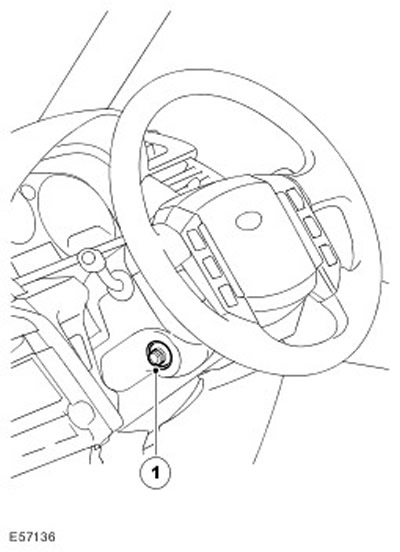
| Item name | Spare part catalog number | Description |
| 1 | Combination switch (rotary with joystick) |
To adjust the position of the column you need to:
- Turn the switch to the "Column" or "Auto" position
- To adjust the distance, slide the switch forward or backward.
- To adjust the tilt, slide the switch up or down.
Landing/exit mode
In Entry/Exit mode, the steering column and driver's seat automatically move to provide easy entry or exit.
To enable the entry/exit mode, set the column position adjustment switch to the "AUTO" position.
NOTE: If the switch is removed from the "AUTO" position when the column is in the up position, the column will return to the learned position when the ignition key is inserted into the lock. The entry/exit mode will be cancelled.
NOTE: If the switch is moved while the entry/exit function is in operation, the steering column movement will stop.
Exit
When the ignition key is removed from the lock, the steering column is moved to its highest and furthest position and the driver's seat is moved back slightly.
Landing
When the ignition key is inserted into the lock, the steering column and seat return to their original positions. If the previously stored driver settings have been changed (using the switches on the seat or the remote control of another key), then the steering column and seat will take a new position.
Steering column control
The steering column position is adjusted by a single DC motor. Each adjustment movement is transmitted via an electromagnetic clutch. There is a separate clutch for tilt movement and a separate clutch for distance movement.
The clutch can only be disengaged when it is not under load. Since both clutches are on the same drive motor shaft, the adjustment sequence should be as follows:
- Turn on the desired clutch
- After approximately 0.1 seconds, the motor starts rotating in the desired direction
- When the engine reaches the stop position, the power to the clutch solenoid and the engine is switched off. Under load, the clutch remains engaged.
- After approximately 0.1 seconds, the engine reverses to relieve the load on the clutch.
| Direction of rotation of the electric motor | Clockwise | Counterclockwise |
| Moving by distance | Retraction | Advancement |
| Moving on a slope | Up | Down |
Simultaneous distance and tilt movement is not possible because the motor must reverse its direction of rotation once the first set position is reached.
To provide feedback, the steering column movement is monitored by a potentiometer.
Comments on this article