Contents: Recalling adjustments from memory ⇩ Function "Lazy Entry" (comfortable…⇩ Immediate adjustment ⇩ Sound and visual confirmation of the…⇩ Diagnostic mode ⇩
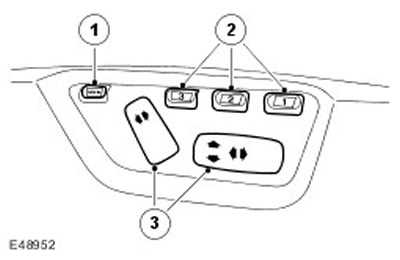
| Item name | Spare part catalog number | Description |
| 1 | - | Seat position memory button |
| 2 | - | Preset adjustment buttons |
| 3 | - | Seat position adjustment buttons |
The memory control unit can store up to three sets of positions for the driver's seat, mirror and electrically adjustable steering column. (if available) for one ignition key (no more than three keys in total). Saving and recalling adjustments from memory is done by three numbered buttons and one separate button. The buttons are activated by briefly pressing them.
The seats can be adjusted when the ignition key is in position I or II, as well as for some time after changing the state of the driver's door or after turning the ignition switch from position I to position 0. (the key remains in the lock).
NOTE: These positions do not include the easy entry mode, when the door does not need to be opened, or when the ignition is on (I or II).
Adjusting the position of the rear-view mirror is only possible when the ignition switch is in position I or II.
Recalling adjustments from memory
The recall function has three memory locations for storing adjustments for the seats, outside mirrors and electric steering column (if available). The control buttons for this function are located on the outer trim panel of the driver's seat. Pressing the button with the desired memory address number causes the seat to move to the position corresponding to this address.
To limit the power consumption when calling up adjustments, the seat is moved in only two directions at a time. To limit the starting current of the electric motors for movement along each axis, a delay of 100 ms is provided between their activation.
First, the longitudinal displacement of the seat and the change in the angle of the backrest occur, and then the seat height and the angle of the seat cushion are adjusted. If the car is stationary, a short press on the button is enough to continue adjusting the seat position until it moves to the called position. If you release the pressed button while the car is moving, the system switches to manual adjustment mode. This means that after releasing the button, the seat movement stops. Therefore, in order to move the seat to the desired position, the button should not be released until all coordinates have completely stopped moving. Successful completion of the operation is confirmed by a double gong signal on the instrument panel.
To remember your settings, do the following:
- Make sure the ignition key is in position I or II.
- Make sure that the reverse gear is not engaged.
- Use the switches on the remote control to manually adjust the seat position.
- Press and release the 'memory store' key (preservation)
- Within 5 seconds, press the desired address memory key.
If after calling the position, you briefly press any position adjustment switch or another call button (another address), then the first call will be cancelled and the seat will move according to the new command.
Both rear-view mirrors first rotate simultaneously around the vertical axis (left/right), and after completing this movement, the mirrors rotate around the horizontal axis (up/down). To reduce the number of electric motors for adjusting the mirrors, their rotation around two axes is performed sequentially rather than simultaneously.
The mirrors are moved in accordance with the following table.
| Actions | Contact 14 of the control module | Contact 7 of the control module | Contact 13 of the control module | Contact 8 of the control module |
| Driver's mirror - up | Battery | - | - | - |
| Driver's mirror - down | "Weight" | - | - | - |
| Driver's mirror - left | - | "Weight" | - | - |
| Driver's mirror - right | - | Battery | - | - |
| Passenger mirror - up | - | - | Battery | - |
| Passenger mirror - down | - | - | "Weight" | - |
| Passenger mirror - left | - | - | - | "Weight" |
| Passenger mirror - right | - | - | - | Battery |
Function "Lazy Entry" (comfortable fit)
Pressing the door unlock button on the remote control activates recall of the stored positions. This function is called 'lazy entry' or 'lazy entry' (literally) or, simply, 'easy entry'. Pressing the seat adjustment switch, any memory button or the door lock button on the remote control immediately cancels the easy entry function.
The current seat and mirror settings are written to the EEPROM of the memory controller each time the ignition switch is turned from position II to position I. These settings are restored the next time the easy entry function is activated by pressing the unlock button on the remote control.
The easy entry function can be switched on or off via the user settings menu in the instrument cluster. The driver can therefore decide whether to use the function or not. For more information, please refer to the Information and Message Center (413-08 Information and Message Center)
Immediate adjustment
When any of the manual seat adjustment switches is pressed, the motor will adjust in the corresponding direction until the switch is released.
Only two seat adjustment motors can operate at a time. However, the motor-relay wiring diagram does not allow certain combinations of motors to operate simultaneously. The table shows which motors can be switched on simultaneously and which cannot.
| Backrest tilt up | Backrest tilt down | Tilt the pillow upwards | Tilt the pillow down | Seat lift | Lowering the seat | Forward shift | Backward shift | |
| Backrest tilt up | - | No | Да | Да | Да | Да | Да | Да |
| Backrest tilt down | No | - | Да | Да | Да | Да | Да | Да |
| Tilt the pillow upwards | Да | Да | - | No | Да | Да | No* | No* |
| Tilt the pillow down | Да | Да | No | - | Да | Да | No* | No* |
| Seat lift | Да | Да | Да | Да | - | No | No* | No* |
| Lowering the seat | Да | Да | Да | Да | No | - | No* | No* |
| Forward shift | Да | Да | No* | No* | No* | No* | - | No |
| Backward shift | Да | Да | No* | No* | No* | No* | No | - |
Button
- - = impossible combination
- Yes - movements can be performed simultaneously
- No = movements cannot be performed simultaneously (physically impossible)
- No* = cannot be enabled at the same time (relay sharing restriction)
The seat adjustment can be activated simultaneously with the adjustment of the rear view mirrors.
Sound and visual confirmation of the end of the operation
An audible signal from the instrument panel notifies the driver of the successful completion of the required operation. The following operations are accompanied by an audible confirmation:
| Operation | Sound confirmation | Name |
| Recording to memory | One gong signal | Successfully saving settings to memory |
| Recalling adjustments from memory | Double gong signal | The signal is given only upon successful movement to the called position. |
| Saving mirror positions to memory when reversing | One gong signal | Position recording completed successfully |
In addition to the audible signal, a confirmation message is displayed on the instrument cluster information center display. For more information, refer to the Information and Message Center (413-08 Information and Message Center)
Diagnostic mode
The diagnostic unit communicates with the memory controller via the CJB via the high-speed CAN bus and the LIN bus. Detected errors are stored in non-volatile EEPROM memory. The memory contents are not lost when the power is disconnected. Only a Land Rover-approved diagnostic system can erase the memory contents.
Comments on this article