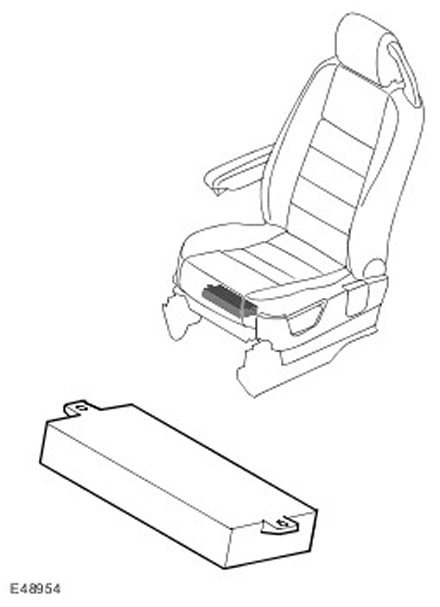
| Item name | Spare part catalog number | Description |
| 1 | - | Memory controller |
The memory controller, located under the driver's seat, receives a number of input signals and generates a number of output signals. Like any other electronic control module, the memory controller must receive information about the current state of the engine and related systems. Based on the data received, the controller makes calculations that determine the nature of the output signals. (managers) signals.
All parameters are stored in non-volatile memory, EEPROM. Current motor positions are continuously monitored by the controllers using built-in Hall sensors and written to the EEPROM memory. If there is a power failure, the stored motor positions are accepted as current positions after its restoration. This allows the relative positions stored in memory to be restored without recalibration. The memory controller checks the integrity of the data in the EEPROM memory each time the controller exits the standby mode. If the data is damaged, the memory controller sets the factory settings for all programmable parameters. All stored adjustments are invalidated, and the programs operate as if no settings had been written to the memory. Functions based on data stored in the memory will reload the corresponding memory cell and remain fully functional.
Determination of jamming of mechanisms
The system considers that the electric motor for moving the seat, steering column (if available) or rear view mirrors are stuck if, with the electric motor running, there is no change in the input signal coming via the feedback line from the corresponding sensor for a certain period of time (within 200 milliseconds for the seat and within 1000 ms for the mirrors and steering column).
If a jam is detected, the movement along the corresponding axis is cancelled, both for the case of recalling the position from memory and when pressing the switch (manual adjustment).
If the electric motor stops due to a break in communication with the sensor, due to jamming of the mechanism or a sensor malfunction, the movement along this axis can be restarted to pass the "jam point". To do this, press the corresponding switch. In this way, it is possible to maintain control of the electric motor when the feedback signal from the sensor is broken.
If a pulse signal is received after the sensor movement has resumed, the movement will continue until the switch is released or until the mechanism stops again due to jamming. If feedback is not resumed, the motor will only run for 0.5 seconds and then stop until the switch is released and pressed again.
During any movement in manual control mode, the memory control unit remembers the point at which the jam occurs. If the movement continues beyond the jam point, the remembered position is deleted from the memory. This happens in all cases when the mechanism moves beyond the remembered jam point. This is true for both manual adjustment and recalling the position from memory.
Initialization
When replacing the memory control unit installed under the seat, it must be initialized, i.e. it must be "taught" the extreme positions of the seats and steering column. This is done as follows:
- performing all possible adjustment movements of the seat from one extreme position to another (longitudinal direction, backrest tilt, height and position of the pillow)
- performing all possible adjustment movements of the steering column from one extreme position to the other (slope and distance).
Battery Monitoring
When the battery voltage drops below 10.5 V, the memory control unit ignores all requests to restore the mirror and seat settings, including the function "Lazy Entry", until the voltage rises to 11.5 V. This is necessary to save battery charge in order to maintain the ability to start the engine.
Standby mode
The controller supports standby mode to minimize power consumption.
The memory control unit enters the sleep mode after receiving a SLEEP signal from the central junction box (CJB) via the LIN bus. In addition, the sleep mode is entered after three seconds have passed since the LIN bus signals have stopped, provided that no motor movements occur during this time and there is no request for adjustment.
If a LIN bus fault occurs, the seats will only operate in 'inch mode'.
If the memory controller cannot enter the standby mode due to motor operation, a request to restore settings, or a switch being pressed, it will enter this mode immediately after the operation being performed is completed.
NOTE: When recalling adjustments from memory, before the system is put into standby mode, adjustments will be completed for all coordinates, not just the one being performed by the currently running electric motor.
The memory controller exits standby mode when the LIN bus resumes transmitting signals. When the memory controller enters standby mode, it must check the system resume conditions. (System Enable Status), to know when to respond to the switch request.
Comments on this article