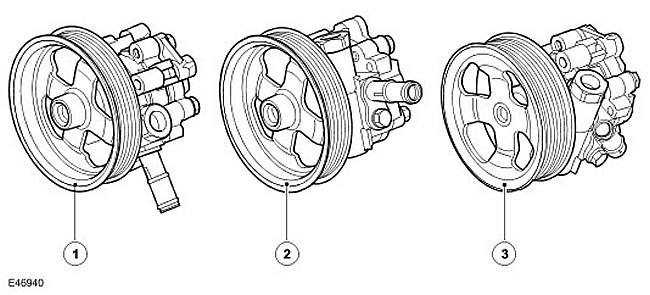
| Item name | Spare part catalog number | Description |
| 1 | - | 4.0L V6 |
| 2 | - | 4.4L V8 |
| 3 | - | TdV6 |
The same power steering pumps are used on models with different engines, but they have different connections and are therefore not interchangeable. A vane pump of the injection type creates hydraulic pressure in the hydraulic distributor of the steering gear. The power steering pump is driven by a poly V-belt from the crankshaft pulley. The pump speed increases proportionally to the engine crankshaft speed. A self-adjusting tensioner is used to maintain the required belt tension.
The pump has a built-in safety valve with a working fluid flow regulator.
The safety valve limits the maximum pressure in the steering gear to 114 bar. (1653 lbf in²)±4 bar (58 lbf in²). The flow regulator limits the supply of working fluid to 8.8±0.5 l/min, regardless of the engine crankshaft speed. The working volume of the pump is 9.6 cc/rev.³.
The pump shaft is located longitudinally in the housing. A drive pulley is pressed onto one end of the shaft, and the opposite end of the shaft is closed with a cover. The shaft rotates in bearings installed in the housing. Seals at both ends of the shaft prevent leakage of the working fluid.
The article is based on information from the website [LRman.ru]
The pump has an oval shaped opening in which ten blades rotate. The pump is driven by a shaft. Due to the shaped opening, the space between the blades increases as they rotate. This causes a vacuum between the blades, which draws liquid from the tank into this space through the suction hose.
As the shaft rotates, the inlet of the blades, between which the liquid is already located, closes, thus "locking" the liquid between the blades. Due to the shaped opening, the space between the blades decreases, which leads to compression of the liquid located between them.
As the shaft continues to rotate, the blades turn toward the outlet. As the blades pass the outlet, fluid flows under pressure from the pump outlet into the steering gear through the high-pressure hose.
The supply of pressurized fluid is regulated by a relief valve with a flow regulator. The flow regulator ensures a constant supply of working fluid to the steering gear, regardless of the engine crankshaft speed. The relief valve regulates the pressure at the pump outlet. The pump outlet has a calibrated hole. If the pressure in the calibrated hole reaches a specified level, the spring-loaded ball in the center of the working fluid flow regulator rises above its seat and allows the fluid to recirculate in the pump.
The safety valve is activated if the flow rate at the pump outlet is restricted, for example when the steering wheel is turned to the stop. If the flow rate at the pump outlet is completely blocked, the fluid recirculates through the pump. Since fresh fluid from the reservoir does not flow in this case, the temperature of the fluid in the pump quickly increases. Therefore, the duration of operation of the steering gear in extreme positions should be minimized to avoid overheating of the pump and the fluid in it.
Comments on this article