Tank
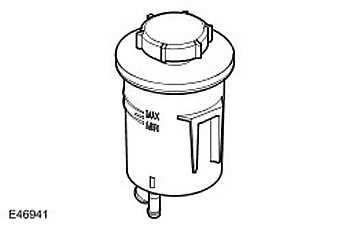
The working fluid reservoir is mounted on a bracket on the left side of the engine compartment, behind the radiator. The tank consists of a body, a lid and a filter. The tank provides the supply of additional working fluid to the system in case of its thermal expansion or contraction. Maintaining the fluid in the tank at the required level allows you to ensure that the supply hose at the bottom of the tank is filled with liquid in any position of the car. If air is present in the system, it exits it into the tank.
The housing is molded from plastic and has two branch pipes at the bottom for fastening the supply and return hoses. Marking on the wall serves to indicate the maximum and minimum levels. A non-replaceable nylon mesh filter with a mesh size of 100 microns is installed in the tank body. The filter prevents solids from the reservoir from entering the pump.
To remove the cover from the housing, it must be turned counterclockwise a quarter of a turn. To prevent fluid leaks, the reservoir cap has an O-ring. The tank lid has a breather that allows the fluid in the tank to change level during movement, without creating excess pressure or vacuum.
High pressure hose
The high pressure hose connects the pump to the steering hydraulic valve and contains two attenuators. Each attenuator is a bullet-shaped restrictor fixed inside the hose. Restrictors dampen fluctuations in fluid pressure from the pump, thereby reducing noise and stress on downstream parts. The attenuators are built into the hose and cannot be replaced separately.
Fluid cooler
The fluid cooler is located in the return line between the steering mechanism and the reservoir. The cooler consists of a flexible hose and a solid tube that are installed between the reservoir and the steering gear return tube. The working fluid cooler is built into the tube and cannot be replaced separately from it.
The cooler is an aluminum tube through which the power steering fluid flows. On the outer circumference of the cooler tube has cells that dissipate heat. Cold air from the front of the car passes over the cooler, entering the cells. The cells act as heat exchangers, removing heat from the fluid flowing through the tube.
Comments on this article