


NOTE: Right hand drive vehicle shown with 4.0L V6 engine.
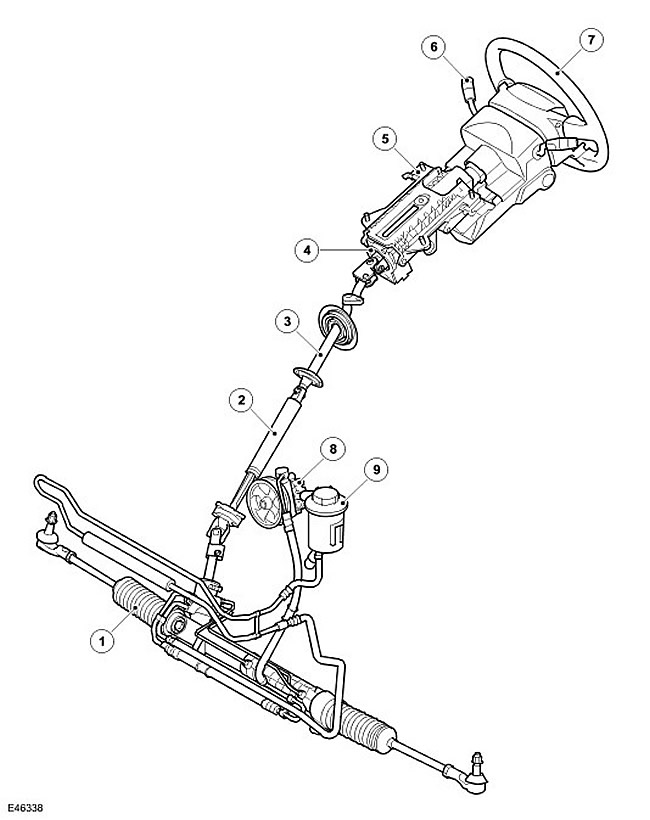
| Item name | Spare part catalog number | Description |
| 1 | - | Steering gear |
| 2 | - | Lower telescopic shaft |
| 3 | - | Intermediate shaft |
| 4 | - | Steering wheel angle sensor |
| 5 | - | Upper Steering Column Assembly |
| 6 | - | Multi-function steering column switches |
| 7 | - | Steering wheel |
| 8 | - | Power steering pump |
| 9 | - | Power steering fluid reservoir |
General information
The steering system of all models includes the following components:
- steering gear
- power steering pump
- tank
- lower telescopic shaft
- intermediate shaft
- upper part of the column assembled
- multi-function steering column switches
- steering wheel
The steering system uses a rack and pinion steering mechanism with a conventional tie rod end mount and a gear-type booster. The rack type varies depending on the steering position, but all three engine options have the same rack.
Each steering system uses a power steering pump driven by the accessory drive belt. The location and mounting of the pump varies with engine type. The power steering reservoir is mounted next to the pump and supplies fluid to the pump via a suction hose.
Each power steering system has a power steering fluid cooler installed in the hydraulic piping system. The cooler is located at the front of the vehicle, allowing it to take advantage of the oncoming air flow while driving. The power steering fluid is cooled by the air flow through the cooler as it returns from the system to the reservoir.
The upper part of the steering column has the same design on all models with any steering arrangement. The lower telescopic shaft is attached to the pinion shaft by two machined surfaces. The intermediate shaft is located between the lower telescopic shaft and the upper part of the steering column assembly.
The steering column, mounted on the vehicle's inner crossmember, provides mounting for the tilt and rake adjustment lever, the steering column multifunction switches, the steering wheel, the steering column lock, and the ignition switch. The steering column design includes a number of components that ensure controlled column collapse during a frontal impact. (to reduce the impact energy transmitted to the driver). The lower telescopic shaft folds and the intermediate shaft is decoupled, which prevents excessive frontal impact load and steering column displacement.
Comments on this article