Contents: Location of cruise control system…⇩ Cruise control system block diagram ⇩ Control switches ⇩
Location of cruise control system components
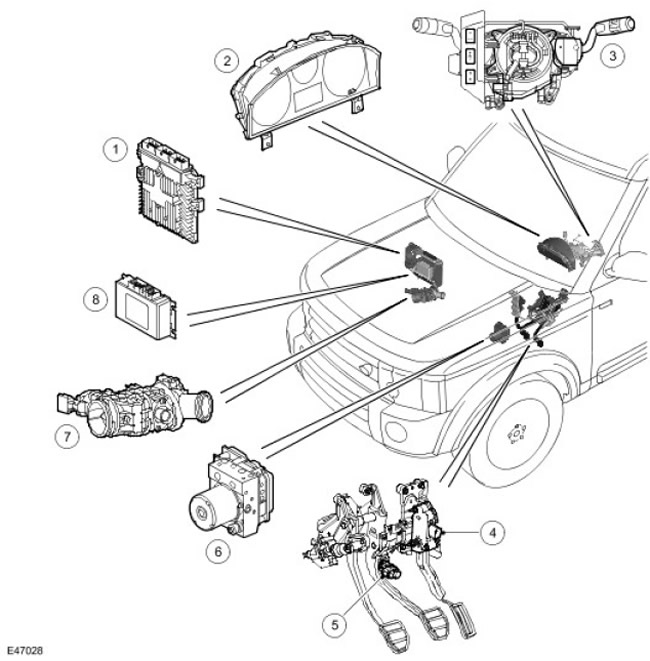
| Item name | Spare part catalog number | Description |
| 1 | ECM (engine control module) | |
| 2 | Instrument panel | |
| 3 | Cruise control system switches | |
| 4 | APP sensor (accelerator pedal position) | |
| 5 | Brake light switch | |
| 6 | ABS control module (anti-lock braking system) | |
| 7 | - | Electronic throttle |
| 8 | - | Transfer Case Control Module |
Cruise control system block diagram
NOTE: A = Wired, D = CAN Bus (local area network of controllers)
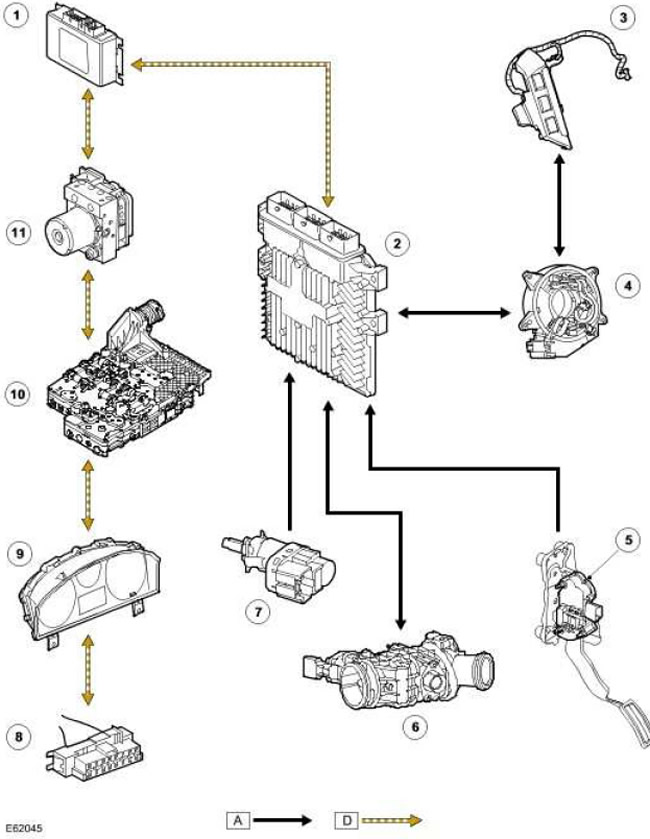
| Item name | Spare part catalog number | Description |
| 1 | Transfer Case Control Module | |
| 2 | ECM (engine control module) | |
| 3 | Cruise control system switches | |
| 4 | Movable contact group | |
| 5 | APP (accelerator pedal position) | |
| 6 | Electronic throttle | |
| 7 | - | Brake light switch |
| 8 | - | Diagnostic connector |
| 9 | - | Instrument panel |
| 10 | - | TCM (transmission control module) |
| 11 | - | ABS control module (anti-lock braking system) |
The cruise control system is integrated with the engine management system and uses priority fuel delivery to automatically maintain a set vehicle speed. Once activated, the cruise control system can increase vehicle speed without using the accelerator pedal. The cruise control system includes the following components:
- Pause/Resume Switch
- Switch "+" ("set/acceleration") and "-" ("deceleration")
- Movable contact group
- Cruise control system indicator light (on the instrument panel)
The driver controls the cruise control system using the steering wheel switches only. When the cruise control system is on, the ECM (engine control module) regulates PWM signals (pulse width modulation), transmitted to the fuel injectors to regulate the fuel supply as required to maintain a given speed.
Control switches
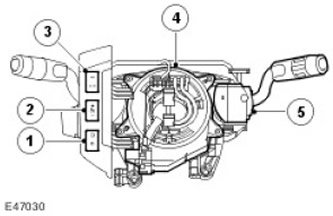
| Item name | Spare part catalog number | Description |
| 1 | - | Pause/Resume Switch |
| 2 | - | Acceleration/Deceleration Switches (+/-) |
| 3 | - | Adaptive Cruise Control Time Break Switches (if any) |
| 4 | - | Movable contact group |
| 5 | - | Steering column wiper control switch |
The cruise control switches are located on the LH (left) side of the steering wheel. The switches are connected via wires directly to the movable contact group. All cruise control switches are push-button rocker switches. The minimum set speed is 30 km/h. Cruise control is automatically suspended if the vehicle speed drops below 24 km/h.
The cruise control switches are resistive multi-link type switches. The cruise control system includes three switches, two of which are related to adaptive cruise control (if any). The switches change the resistance of the voltage signal sent to the ECM. (engine control module). A reference voltage of 5 V is supplied to the switches, which changes depending on the pressing of the switches.
Pause/Resume Switch
The Suspend/Resume switch controls the cruise control mode selection. When the ignition key is in position II, pressing the Suspend switch engages the Suspend mode, which temporarily disengages the cruise control system but retains the previously set speed in the ECM memory.
Resume switch
If the cruise control system has been suspended by pressing the suspend switch or pressing the brake pedal, pressing the resume switch restores the previously set speed.
Acceleration/Deceleration Switches (+/-)
If the cruise control system is enabled, pressing the " + " switch sets the current vehicle speed as the speed supported by the cruise control system. Each time the switch is pressed briefly, the set speed increases by 1 km/h. If the switch is held down, the driving speed increases continuously until the switch is released. Each time the "-" switch is briefly pressed, the set speed decreases by 1 km/h. If the switch is held down, the driving speed continuously decreases until the switch is released.
Comments on this article