The main difference between partial replacement of elements and complete replacement is the preparation of butt and overlap seams.
- When cutting body parts, care should be taken to properly remove paint and zinc coating on internal areas. This applies primarily to hard-to-reach internal areas.
- To ensure the quality of the weld, it is important that the inner surface is cleaned down to the metal. Zinc and paint residues in the weld area burn off and cause porosity during welding.
- If the zinc layer and paint coating are not removed, the zinc and paint will burn during the welding process. The resulting soot prevents proper protection of the cavity.
Procedure
Within 30 mm of the weld, the paint must be removed using a rotating wire brush. This operation should be performed on both new and old body parts. Depending on the body element, the zinc coating layer must be removed within 10 mm of the weld.
NOTE: If space is limited, a flat scraper or wire brush may be used instead of a rotary brush. Do not use an angle grinder, which will weaken the structure.
Applying a wax coating to protect the cavities on the door threshold after partial repair:
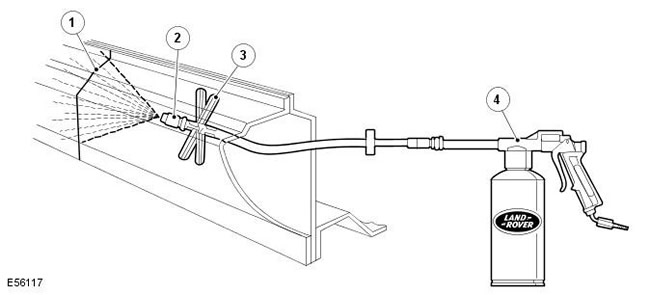
| Pos. | Spare part number | Name |
| 1 | - | Welding bead |
| 2 | - | Spray head |
| 3 | - | Remote element |
| 4 | - | Spray |
Classification of various corrosion protection measures for dent removal
| Corrosion protection method | External surfaces | Accessible internal surfaces | Inaccessible internal surfaces |
| Coloring | X | X | |
| Cavity Protector | X |
Classification of various methods of corrosion protection when installing new elements
| Corrosion protection method | Welded flanges before welding in place (contact surfaces) | All surfaces cleaned by grinding | Welding flange available | Inaccessible weld flange |
| Welding primer | X | |||
| Coloring | X | X | ||
| Flange Sealant | X | |||
| Cavity Protector | X |
Comments on this article