Contents: Hybrid Filling Block Technology ⇩ Two-stage filling units ⇩ Driver's airbag ⇩ Passenger airbag ⇩ Passenger airbag switch ⇩ Passenger airbag deactivation…⇩ Side airbags ⇩ Upper side airbags ⇩ Airbag warning light ⇩
Hybrid Filling Block Technology
All airbags are equipped with hybrid filling units instead of outdated pyrotechnic gas generators, in which the filling of the airbags was carried out by detonating a pyrotechnic charge. In hybrid filling units, an autonomous pyrotechnic device is used to heat a cylinder with compressed inert gas located inside the unit. When the pressure exceeds the set value, the cylinder explodes, and the gas enters the fabric cushion.
The advantage of the hybrid filling unit is the use of cooler gas, resulting in a lower cushion temperature and no gas release after deployment, typical of solid pyrotechnic gas generators.
Two-stage filling units
The driver and passenger airbags are equipped with two-stage inflation units. Each airbag uses two separate inflation units with independent pyropatrons that are connected to the airbag. This design allows the airbag size, pressure and rate of pressure increase to be optimized to match the design features of the vehicle and the force of the impact during a collision.
The RCM evaluates the severity of the crash, the tension of the seat belt and the proximity of the driver's seat to the steering wheel, and uses this information to determine the airbag deployment pattern:
- At relatively low speeds, or if there is a small passenger near the steering wheel, only the 'stage 1' inflator deploys, filling the airbag to approximately 70% of its capacity.
- In the event of a high-speed collision, 'stage 1' is activated, and after a set delay, 'stage 2' is activated; in this case, the airbag is completely filled, except in cases where the driver is dangerously close to the steering wheel.
Driver's airbag
The driver's airbag has a two-stage inflator with a separate electrical connector for each stage. Notches on the inside of the housing create weak points that cause the housing to rupture predictably when the airbag deploys.
Passenger airbag
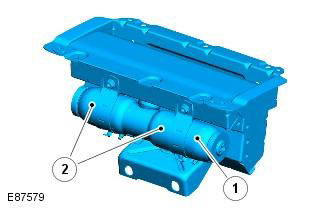
| Pos. | Spare part number | Name |
| 1 | - | The first stage is 70% of the airbag volume |
| 2 | - | The second stage is the full volume of the airbag |
The top of the airbag module is attached to a reinforcement cover on the instrument panel. The reinforcement cover has one resettable panel that is forced out of place by the airbag, tearing the instrument panel trim. The airbag has a two-stage inflator with a separate electrical connector for each stage.
Passenger airbag switch
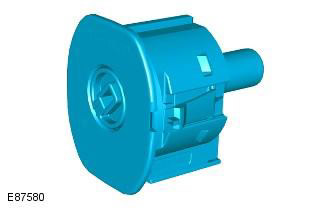
Vehicles sold in certain markets are equipped with a key-activated passenger airbag switch. When the airbag switch is turned, the ground connection between the two terminals of the RCM connector is changed. When the passenger airbag is turned off, a warning indicator on the overhead console near the rearview mirror illuminates.
The passenger airbag switch is activated by the emergency key, which is located on the instrument panel.
Passenger airbag deactivation indicator
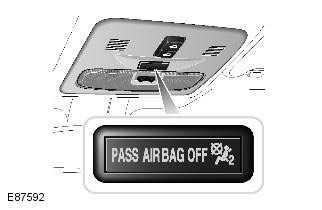
When the switch is turned to the deactivation position, the RCM deactivates the airbag and, if there is a passenger in the seat, illuminates the warning indicator.
Side airbags
The side airbag is attached to the frame of the back of each front seat and is located under the seat upholstery.
Side airbags are differentiated by the side on which they are installed, and each consists of a plastic housing that contains the folded airbag and gas generator. The gas generator igniter is connected by a wire to a connector on the main seat harness connector block, located under the front edge of the seat cushion. When deployed, the side airbag tears the plastic housing and the seat back upholstery.
Upper side airbags
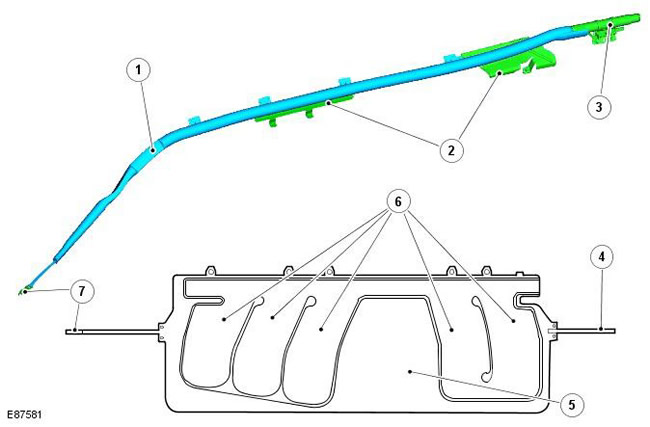
| Pos. | Spare part number | Name |
| 1 | - | Curtain airbag housing |
| 2 | - | Guides for opening |
| 3 | - | Gas generator |
| 4 | - | Back stretch |
| 5 | - | Curtain |
| 6 | - | Air chambers |
| 7 | - | Front strap |
Side airbags protect the head in a side impact and also help prevent unbelted passengers from being thrown out of the vehicle through open or broken windows in a rollover.
The curtain is opened by one filling unit located behind the rear seats; this fills five separate cavities to protect occupants' heads in the event of a side impact or rollover. Steel guides ensure the curtain unfolds correctly, while straps at the front and rear ensure that it remains taut.
The inflation of the curtain airbags is deliberately slowed down so that they remain deployed until the vehicle has finished rolling over.
Airbag warning light
The airbag warning indicator consists of a red LED that illuminates the SRS icon on the instrument panel.
The air bag warning indicator is controlled by a message received by the instrument cluster via the high speed CAN bus from the RCM. The RCM sends a signal to illuminate the air bag warning indicator if a malfunction is detected and also illuminates the indicator for approximately 6 seconds during the instrument cluster indicator lamp check at the beginning of each ignition cycle.
Comments on this article