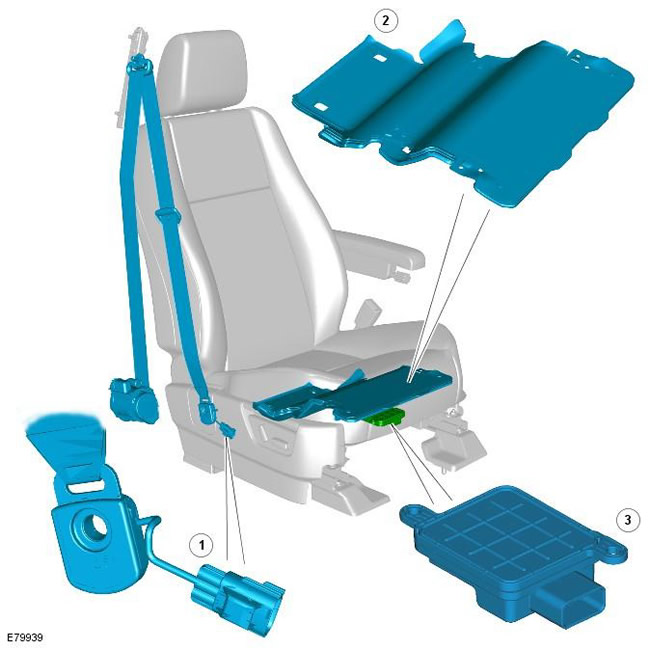
| Pos. | Spare part number | Name |
| 1 | - | Seat belt tension sensor |
| 2 | - | Passenger presence sensor |
| 3 | - | Occupant Presence Sensor Module |
In North American countries where seat belt use is not common, additional technology is used to classify the front seat occupant. The occupant classification system sends information about the load on the seat to the RCM.
The passenger classification system consists of the following components:
- A pressure pad installed under the front seat cushion, connected to a pressure sensor.
- Seat belt tension sensor installed at the front passenger seat belt anchor point.
- Occupant classification module mounted under the front passenger seat.
The pressure pad is an analogue of a heating pad filled with silicone fluid. Any load on the pressure pad is registered by a pressure sensor. The seat belt tension sensor is a strain gauge that determines the load on the seat belt fastening bolt. The sensor is located at the lower seat belt fastening point.
The occupant presence sensor detects changes in weight on the passenger seat and sends a corresponding signal to the occupant presence module. In addition, the seat belt tension sensor provides a separate input to the occupant presence module. The module processes the signals from the sensors and sends a corresponding signal to the RCM via the high-speed CAN bus.
RCM monitors and processes data from these and other sensors before deciding whether to deploy the airbag. In addition to weight, the system is able to take into account several other variables: the tilt of the vehicle and the exact position and structure of the weight on the seat.
This helps prevent the airbag from accidentally deploying, for example if there is a small child in a child seat or an unbuckled but very light adult passenger in the seat; in both cases, the airbag will be deactivated. The occupant classification system is an important part of the occupant type airbag deployment control strategy.
The classification system can give four possible definitions:
The seat is not occupied: Passenger airbag, passenger side airbag and seat belt and pretensioner are disabled; the passenger airbag off indicator does not come on.
Busy, blocked: seat occupied by small passenger, passenger airbag, passenger side airbag and seat belt and pretensioner are disabled; the passenger airbag deactivation indicator is on.
The seat is occupied: the seat is occupied by a large passenger; passenger airbag, passenger side airbag and seat belt and pretensioner are on, passenger airbag off indicator is off. The status of the passenger seat belt and pretensioner depends on the status of the seat belt buckle:
- active for buttoned
- inactive for unbuttoned
- active for buttoned
- inactive for unbuttoned
Occupant Presence Sensor Module
The occupant sensor module is mounted under the front passenger seat. The module supplies power to the occupant sensor and monitors the return voltage signal to determine whether the seat is occupied. The result is transmitted to the RCM via the high-speed CAN bus. The occupant sensor module also monitors the occupant sensor circuits for shorts or opens. If a malfunction is detected, the occupant sensor module transmits a malfunction message to the RCM.
Seat belt tension sensor
The seat belt tension sensor is a strain gauge built into the passenger seat belt anchorage. The sensor converts the force applied to the seat belt into an electrical signal. If a child seat is installed in the front passenger seat, the force applied to the passenger seat belt is reflected by the sensor output signal, which provides data that supplements the information from the occupant presence sensor.
The occupant presence sensor module processes incoming data and transmits it to the driver and passenger protection system control unit, which then evaluates the need to deploy the passenger airbag.
Comments on this article