Contents: Removal ⇩ Installation ⇩
Special tool
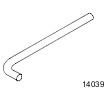 204-159 Lever, Wheel Knuckle 204-159 Lever, Wheel Knuckle | 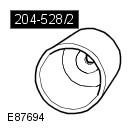 204-528/2 Remover/Installer, Bushing 204-528/2 Remover/Installer, Bushing | 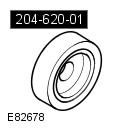 204-620-01 Installer, Wheel Knuckle Bushing 204-620-01 Installer, Wheel Knuckle Bushing |
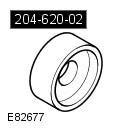 204-620-02 Remover/Installer, Wheel Knuckle Bushing 204-620-02 Remover/Installer, Wheel Knuckle Bushing | 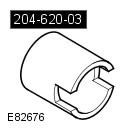 204-620-03 Remover, Wheel Knuckle Bushing 204-620-03 Remover, Wheel Knuckle Bushing | 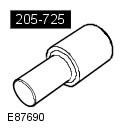 205-725 Remover/Installer, Wheel Hub 205-725 Remover/Installer, Wheel Hub |
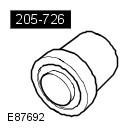 205-726 Remover/Installer, Wheel Hub Bearing 205-726 Remover/Installer, Wheel Hub Bearing | 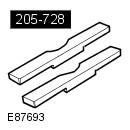 205-728 Remover/Installer, Wheel Hub 205-728 Remover/Installer, Wheel Hub | 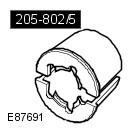 205-802/5 Remover, Wheel Hub/Bearing 205-802/5 Remover, Wheel Hub/Bearing |
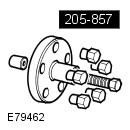 205-857 Remover, Halfshaft 205-857 Remover, Halfshaft | 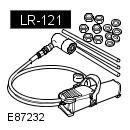 LR-121 Hydraulic Cylinder 10t LR-121 Hydraulic Cylinder 10t |
Removal
1. Raise and support the vehicle.
WARNING: Ensure that the vehicle is supported securely.
2. Remove the wheel and tire assembly. Refer to procedure: Wheel and Tire (204-04 Wheels and Tires, Removal and Installation).
3. Loosen and discard the rear axle nut.
CAUTION: Do not use a hammer to separate the axle shaft from the hub assembly, failure to do so may result in damage to the axle shaft.
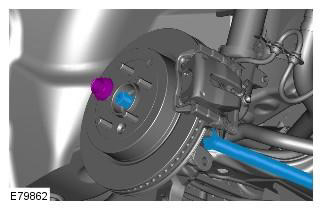
4.
CAUTION: Discard nut.
NOTE: The illustration shows the right side, the left side looks similar.
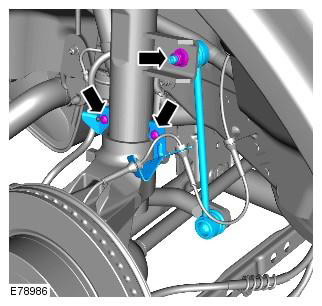
5. Disconnect the wheel speed sensor from the wheel knuckle.
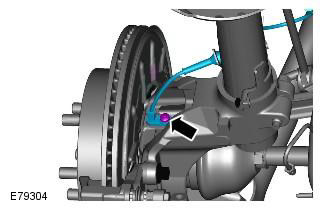
6. Move aside and tie down the brake caliper assembly with the support bracket.
CAUTION: Do not place any stress on the brake hose.
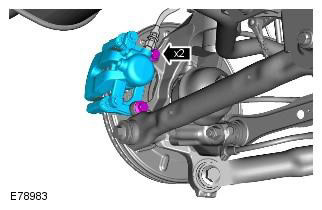
7. Release the parking brake shoe adjuster.
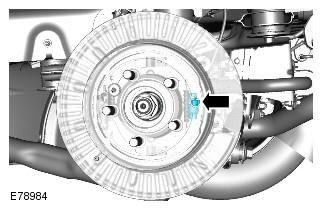
8. Remove the brake disc.
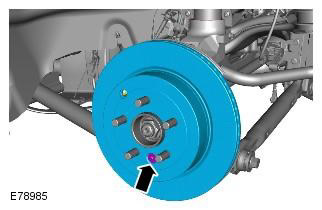
9. Disconnect the parking brake cable from the wheel knuckle. Find the clamp.
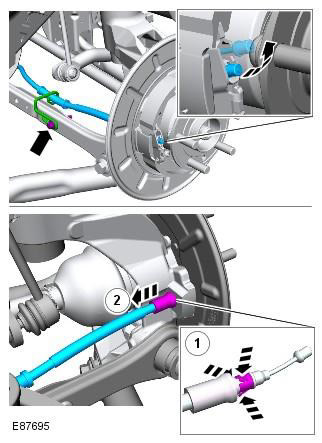
10.
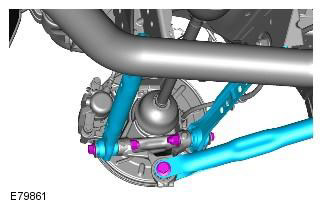
11.
- Remove the rear axle shaft. Special tool(s): 205-857
- Move aside and tie down the rear axle.
To avoid damaging the ball joint, do not allow the axle shaft to hang loose on one side.
To avoid damage to the ball joint, do not store or install axle shafts in the fully folded position.
AAR type roller joints (Angularly Adjusted Roller), mounted on the inside of some axle shafts, do not have an internal retaining mechanism and can therefore become separated.
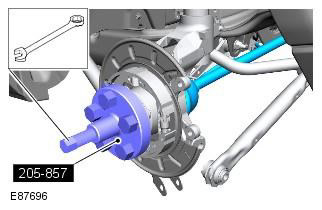
12. Unscrew and discard the wheel knuckle clamp bolt.
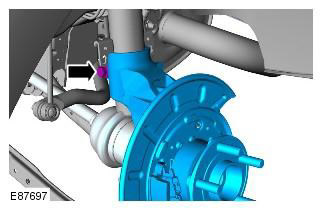
13. With assistance, remove the wheel knuckle assembly. Special tool(s): 204-159
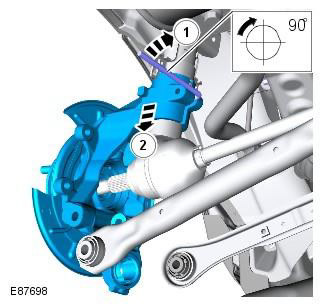
14.
NOTE: Do not perform further disassembly if the component is removed only for access.
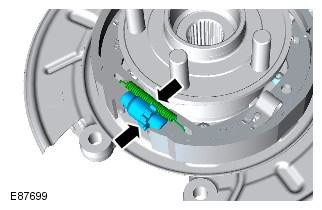
15.
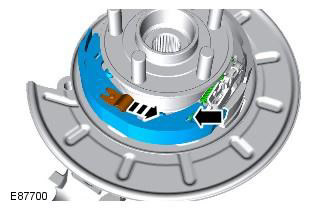
16.
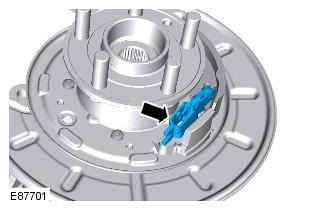
17.
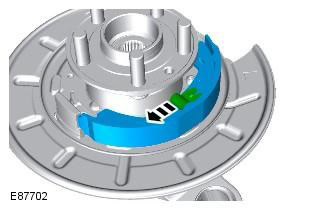
18.
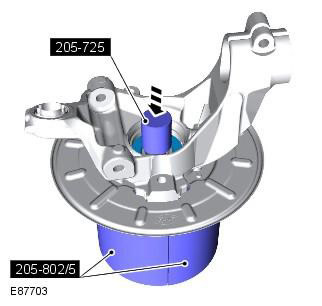
- Place the wheel knuckle assembly in the press and support it with the special tool. Special tool(s): 205-802/5
- Using the special tool, press the drive flange out of the wheel knuckle assembly. Special Tool(s): 205-725
NOTE: This operation will inevitably damage the bearing.
19.
NOTE: The inner bearing race will remain on the drive flange.
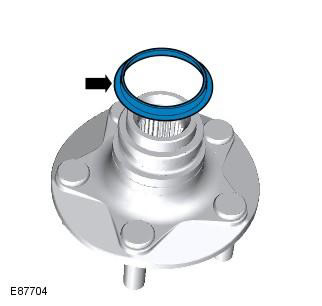
20.
- Close both halves of a suitable bearing retainer around the inner bearing race and install the drive flange in the press.
- Using the special tool, press the drive flange out of the inner bearing race. Special tool(s): 205-725
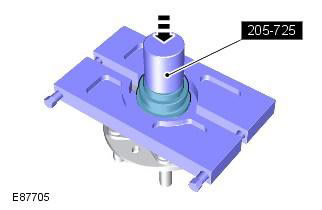
21. Remove the snap ring from the wheel knuckle assembly.
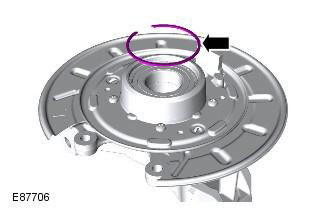
22.
- Place the wheel knuckle assembly in the press and support it with special tools. Special tool(s): 205-728
- Using the special tool, press the wheel bearing out of the wheel knuckle assembly. Special Tool(s): 205-726
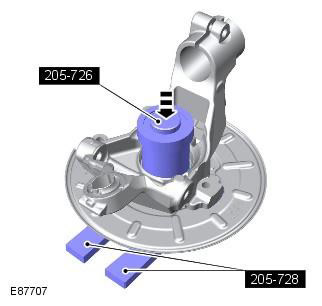
23. Remove the brake support plate.
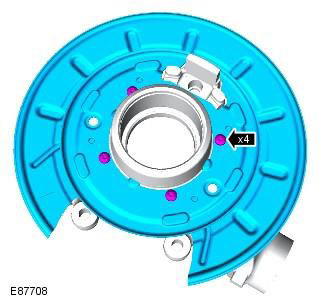
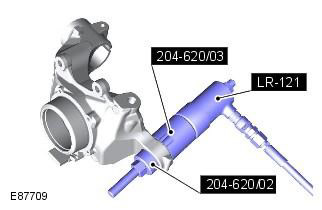
24. Remove the wheel knuckle bushing. Special tool(s): LR-121, 204-620-02, 204-620-03
CAUTION: Mark the positions of the components to facilitate subsequent installation.
Installation
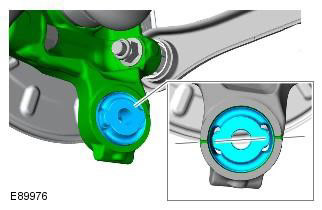
1.
CAUTION: The alignment marks must be centered.
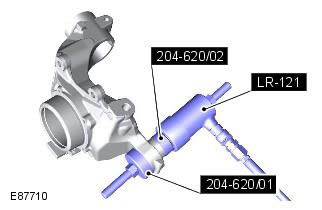
2. Install the wheel knuckle bushing. Special tool(s): LR-121, 204-620-01, 204-620-02
CAUTION: Make sure the correct special tool is used to set the bushings to the correct depth.
3. Install the brake support plate.
4.
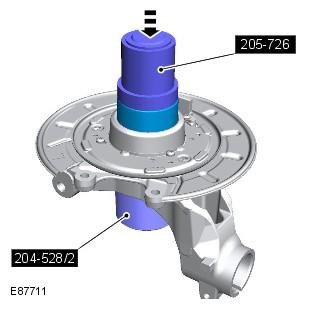
- Place the wheel knuckle assembly in the press and support it with the special tool. Special tool(s): 204-528/2
- Using the special tool, press the new wheel bearing into the wheel knuckle assembly. Special Tool(s): 205-726
CAUTION: One side of the bearing is magnetic. The magnetic side can be identified by its black matte coating. The magnetic side should face the inside of the vehicle. Clean the magnetic side before installing the bearing. Handle the bearing with extreme care.
5. Install the snap ring onto the wheel knuckle assembly.
6.
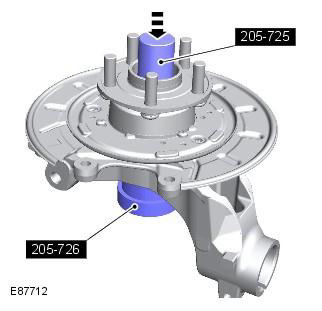
- Place the wheel knuckle assembly in the press and support it with the special tool. Special tool(s): 205-726
- Using the special tool, press the drive flange into the wheel knuckle assembly. Special Tool(s): 205-725
7. Clean the backing plate and apply grease to the surfaces that contact the brake pads.
WARNING: Do not use compressed air to clean brake components. Dust from friction materials is harmful if inhaled.
8. Clean the regulator and set it to the minimum length.
9. Install the secondary brake shoe. Install the spring clip and stud.
10.
- Install the adjusting plate and spring.
- Install the primary brake shoe.
- Install the return spring.
- Install the spring clip and pin.
CAUTION: The return spring and adjusting spring must be properly installed on the primary shoe.
CAUTION: The brake shoe spring should not be stretched too much.
11. Install the brake shoe adjuster.
CAUTION: The brake shoe spring should not be stretched too much.
12. With assistance, install the wheel knuckle assembly. Special tool(s): 204-159
13. Screw in the new wheel knuckle clamp bolt. Tightening torque: 110 Nm
14. Install the rear axle shaft onto the drive flange.
15. Install the new rear axle nut. Do not tighten completely at this stage.
CAUTION: At this stage, tighten the nuts only by hand.
16. Connect both lower control arms to the hub assembly. Do not fully tighten at this stage.
CAUTION: At this stage, tighten the nuts only by hand.
17. Connect the trailing arm to the hub assembly. Do not fully tighten at this stage.
CAUTION: At this stage, tighten the nuts only by hand.
18. Attach the parking brake cable. Secure the parking brake cable.
CAUTION: Make sure the clamp is installed correctly.
19. Install the brake disc. Tightening torque: 35 Nm
CAUTION: Clean mating surfaces of any foreign material.
20. Secure the brake caliper and backing plate to the wheel knuckle. Tightening torque: 110 Nm
Clean the mating surfaces of any foreign material. Make sure the brake hose is not kinked and is installed correctly.
21. Install the rear wheel speed sensor to the wheel knuckle. Tightening torque: 5 Nm
22. Install the brake line and wheel speed sensor brackets. Tightening torque: 10 Nm
23. Secure the stabilizer bar strut. Tightening torque: 60 Nm
WARNING: Use a new nut.
24. Jack up the vehicle by placing the jack under the rear hub.
25.
- Tighten the nuts and bolts of both lower arms. Tightening torque: 175 Nm
- Tighten the trailing arm nut and bolt. Tightening torque: 270 Nm
- Tighten the rear axle nut. Tightening torque: Step 1: 330 Nm, Step 2: 30°
- Secure the hub nut with a caulking pin.
Nuts and bolts must be tightened when the vehicle is supported by the suspension.
Do not use an air tool to install the nut. Failure to do so may result in damage to this component.
26. Adjust the parking brake. Refer to the procedure: Adjusting the Parking Brake Cable (206-05 Parking Brake and Parking Brake Actuator, General Procedures).
27. Install the wheel and tire assembly. Refer to procedure: Wheel and Tire (204-04 Wheels and Tires, Removal and Installation).
Comments on this article