Contents: General information ⇩ Practical implementation of tests…⇩ Repairing a leak using recommended…⇩ Water leaks according to mileage or…⇩ Water leaks after body repair ⇩ Water drainage system ⇩ Water drainage system ⇩ Water leaks. diagnostics and…⇩
General information
- If water leaks are observed after body repair, the cause can be determined using the methods described below. To find the places where water has penetrated, it is necessary to consistently perform a check, guided by logical considerations. Before starting to perform checks, a full inspection should be performed.
- An external inspection of existing leaks may indicate the following signs:
- The following signs may indicate existing leaks:
- Check the clearances and fit of components such as the hood, tailgate, trunk lid, doors, etc.
- Check the correct installation and possible damage to the sealing elements: plugs, rubber door seals, etc.
- Check that the water drainage holes are not clogged.
- To obtain additional information about the presence of possible leaks, various tests can be used:
- Testing using a water hose
- Water dousing test
- Road test
- Testing with chalk (powder)
Practical implementation of tests and checks
Testing using a water hose:
NOTE: Never direct the water jet directly at the rubber seal.
- Perform a water hose test with the help of a second person. (inside the car).
- Use removable spray tips (water nozzle for providing a fine spray of water).
- Start at the lower end and spray the entire area, gradually moving up.
- Additional checks can be performed at the car wash.
- Some leaks start here or only appear here.
- The interior of the respective vehicle should be checked using lighting during the washing procedure.
- If no leaks are found when performing the above checks, road tests should be performed on wet roads.
- Road tests in various conditions:
- At different speeds.
- On various road surfaces (from asphalt to cobblestones).
- With the vehicle loaded or unloaded.
- Driving through puddles (splashes of water).
- This test checks the clamping and bearing surfaces of the seal.
- Performing the check:
- Sprinkle the door seal with powder or cover it with chalk.
- Coat the seal bearing surface with a thin layer of grease.
- Close the door slowly and open it again.
- Check the width and continuity of the imprint on the door seal.
Other equipment can also be used to search for leaks: stethoscopes, ultraviolet lamps, special mirrors or ultrasonic devices.
Repairing a leak using recommended tools, accessories and materials
Tools and auxiliary equipment:
- Dry absorbent cloth
- Removable spray tip
- Backlight, fluorescent tube
- Mirror
- Compressed air
- Sealing Protrusion Installation Tool
- Vacuum cleaner for wet/dry cleaning
- Compressor for sealant
- Interior trim remover
- Blade or penknife
- Wedge (wooden or plastic)
- Heat gun
- Special mirror for detecting hidden leaks
- Testing device using air supply
- Sealant (tape and plastic compound)
- Universal label
- Curved edge sealant
- Sealant for sealing windows
- Waterproofing (PVC)
- Double-sided adhesive tape for waterproofing
- Denatured alcohol (sold in stores)
- Polyurethane adhesive
- Silicone remover
- Tar remover
Water leaks according to mileage or service life
Increased mileage affects the problem of leaks in the car. Existing factors:
- Maintenance and care of seals:
- Lack of maintenance, inadequate or improper maintenance
- Use of unsuitable materials
- Damage to seals:
- Due to ageing, wear and tear or improper handling/installation.
- Heavy vehicle contamination:
- Heavy contamination of the vehicle can seriously impair the functioning of the water drainage channels and rubber seals.
- Factors depending on the service life:
- Terms of Use
- Ultraviolet radiation
- Extreme climate conditions
- Corrosion can have a serious impact on body components, especially as a result of the following processes:
- Light or heavy rusting of the seal mandrel
- Rusting of welded seams of the body
- Perforation corrosion
Water leaks after body repair
If a leak is observed in the car after body repair, the following points must be taken into account:
- Check that the auxiliary components are installed correctly and that they are sealed.
- Check that the doors, including the rear door and the tailgate, are installed correctly. The corresponding seals must not be damaged and must be installed correctly.
- Check that the welds are sealed correctly.
- Check that the rubber sealing rings are installed correctly.
- Windows with hermetically sealed glazing must have a correct and complete adhesive connection.
Water drainage system
If water penetration is observed in the vehicle, the areas where water enters or drains should be checked first.
Water drainage system
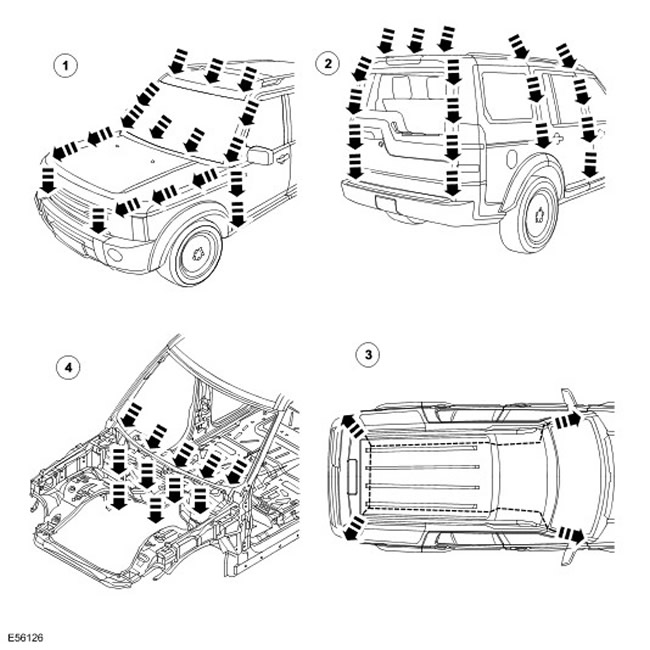
| Item name | Spare part catalog number | Description |
| 1 | Water drain, front | |
| 2 | Water drainage, side and rear | |
| 3 | Roof drainage system | |
| 4 | Engine compartment drainage system |
Water leaks. diagnostics and troubleshooting: Front part of the cabin
Windshield
- Diagnostics: Water ingress into the area of the front body pillar, into the area of the instrument panel or on the sill panel.
- Reason: Tears in the sealant bead
- Remedy:
- Breaks in the sealant bead can be found from the inside using compressed air. A leak can be identified from the outside by the air escaping.
- The second method of testing is a test using water. The outer facing panels should be separated carefully, using a plastic tool. The leak should be looked for from the inside, with outside help.
Side windows can have the same problems as the windshield, so the same troubleshooting steps should be used.
Door seal
- Diagnostics: Water penetration into the lower part of the door interior trim or into the sill panel area.
- Cause:
- The waterproofing screen installed behind the inner door trim serves to drain water that has entered the door cavity. Water is drained through drainage holes downwards or outwards. If the waterproofing screen is damaged or installed incorrectly, water may enter the interior.
- Additionally, the drain holes can become clogged with leaves, dirt, or excess cavity protection material. Water collects in the door and leaks into the vehicle's interior.
- Check the waterproofing screen for damage or improper installation.
- If the flashing needs to be re-bonded, only an approved joint sealant should be used.
- Before installing the waterproofing screen, you need to check the cleanliness of the drainage holes.
Door seals
- Diagnostics: Water penetration into the threshold panel area
- Reason: Insufficient clamping force between the seal and the door.
- Solution: Check the clamping force: The easiest way to check the clamping force between the seal and the corresponding supporting surface is to use a paper tape test. Place strips of paper at various points between the door and the seal and close the door completely. If the paper can be removed without much resistance, the clamping force is too low. Adjust the clamping force: The clamping force is usually adjusted using the door lock counter part. In this case, you should check the alignment of the edges of the door and the side panel or the front and rear doors. Another way to adjust is to change the position of the flange for fixing the seal. The clamping force increases as the flange is moved towards the door.
- Check the bearing surface: Apply chalk evenly to the sealing surface. Cover the bearing surface of the door evenly with Vaseline. Close the door completely - the lock should click into place. Open the door. The chalk imprint is clearly visible on the lubricant film. (supporting surface). The supporting surface must be at least 5 mm wide at all points.
- Check the clamping force: The easiest way to check the clamping force between the seal and the corresponding supporting surface is to use a paper tape test. Place strips of paper at various points between the door and the seal and close the door completely. If the paper can be removed without much resistance, the clamping force is too low.
- Adjust the clamping force: The clamping force is usually adjusted using the door lock counter part. In this case, it is necessary to check the alignment of the edges of the door and the side panel or the front and rear doors. NOTE: When adjusting the clamping force, it is always necessary to check the correct alignment of the profiles of the various components.
- Another adjustment method is to change the position of the seal mounting flange. The clamping force increases as the flange moves toward the door.
- Check the bearing surface: Apply chalk evenly to the sealing surface. Cover the bearing surface of the door evenly with Vaseline. Close the door completely - the lock should click into place. Open the door. The chalk imprint is clearly visible on the lubricant film. (supporting surface). The supporting surface must be at least 5 mm wide at all points.
NOTE: When adjusting the clamping force, always ensure that the profiles of the various components are correctly aligned.
NOTE: Do not move the flange too far towards the door as this may reduce the sealing surface area relative to the door.
- Other reasons:
- The door seal must completely seal the door where it meets the body.
- Water can penetrate directly or indirectly into the vehicle's interior if the seal is damaged somewhere.
- Remedy:
- A damaged or worn door seal should always be replaced completely.
- When replacing the seal, please note the following:
- Always install the seal first in the small radius area (corners).
- Then secure the seal evenly onto the flange by tapping it lightly with a rubber mallet.
- Twisting of the installed seal is not permitted.
NOTE: It is not permitted to reduce the specified seal length.
- Another reason:
- The door seal contacts the weld flange along the entire perimeter. If this weld flange is deformed or damaged in any place (usually in areas with small radii), leaks may occur in this place.
- A stretched seal mandrel can also cause leaks.
- In both cases, water penetrates into the vehicle interior under the sealing mandrel.
- Remedy:
- Straighten the warped weld flange using a hammer and anvil, preventing and, if necessary, repairing any damage to the paintwork.
- Another reason:
- The door seal contacts the weld flange along the entire perimeter. If this weld flange is deformed or damaged in any place (usually in areas with small radii), leaks may occur in this place.
- A stretched seal mandrel can also cause leaks.
- In both cases, water penetrates into the vehicle interior under the sealing mandrel.
Sliding/lifting sunroof
- Diagnostics: Water penetration through the roof hatch opening
- Cause:
- The sunroof is installed in a water catch basin. Water flows out through the water catch basin, water drain holes and drain hoses. The drain hoses run down on both sides through the A-pillar and C-pillar.
- Drain holes or drain hoses may be clogged with leaves, dirt, skid plate material, etc.
- Remedy:
- Check the water trap for leaks.
- Check the drain hoses for leaks and to ensure they are properly connected to the water trap.
- Check the drainage system for blockages and, if necessary, blow it out with compressed air.
- Check the outer seal and correct adjustment of the sunroof.
NOTE: If you have a sunroof leak, first check the outer rubber seal and the lock actuator or latch mechanism.
Rear door and tailgate
- Diagnostics: Water penetration into the rear of the headliner and into the luggage compartment.
- Cause:
- The problems with leaking rear doors and tailgate are similar to the problems with other doors.
- In addition, the area to be sealed must be much larger. The openings for the passage of cables and hoses must also be sealed.
- Rubber sealing bushings for cable and hose routing holes should be checked for damage and correct installation. (completely disconnected).
- The hinge mounting points of the rear door and the trunk door may leak.
- Remedy:
- Check the rubber sealing rings and replace them if necessary.
- Check the hinge attachment points and re-seal them with sealant if necessary.
- Diagnostics: Water ingress into the side area of the luggage compartment
- Cause:
- The forced air exhaust duct from the passenger compartment is located in the rear door pillar, behind the rear lights.
- The rubber flap of the forced air suction must be able to move freely.
- Remedy:
- Remove the forced air suction.
- Check the sealing area between the body and the housing, as well as the rubber flap.
- Replace the seal if necessary.
Rear window and sunroof
- Diagnostics: Water penetration into the luggage compartment area
- Cause:
- Leaks in the rear window and sunroof.
- Check for leaks in the same way as you would check for leaks in your windshield.
- Diagnostics: Water penetration into the luggage compartment area
- Cause:
- Some panel joints are made during vehicle manufacture in the wheel arch and luggage compartment areas. These joints are sealed with sealant.
- Uneven application of sealant may result in a rupture in the sealed weld.
- Remedy:
- Clean the sealed weld.
- Find the leak in the sealed weld.
- Re-seal with a sealer.
Comments on this article