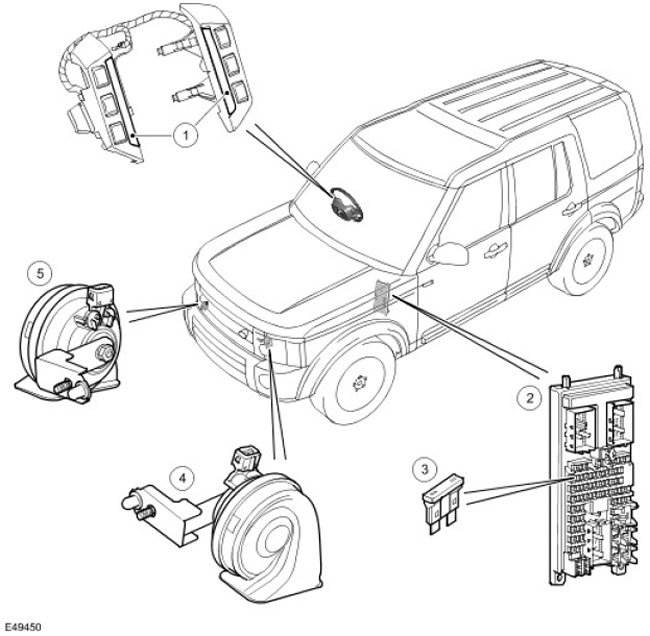
| Item name | Spare part catalog number | Description |
| 1 | - | Steering wheel horn switches |
| 2 | - | Central Junction Box (CJB) |
| 3 | - | Fuse 12 |
| 4 | - | Low tone beep |
| 5 | - | High pitched beep |
General information
The car is equipped with two sound signals - high-tone and low-tone. The sound signals are mounted on brackets attached to the front cross member assembly, on both sides of the radiator.
The horns are activated by pressing one of two switches located on either side of the driver's airbag on the steering wheel.
The horns are also used by the vehicle's anti-theft system. When the anti-theft system requests the horns to be turned on, the central junction box (CJB) closes the horn relay solenoid to ground, the relay contacts close, which causes battery voltage to be applied to the horns. For more information, refer to Anti-Theft - Active (419-01A Anti-Theft - Active)
Battery voltage is continuously supplied to the horn circuit, so the horn can operate at any time, regardless of the position of the ignition key.
The horn switches are controlled by a relay built into the CJB. The circuit between the relay contact and solenoid and the vehicle battery is provided with a fusible link (17E) in the battery distribution block and a fuse (F12) in the CJB. Pressing the horn switches closes the relay ground circuit and voltage is applied to the solenoid. The solenoid closes the relay contact and battery voltage is applied to both horns. When the switch is released, the solenoid ground circuit opens, the solenoid is deactivated and the relay contacts open, stopping the supply of power to the horns.
Comments on this article