


Dismantling
1. Remove the cylinder head gaskets.
ENGINE KV6 - MODIFICATION K, Piston group, Left cylinder head gasket.
ENGINE KV6 - MODIFICATION K, Piston group, Right cylinder head gasket.
Disassembly
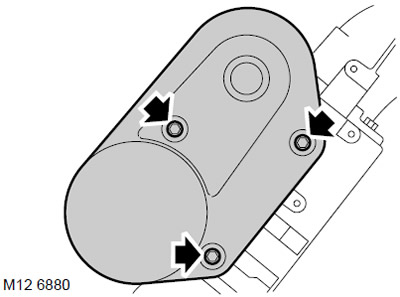
1. Left cylinder head: Unscrew the 3 bolts securing the left rear timing belt cover and remove the cover.
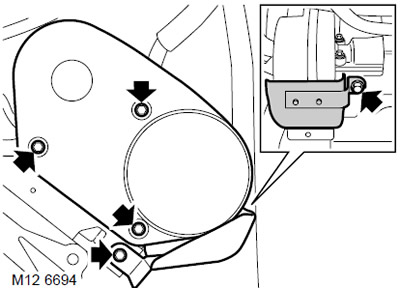
2. Right cylinder head: Remove the 2 bolts securing the heat shield to the rear timing belt cover on the right cylinder head.
3. Right cylinder head: Unscrew the 3 bolts securing the rear timing belt cover on the right cylinder head and remove the cover.
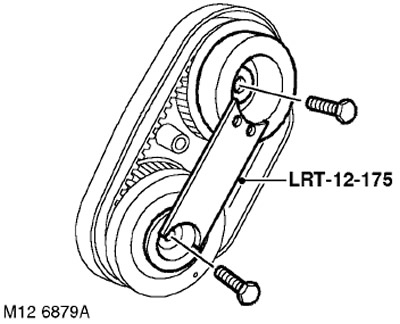
4. Install the LRT-12-175 tool on the rear gears, unscrew and dispose of the bolts securing the gears to the camshafts.
5. Remove the gears, timing belt and LRT-12-175 tool as an assembly.
6. Remove the LRT-12-175 tool from the gears and remove the timing belt from the wheels. Discard the timing belt.
7. Remove the spark plugs.
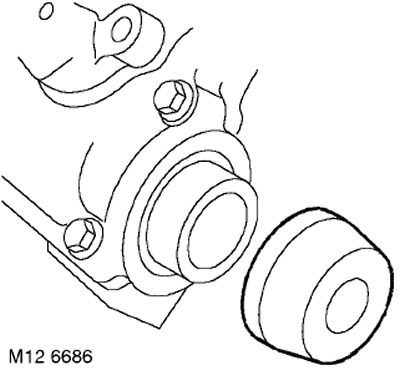
8. Remove and discard the exhaust camshaft cap seal from the cylinder head.
NOTE: Illustration shown is for right cylinder head.
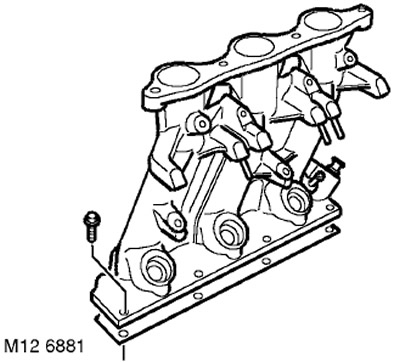
9. Sequentially loosen and unscrew the 7 bolts securing the intake manifold to the cylinder head, remove the manifold and dispose of the gasket.
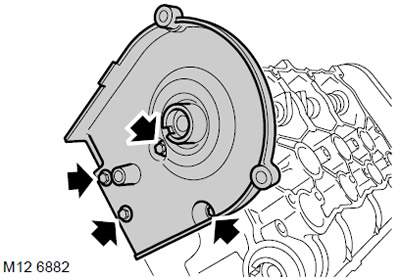
10. Unscrew the 4 bolts securing the rear cover of the front timing belt to the right cylinder head and remove the cover.
NOTE: Left cylinder head rear timing belt cover shown.
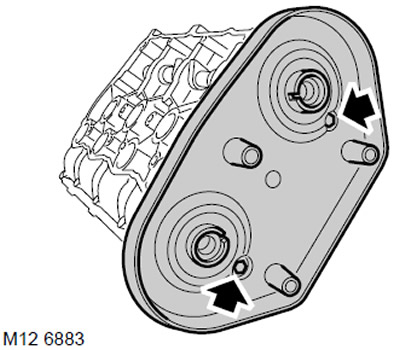
11. Unscrew the 2 bolts securing the rear timing belt rear cover to the cylinder head and remove the cover.
NOTE: Left cylinder head rear timing belt cover shown.
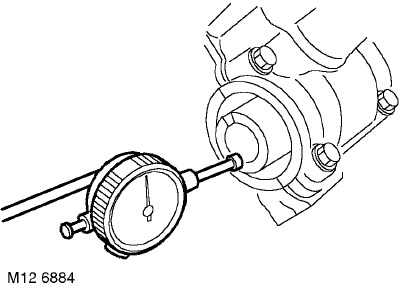
12. Check the axial clearance of the camshafts using a dial indicator.
TECHNICAL SPECIFICATIONS, Engine - petrol KV6.
CAUTION: If the axial play exceeds the permissible value, recheck with a new camshaft(s). If the axial play is still greater than the permissible value, replace the cylinder head assembly with the camshaft cover.
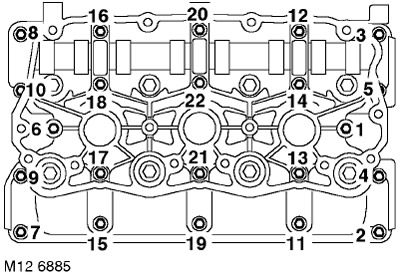
13. Gradually, in the sequence shown in the figure, loosen the 22 camshaft cover mounting bolts until the valve springs are completely unloaded.
14. Remove the camshaft cover.
The article is based on information from the website www.LRman.ru
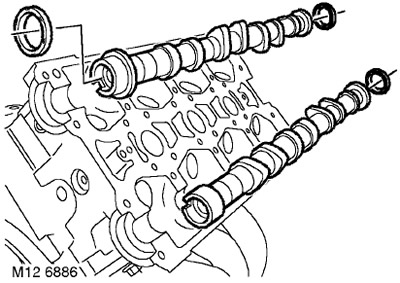
15. Remove the camshafts and discard the camshaft seals.
NOTE: Exhaust camshafts are color coded orange.
16. Using a magnet, remove the 12 hydraulic lifters from the cylinder head.
CAUTION: The hydraulic lifters must be laid out in the order in which they were installed on the cylinder head. When working with hydraulic lifters, the maximum possible cleanliness must be maintained. Failure to comply with these requirements may result in engine failure.
17. Measure the outside diameter of the hydraulic lifters.
TECHNICAL SPECIFICATIONS, Engine - petrol KV6.
NOTE: The measurement is taken in the middle belt of the compensators.
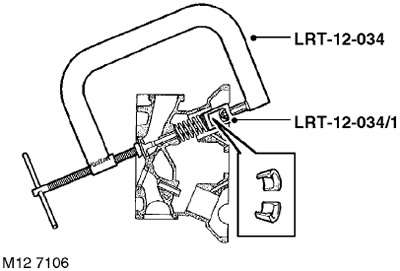
18. Using the LRT-12-034 valve spring compressor with the LRT-12-034/1 tip, compress the valve springs, remove the two valve spring crackers, release the spring and remove the LRT-12-034 valve spring compressor.
19. Remove the valve spring with the upper plate.
20. Remove the valve from the cylinder head.
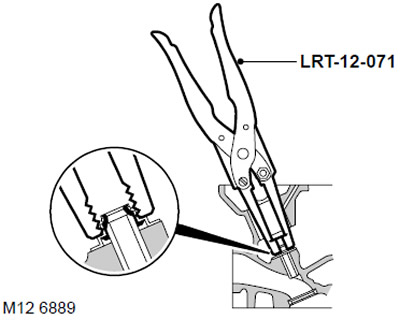
21. Remove the valve stem seal using the LRT-12-071 puller. Discard the valve stem seal.
22. Do the same on the remaining valves, laying out the removed parts in the order in which they were on the cylinder head.
Examination
1. Wipe the camshafts, the bearing surfaces of the camshaft journals in the bed, the mating surfaces of the camshaft bed and the cylinder heads.
2. Check the condition of the camshafts. If they are scratched, dented or excessively worn, replace the camshafts.
3. Place the camshafts in the cylinder head and apply a strip of deformable gauge to each of the journals.
CAUTION: Do not confuse the intake and exhaust camshafts. The camshafts are color coded: ORANGE - intake camshaft, BLUE - exhaust camshaft.
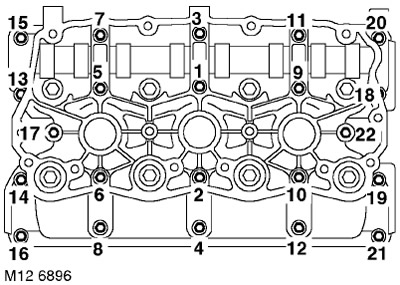
4. Install the camshaft cover and gradually tighten the bolts to 10 Nm in the sequence shown in the figure. Do not rotate the camshafts.
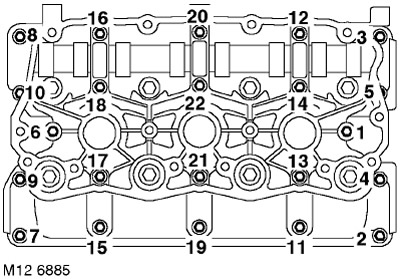
5. Loosen and remove the camshaft cover mounting bolts in the sequence shown in the figure. Remove the camshaft cover from the cylinder head.
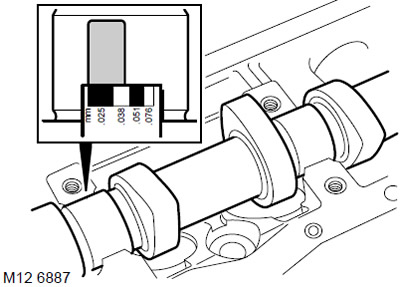
6. Measure the widest part of each gauge strip.
TECHNICAL SPECIFICATIONS, Engine - petrol KV6.
7. If the clearance is greater than the permissible value, install new shafts and repeat the check. If the clearance is still too large, replace the cylinder head.
8. Using a rag soaked in oil, remove all traces of the deformed gauge from the necks.
9. Clean the sealing surfaces of the cylinder heads. Wipe the mating surfaces of the intake and exhaust manifolds.
CAUTION: Do not use a metal scraper.
10. Clean the lower surface of the cylinder head from carbon deposits.
11. Blow out the oil passages and cooling system passages.
12. Inspect the cylinder head for damage, paying particular attention to the sealing surfaces.
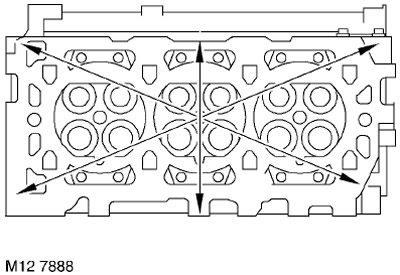
13. Check the cylinder head plane for warpage by placing a straight edge along the directions shown in the figure.
TECHNICAL SPECIFICATIONS, Engine - petrol KV6.
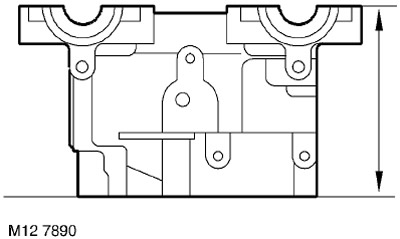
14. Check the cylinder head height.
TECHNICAL SPECIFICATIONS, Engine - petrol KV6.
NOTE: Grinding the underside of the cylinder heads is permitted provided that the head height remains within acceptable limits.
15. Check the condition of the valve springs and measure the height of the springs in the free state.
TECHNICAL SPECIFICATIONS, Engine - petrol KV6.
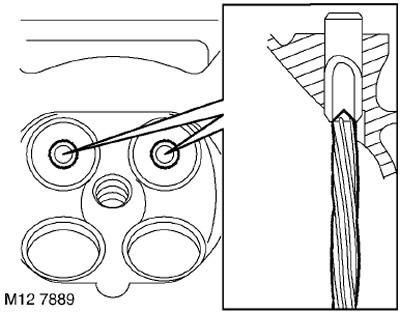
16. Using a 6 mm diameter reamer, remove carbon deposits from the exhaust valve guides. The reamer is inserted into the guide from the lower plane of the head.
17. Remove carbon deposits from the intake valve guides, intake and exhaust valves, and valve seats. After completing the carbon removal procedure, blow out the head to remove all particles.
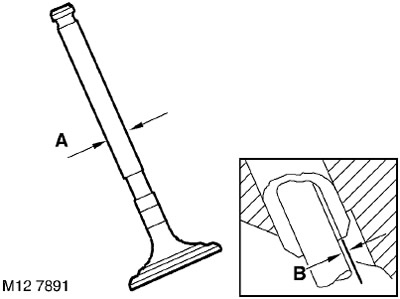
18. Measure and record the diameters 'A' of the stems of the old valves, replace the valve if the stem diameter is less than the permissible value.
TECHNICAL SPECIFICATIONS, Engine - petrol KV6.
19. Using the procedure below, measure the clearances 'B' between the intake and exhaust valve stems and their guides.
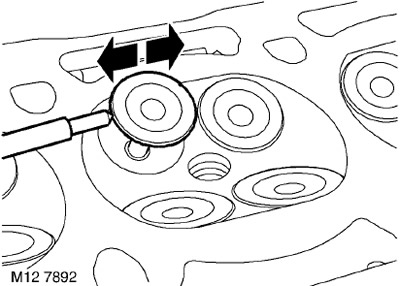
20. Insert all valves into their respective bushings.
21. Pull the valve plate up 15 mm and install the dial indicator as shown in the figure.
22. Move the valve disc toward the front of the cylinder head and set the indicator to zero, making sure that the indicator leg remains pressed against the disc.
23. Move the valve towards the rear of the cylinder head and read the indicator 'B'.
TECHNICAL SPECIFICATIONS, Engine - petrol KV6.
24. Remove the valves and put them back in their original order.
25. Replace valves and valve guides if necessary.
26. To remove the guide bushings, place the cylinder head with its bottom plane on wooden blocks.
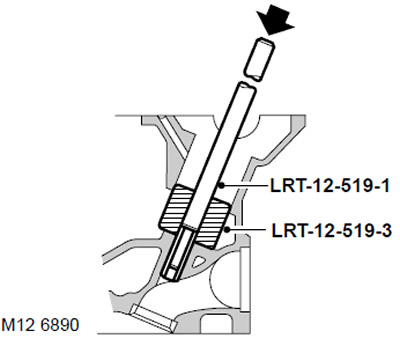
27. Insert the LRT-12-519-3 drift into the push rod socket and knock out the bushing using the LRT-12-519-1 drift.
CAUTION: Place the valve guides in the order they were on the assembled engine.
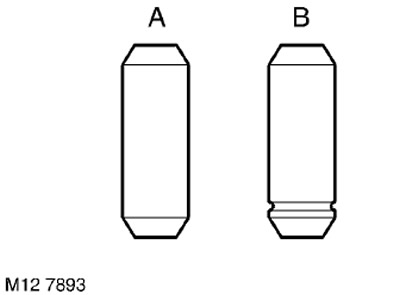
28. Determine the type of installed bushings: 'A' - Factory assembly 'B' - Replaced during operation.
CAUTION: Factory fitted 'A' bushings must be replaced with 'B' repair bushings.
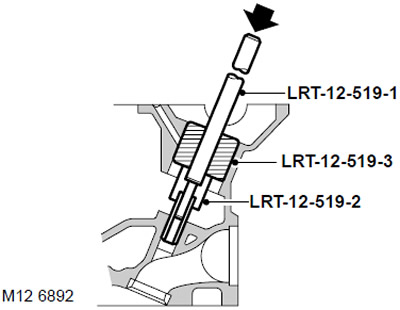
29. Install the valve guide into the guide socket with the groove facing the valve seat and install the LRT-12-519-2 limiter onto the guide.
CAUTION: When replacing bushings, the cylinder head and bushing must be at room temperature.
30. Install the LRT-12-519-3 nylon mandrel into the compensator socket and drive the bushing with the LRT-12-519-1 mandrel until the limiter reaches the surface of the cylinder head.
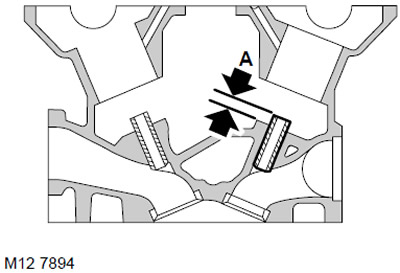
31. Check that the protrusion 'A' of the driven bushing is 6.0 mm.
32. Check the condition of the valve seats and those valves that are intended to be reused.
33. Replace valve seats if necessary.
CAUTION: Use caution when removing seats to avoid damaging the seating surface.
34. Cool the new seats in liquid nitrogen and immediately press them into the cylinder head, without stopping during pressing.
CAUTION: Do not heat the cylinder head. The seats after chamfering should not protrude above the lower plane of the cylinder head
35. Cut the seat chamfers using a special cutter with a pilot, ensuring the following angles of inclination:
- 15° - First cut
- 45° - Final cut with burr removal
- 60° - Trimming to obtain the required chamfer width
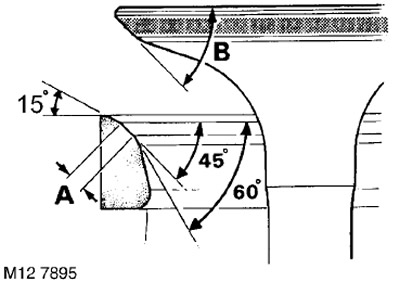
36. Check the width of the valve chamfer and its angle:
- Chamfer width 'A' - Inlet = 1.2mm; Release = 1.6 mm
- Valve bevel angle 'B' - Inlet and Outlet = 45°
37. Grind the valves to the seats using lapping paste.
38. Apply a thin layer of Prussian blue to the valve seat chamfer, insert the valve into the guide and press it several times without turning. Remove the valve and check the uniformity and position of the fit using the imprint. The paint should be imprinted along the center line of the chamfer. a: The imprint is closer to the stem (high), deepen the cut at an angle of 60° and restore the width of the seat chamfer. b: The imprint is closer to the edge of the disc (low): deepen the cut at an angle of 45° and restore the width of the seat chamfer. Lap the valve and recheck its fit to the seat.
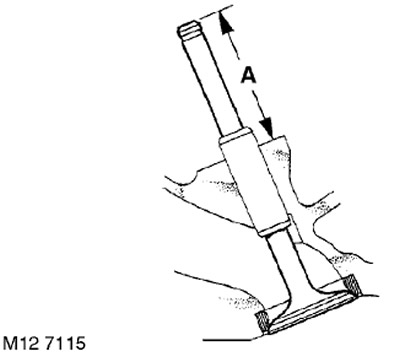
39. Check the protrusion of valve stem 'A'.
TECHNICAL SPECIFICATIONS, Engine - petrol KV6.
CAUTION: If the valve stem protrudes more than the permissible limit, install a new valve and check the stem protrusion again. If this does not help, replace the valve seat.
40. Wash the valve springs and lubricate the valves.
Assembly
1. Lubricate new valve stem seals with clean engine oil.
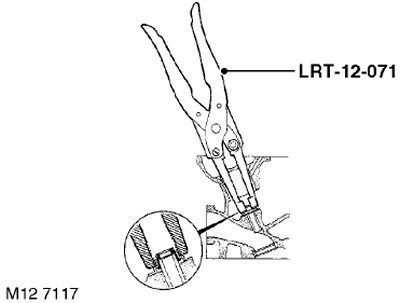
2. Using the LRT-12-071 tool, install new oil seals.
3. Insert the valves.
4. Install the spring and upper spring plate.
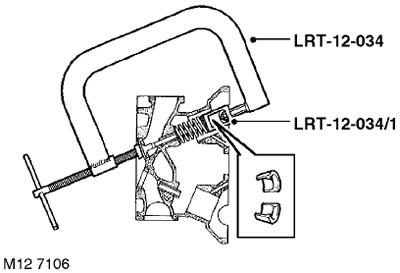
5. Install the LRT-12-034 valve spring compressor with the LRT-12-034/1 tip onto the valve plate and compress the spring.
6. Install the crackers.
7. Release the valve spring and remove the LRT-12-034 valve spring compressor.
8. Using a wooden block, strike the end of the valve stem two or three times so that the crackers take the working position in the grooves of the stem.
9. Carefully wipe the hydraulic compensators and lubricate them with clean engine oil. Install the hydraulic compensators in the cylinder head, in their original places.
10. Check that the mating surfaces of the cylinder head and camshaft covers are clean and dry.
11. Lubricate the camshafts with clean engine oil.
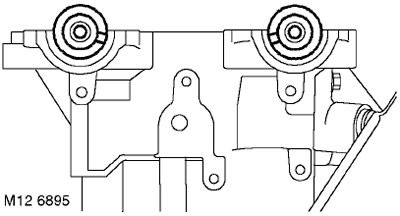
12. Place the camshafts in the cylinder head so that the grooves for the gears are directed towards the middle of the engine, as shown in the figure.
CAUTION: Do not confuse the intake and exhaust camshafts. The camshafts are color coded: ORANGE - intake camshaft, BLUE - exhaust camshaft.
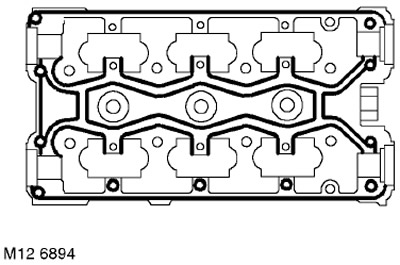
13. Apply continuous thin beads of STC 4600 sealant in the areas shown in the figure. Use a roller trowel to spread the sealant in a thin layer over the surface.
ATTENTION: Assembly of prepared parts must be carried out immediately to prevent contamination of surfaces with applied sealant.
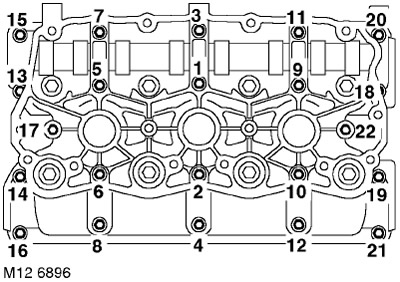
14. Install the camshaft cover, screw in and gradually tighten the bolts to a torque of 10 Nm in the sequence shown in the figure.
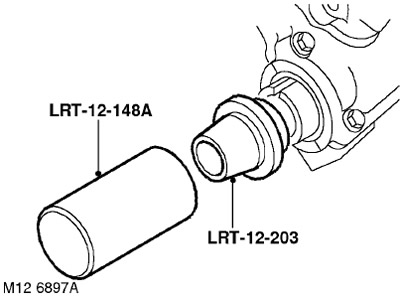
15. Remembering that the front seals are black and the rear seals are red, install new seals using the LRT-12-203 and LRT12-148A drifts.
CAUTION: Seals must be installed dry. Do not use the LRT-12-148 driver to install seals.
16. Clean the rear timing belt cover mounting bolts and apply STC 50552 sealant to the first three threads.
17. Install the rear timing belt rear covers onto the cylinder head, install the bolts and tighten them to torque.
18. Screw in the spark plugs.
19. Clean the rear camshaft gears and their seats on the camshafts.
ATTENTION: If sintered gears (powder metallurgy technology) have been in contact with oil for a long time, they must be soaked in a solvent and then washed in a clean solvent before installation. The porous structure of the sintered material absorbs oil, which, when released, will contaminate the timing belts.
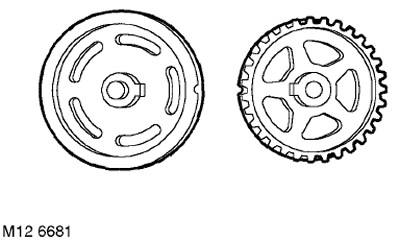
20. Place the inverted gears on a flat surface with the marks facing as shown in the figure.
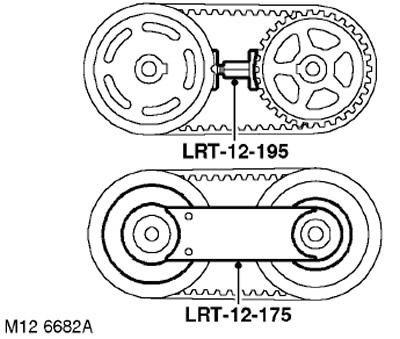
21. Place the timing belt on the toothed wheels, keeping the timing marks aligned.
22. Install the LRT-12-195 tool between the gears, rotate the tool nut until the belt is sufficiently tensioned.
23. Turn the gears with the belt over and install the LRT-12-175 device on the gears.
24. After checking the alignment of the installation marks, remove the LRT-12-195 device that was between the wheels.
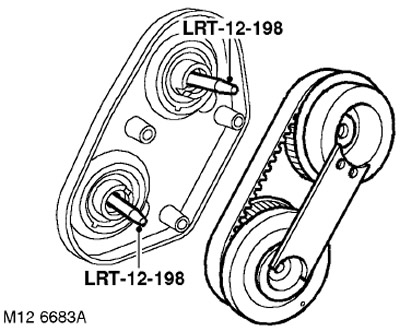
25. Install the LRT-12-198 guide pins into the end of each camshaft.
26. Using guide pins LRT-12-198, place the timing gears on the camshafts.
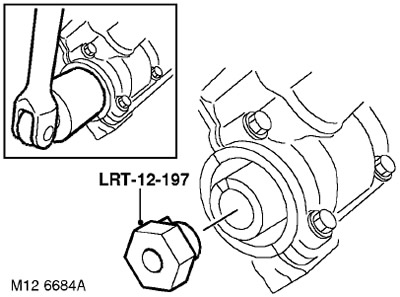
27. Screw the special bolt LRT-12-197 into the front end of the exhaust shaft.
28. With the help of a partner, install a 30 mm socket head on the special bolt LRT-12-197 and rotate the camshaft until the protrusions on the gear wheels align with the grooves of each of the camshafts.
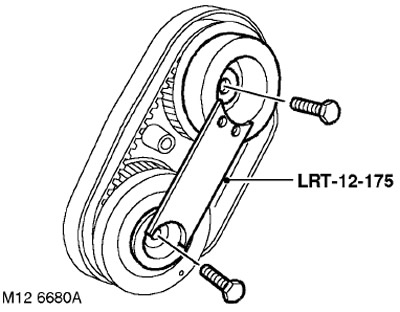
29. Remove the guide pins LRT-12-198 and screw in new gear mounting bolts.
30. Tighten the gear mounting bolts:
- Stage 1: 27 Nm
- Step 2: 90° turn
31. Remove the LRT-12-175 tool from the gears.
32. Remove special bolt LRT-12-197 from the front of the exhaust camshaft.
NOTE: There is a possibility that after replacing the front or rear timing belt and setting the crankshaft pulley to the 'SAFE' position, the position marks on the rear timing gears may no longer align. This misalignment is acceptable provided the belt replacement procedure was carried out correctly.
33. Install the rear timing belt cover and tighten the mounting bolts to 9 Nm.
Installation
1. Install the cylinder head gaskets.
ENGINE KV6 - MODIFICATION K, Piston group, Left cylinder head gasket.
ENGINE KV6 - MODIFICATION K, Piston group, Right cylinder head gasket.
Comments on this article