Dismantling
1. Remove the cylinder head gaskets.
ENGINE KV6 - MODIFICATION K, Piston group, Left cylinder head gasket.
ENGINE KV6 - MODIFICATION K, Piston group, Right cylinder head gasket.
2. Remove the oil pump gasket.
ENGINE KV6 - MODIFICATION K, Piston group, Oil pump overhaul.
3. Remove the rear crankshaft oil seal.
ENGINE KV6 - MODIFICATION K, Piston group, Replacement of rear crankshaft oil seal.
4. Remove the lower engine sump cover.
ENGINE KV6 - MODIFICATION K, Piston group, Lower oil pan cover.
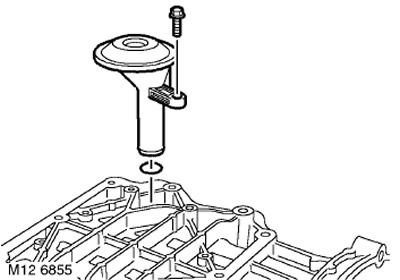
1. Unscrew the bolt securing the oil receiver with the mesh filter, remove the oil receiver and dispose of the O-ring.
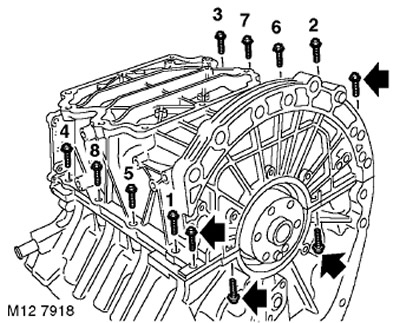
2. In the sequence shown in the figure, unscrew and dispose of the 8 M8 bolts securing the upper part of the pan to the cylinder block.
3. Remove the remaining M8 bolts and 2 M6 bolts that secure the top of the pan to the cylinder block.
4. Remove the tray.
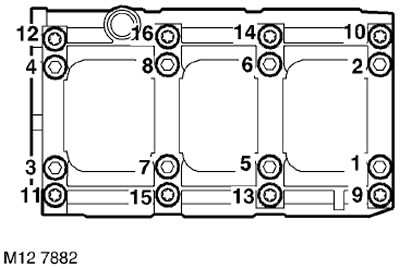
5. In the sequence shown in the figure, unscrew and dispose of the 16 bolts securing the integral main bearing cap to the cylinder block.
NOTE: Short bolts are installed on the outside of the main bearing cap.
6. Release the main bearing cap from the guide pins and remove the bearing cap from the engine.
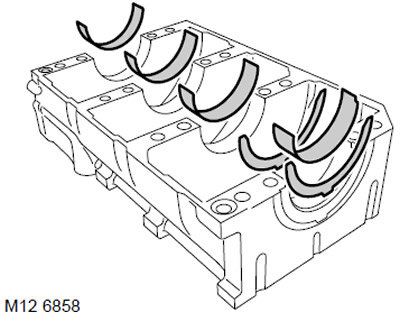
7. Remove the lower main bearing shells and two thrust half rings from the integral bearing cap, lay out the shells in the order in which they were on the engine and dispose of the half rings.
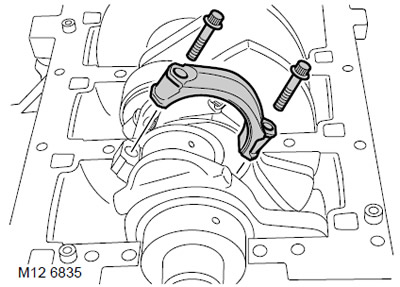
8. Temporarily tighten the front pulley mounting bolt.
9. Unscrew the 4 fitting bolts (the bolt that also functions as a pin) and remove the caps from the connecting rods of the 1st and 2nd cylinders. Lay out the caps in the order in which they were installed.
NOTE: The number stamped under the connecting rod cap mounting bolt is the size group code for the connecting rod bearing bed. The number stamped on the connecting rod body is the cylinder number, and the letter is the weight group code.
CAUTION: Do not remove the LRT-12-144 fasteners unless you are removing the pistons and connecting rods.
10. Move the connecting rods away from the crankshaft journals.
11. Remove the connecting rod bearings from the connecting rod and from the connecting rod cap.
12. Turn the crankshaft by the pulley mounting bolt and unscrew the mounting bolts of the remaining connecting rod caps. Remove the connecting rod caps and take out the liners from them. Lay out the connecting rod caps in the order in which they were installed on the engine.
13. Remove the crankshaft, take out the upper main bearings and thrust half rings from the cylinder block. Dispose of the thrust half rings.
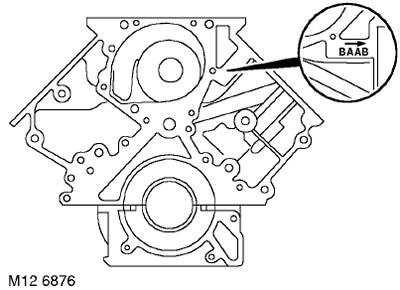
14. Selection of main bearings: copy the letter code of the main bearing size group from the front wall of the cylinder block. The letters are arranged according to the main journal numbers, from left to right: the first letter refers to the first (front) main journal.
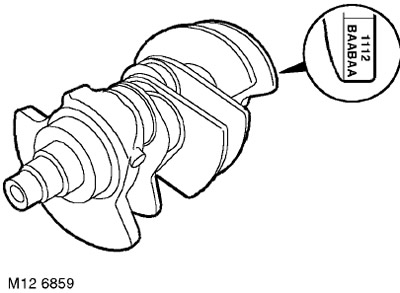
15. Rewrite the letter code of the main bearing size groups stamped on the crankshaft counterweight. The first letter on the left refers to the bearings of the first main journal and so on in order.
Examination
1. Measure the diameter of the crankshaft main journals.
2. The obtained value should be within the tolerance. If it is not, the crankshaft should be replaced.
TECHNICAL SPECIFICATIONS, Engine - petrol KV6.
3. Select the main bearings for installation on the engine using the appropriate tables in the general information section.
TECHNICAL SPECIFICATIONS, Engine - petrol KV6.
4. The thickness of the main bearing is indicated by a colored mark on its edge.
TECHNICAL SPECIFICATIONS, Engine - petrol KV6.
5. Crankshaft journals: Measure the diameter of the crankshaft journals and replace the shaft if the measured values are not within the tolerance.
TECHNICAL SPECIFICATIONS, Engine - petrol KV6.
6. Determine the thickness of the connecting rod bearing by the color mark on its edge.
TECHNICAL SPECIFICATIONS, Engine - petrol KV6.
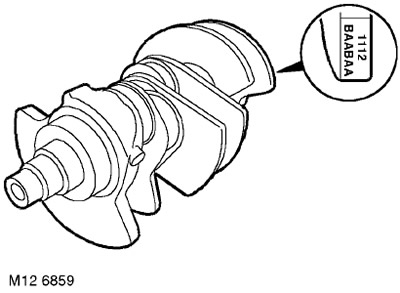
7. Selection of connecting rod bearings: Write down the letter code of the size group of connecting rod journals, located on the rear counterweight. The first letter on the left refers to the bearings of the first connecting rod journal and so on in order.
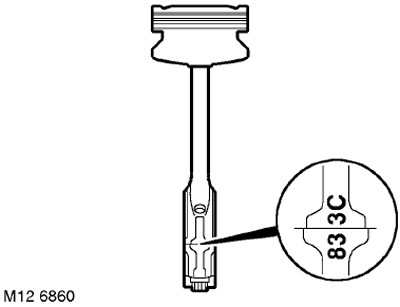
8. Copy the digital code (7, 8 or 9) of the connecting rod bearing seat size group stamped on the connecting rod cover.
9. Selection of connecting rod bearings: The required connecting rod bearings are selected according to the tables in the section devoted to general data.
TECHNICAL SPECIFICATIONS, Engine - petrol KV6.
10. Check that all threaded holes are clean and dry. Remove any remaining sealant from the threaded portion of the oil pan mounting bolt and from the threaded hole for the bolt.
CAUTION: Do not use a tap (for cleaning threads).
11. Check that the integral main bearing seat dowel pins are in place and that the dowel holes are clean and dry.
12. Check the coolant hose on the cylinder block for signs of leakage or corrosion and replace if necessary. Apply STC 50554 sealant to the new hose being installed in the cylinder block.
13. Wipe the main bearing beds in the cylinder block.
14. Wipe the main and connecting rod journals of the crankshaft. Wipe the bearing beds in the connecting rods and in the connecting rod caps.
15. Install the selected main bearings in the beds. Grooved bearings are installed in the cylinder block, flat bearings are placed in the main bearing cap.
16. Install new thrust half rings on the cylinder block.
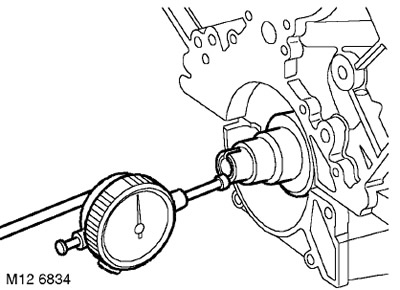
17. Install the dial indicator leg on the end of the crankshaft as shown in the figure. Move the crankshaft back, away from the indicator, set the indicator to "zero", move the crankshaft forward and read the reading.
TECHNICAL SPECIFICATIONS, Engine - petrol KV6.
CAUTION: If the axial clearance value exceeds the permissible value, the crankshaft must be replaced.
Assembly
1. Install the selected connecting rod bearings into the connecting rod and caps.
2. Lubricate the connecting rod journals with clean engine oil. Holding the crankshaft so that the connecting rod journals are in a horizontal plane, lay the crankshaft on the bed.
3. Carefully slide the connecting rod onto the journal, install the connecting rod cap, paying attention to the fact that the installation grooves in the cap and in the connecting rod body should be on different sides, and slightly tighten the connecting rod bolts.
4. Tighten the fitting bolts:
- Stage 1: 20 Nm
- Step 2: 45° turn
5. Using a non-stripping cloth dampened with solvent, wipe the mating surfaces of the main bearing cap and cylinder block.
6. Lubricate the thrust half rings with clean engine oil and insert them into the main bearing cap, with the grooves facing outward.
7. Install the main bearing cap and check that all bearing shells are in place.
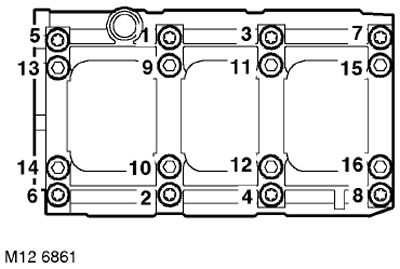
8. Install new bearing cap bolts, remembering that the longer bolts are installed on the inner row, and tighten them:
- Stage 1: 20 Nm
- Step 2: 90° turn
9. Using a non-stripping cloth dampened with solvent, wipe the mating surfaces of the oil pan and cylinder block.
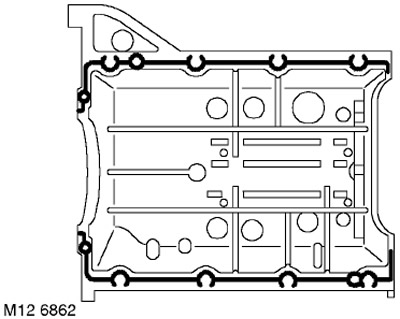
10. Apply a continuous bead of STC 50550 sealant to the tray along the contours shown in the figure and spread it in a thin layer using a roller trowel.
ATTENTION: Assembly of prepared parts must be carried out immediately to prevent contamination of surfaces with applied sealant.
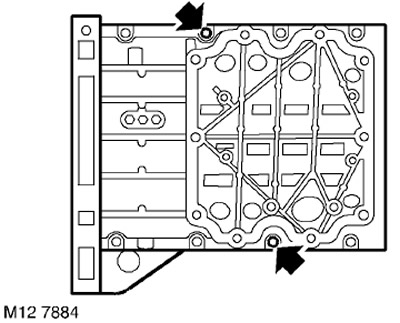
11. Install two guide pins with M8 thread into the cylinder block as shown in the figure.
12. Install the pan on the cylinder block.
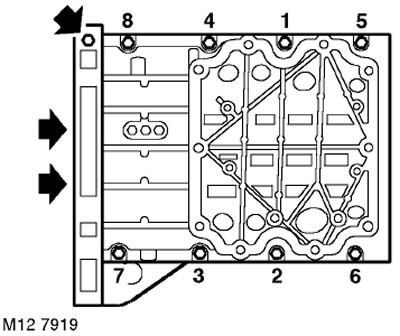
13. Screw in and lightly tighten 6 M8 bolts, unscrew the guide pins, screw in and lightly tighten the remaining 2 M8 bolts.
14. Tighten the bolts to 25 Nm in the sequence shown in the figure.
15. Screw in the remaining M8 bolt and tighten it to a torque of 25 Nm.
16. Screw in 2 M6 bolts and tighten them to a torque of 9 Nm.
17. Wipe the oil pickup tube and mating surfaces.
18. Lubricate the new O-ring with clean engine oil and place it on the oil pickup tube.
ATTENTION: It is mandatory to install the O-ring with the number LYX 000210L from the spare parts catalog.
19. Apply STC 50552 sealant to the threaded portion of the oil pan mounting bolt.
20. Install the oil pickup pipe, screw in the bolts and tighten them to a torque of 25 Nm.
21. Clean the oil pump, the crankshaft oil seal seat in the pump housing and the mating surface of the cylinder block, check that the threaded seats in the cylinder block are clean and dry.
22. Wipe the sealing surface of the crankshaft nose.
Installation
1. Install the oil pump gasket.
ENGINE KV6 - MODIFICATION K, Piston group, Oil pump overhaul.
2. Reinstall the lower engine oil pan cover.
ENGINE KV6 - MODIFICATION K, Piston group, Lower oil pan cover.
3. Install the rear crankshaft oil seal.
ENGINE KV6 - MODIFICATION K, Piston group, Replacement of rear crankshaft oil seal.
The full version is available on the website: lrman.ru
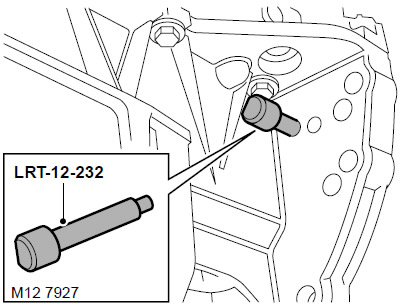
4. Rotate the crankshaft until the LRT-12-232 pin enters the oblong hole in the drive disk through the hole in the pan located at the edge of the pan.
CAUTION: Make sure that the pin enters the oblong hole. Do not use the arrow cast on the oil pump housing as an alignment mark. Do not remove the pin from the drive plate until the timing belts are installed.
5. Install the cylinder head gaskets.
ENGINE KV6 - MODIFICATION K, Piston group, Left cylinder head gasket.
ENGINE KV6 - MODIFICATION K, Piston group, Right cylinder head gasket.
Comments on this article