For body repairs, only genuine Land Rover body parts and repair materials (sealants, paint, etc.) approved for use by Land Rover may be used.
Genuine Land Rover body repair parts
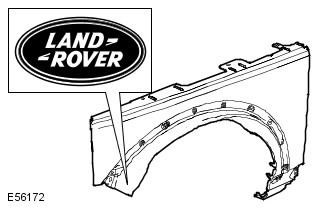
All Land Rover body repair parts are cathodically coated. Individual body parts are galvanized on one or both sides (in different areas depending on the vehicle model).
Together with the elastic paint coating, this guarantees optimum and high protection against corrosion caused by impacts from small objects such as gravel.
NOTE: Individual protective coatings (galvanising, cathodic coating) on Land Rover body components should, as far as possible, not be damaged or destroyed by sandblasting or other mechanical operations.
If hairline cracks appear in the area where body parts meet (e.g. around door hinges) after straightening, the corrosion protection must be restored to the level provided by the factory technology. If necessary, the paintwork must be completely restored. The same applies to straightening complex profiles (e.g. floor panels). If necessary, renew or refresh the paintwork, sealant rollers and underbody protection.
After repairs, all interior surfaces that will no longer be visible or accessible should be primed, and this should be done before applying cavity filler. The coating should be applied evenly to interior surfaces; to do this, you should carefully spray the entire cavity (twice, with intermediate drying).
If body panels are subjected to strong heating during repair, this inevitably leads to damage or even destruction of the structure of the corrosion protection material. If heating is used, the effectiveness of the cavity protection material is reduced. Therefore, reworking of damaged areas is mandatory.
Welds must be cleaned before applying anti-corrosion protection.
The corrosion protection measures that must be taken when replacing body parts are described on the following pages.
Comments on this article