car logo Ford
car logo Volkswagen
car logo BMW
car logo Opel
car logo Audi
car logo Toyota
car logo Peugeot
English Русский
Български
Беларускі
Український
Српски
Hrvatski
Română
Polski
Slovenský
Magyar


Main
Freelander
Discovery
Range Rover
Defender
Contacts
Articles

How the parking assistant works (Freelander 2)

 
  • Main
  • Freelander
  • Freelander 2
  • Electrical equipment
  • Assistance with parking
  • How the parking assistant works
 
        0  
When the parking assist module activates the system, to indicate that the system is operating, the switch LED turns on and a single beep sounds from the front and rear speakers. The parking assist module processes the signals received from the sensors to determine if there is an object within the sensor range.

In the combined mode, the sensors emit a series of ultrasonic pulses and then switch to the mode of receiving sound reflected from an obstacle within the radius of action. The received reflected signals are amplified and converted from analog to digital form in the sensor itself. The digital signal passes to the parking assistance module and is compared with the programmed data located in the module's EEPROM. The control module receives this data from the sensor via the signal transmission line and calculates the distance to the obstacle based on the time interval between the irradiation of the obstacle and the reception of the reflected signal. The pulse duration is determined by the module, which, using the sensor, controls the frequency of the output pulse.

In receiver mode, the sensor receives pulses emitted by neighboring sensors. The control module uses this information to accurately determine the position and distance to the obstacle.

If no obstacles are detected, no additional warning signals are emitted. If an obstacle is detected, repeated acoustic signals are emitted from the corresponding front or rear speakers. The interval between the signals decreases as the distance between the obstacle and the vehicle decreases. At a distance of approximately 250 mm, the acoustic signal becomes continuous.


If after the initial detection of an obstacle the distance between it and the vehicle does not decrease, the nature of the warning signal remains unchanged if the obstacle is detected by the central sensor, or the signal stops sounding after 3 seconds if the obstacle is detected by the corner sensor.

The audible signals stop when the vehicle is moved out of reverse gear. The module continues to monitor the distance and resumes the warning signals if a decrease in distance is detected.

The system is cancelled when the parking assist switch is pressed or the ignition is turned off. The system is also cancelled if the vehicle moves more than 50 m or the vehicle's forward speed exceeds 30 km/h.

The system can detect the connection of a trailer to the vehicle via a medium-speed CAN bus message from the trailer module. When the parking assistance module detects that a trailer is connected to the vehicle, the rear sensors are disabled to prevent continuous warnings due to the proximity of a trailer.

The parking assistance module also contains software that compensates for the effects of frost, ice or rain on the sensors. Ice compensation occurs if the outside temperature value received in the medium-speed CAN bus message from the instrument cluster is less than 6°C.

Distance calculation


NOTE: A = Intermittent warning sound; B = Continuous beep
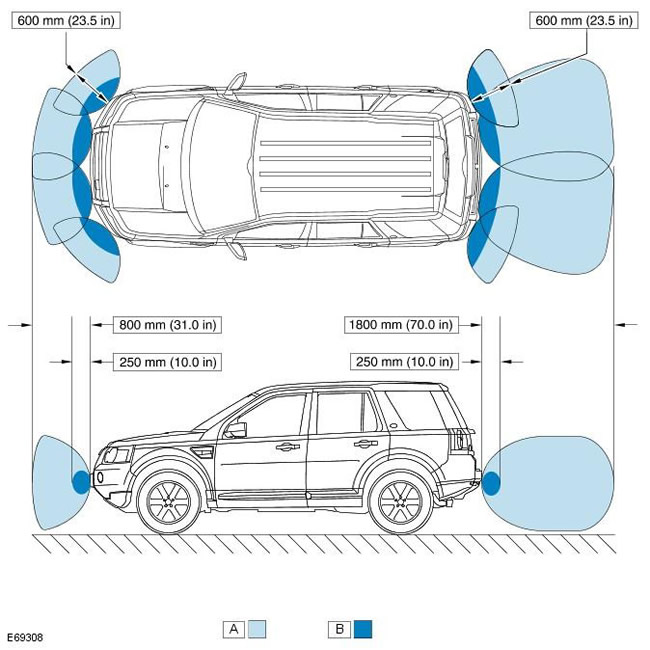

NOTE: A = Intermittent warning sound; B = Continuous beep


The maximum detection range for front sensors is 800 mm for center sensors and 600 mm for corner sensors.

The maximum detection range for rear sensors is 1800 mm for center sensors and 600 mm for corner sensors.


This article is available at russian, bulgarian, belarusian, ukrainian, serbian, croatian, romanian, polish, slovak, hungarian
Article review: Roman Mitrofanov


Previous articles
Parking Assistance Specification
Description and principle of operation
Parking assistance system module
Parking assistance system sensors
Parking assistance switch
Parking assistant control diagram

Current article
How the parking assistant works

Next articles
Inspection and verification
DTC Trouble Code Index
Front interior parking assistance sensor
Front exterior parking assistance sensor
Removal and installation the system module
Rear interior parking assistance sensor
Rear exterior parking assistance sensor


Similar articles from Land Rover repair manuals:
• How the parking brake works Discovery 3 (2004-2009)
• Parking brake indicator switch Discovery 1 (1989-1998)
• Adjusting the parking brake Range Rover 3 (2001-2012)
• Parking brake cable Defender 2007+ (2007-2016)

Comments on this article


No comments yet


How much will 48 + 31 =


Freelander 2 
  • General information
  • Using the manual
  • Repair technique
  • Precautionary measures
  • Road test
  • Fault codes
  • Identification codes
  • Jacking and lifting
  • Maintenance - Diesel
  • Maintenance - petrol
  • Chassis
  • Suspension
  • Front suspension
  • Rear suspension
  • Wheels and tires
  • Terrain response
  • Transmission system
  • Cardan shaft
  • Rear drive axle
  • Rear axle shafts
  • Front axle shafts
  • Brake system
  • Parking brake
  • Hydraulic brake
  • Brake booster
  • Anti-lock braking system
  • Exchange rate stability
  • Steering
  • Steering column
  • Power unit
  • Engine device
  • Engine repair
  • Description of the cooling system
  • Cooling system repair
  • Fuel supply
  • Drive units
  • Launch system
  • Ignition system
  • Exhaust toxicity
  • Air filtration
  • Fuel vapor control
  • Electronic control part
  • Automatic gearbox
  • Gearbox cooling
  • Automatic transmission controls
  • Mechanical transmission
  • Transfer case
  • Exhaust system
  • Fuel tank and lines
  • Speed control
  • Electrical equipment
  • Climate control system
  • Climate control
  • Additional climate control
  • Instrument panel
  • Sound signal
  • Information and messages
  • Assistance with parking
  • Battery and alternator
  • Information and entertainment
  • Outdoor Lighting
  • Interior lighting
  • Communication network
  • Wiring harnesses
  • Anti-theft system
  • Multifunctional modules
  • Body and coating
  • Body front panels
  • Lockable body parts
  • Interior trim
  • Rear view mirrors
  • Car seats
  • Glass, frames and mechanisms
  • Instrument panel and console
  • Handles, locks, latches
  • Windshield wipers and washers
  • Sunroof
  • Bumpers
  • Seat belt system
  • Restraint system
  • Body repairs
  • Front end repairs
  • Roof element repairs
  • Side panel repairs
  • Tailgate repairs
  • Subframe and mounts

Freelander 1 
  • General information
  • Using the manual
  • Precautionary measures
  • Technique
  • Specifications
  • Connection tightening torques
  • Maintenance
  • Power unit
  • Diesel engine Td4
  • Petrol engine K1.8
  • Piston group K1.8
  • KV6 petrol engine
  • Piston group KV6
  • Decreased toxicity
  • Motor control EDC
  • Engine management MEMS
  • Motor control Siemens
  • Fuel supply diesel Td4
  • Fuel supply for K1.8 engine
  • Fuel supply of KV6 engine
  • Cooling diesel Td4
  • Engine cooling K1.8
  • Engine cooling KV6
  • Exhaust system Td4
  • Exhaust system K1.8
  • Exhaust system KV6
  • Clutch
  • Mechanical transmission
  • Transfer case
  • Automatic gearbox
  • Chassis
  • Drive shafts
  • Rear axle and final drive
  • Steering
  • Front suspension
  • Rear suspension
  • Brake system
  • Body and coating
  • Passive safety
  • Doors, locks and glass
  • Exterior body parts
  • Interior trim details
  • Seats
  • Roof hatch
  • Roof
  • Body geometry
  • Body parts repair
  • Sealing and corrosion
  • Electrical equipment
  • Heating and ventilation
  • Air conditioning
  • Windshield wipers and washers
  • Starting engine and charging
  • Lighting and headlights
  • Control modules
  • Safety system
  • Window management
  • Entertainment systems
  • Wiring harnesses
  • Governing bodies
  • Devices


LRman.ru © 2013-2026 | Mobile version | Free Lander | Discovery | Range Rover | Defender | Contacts | | Sitemap |
Car repair and service instructions Land Rover: Freelander, Discovery, Range Rover, Defender
We use cookies to make pages load faster and provide a more user-friendly experience 🍪