car logo Ford
car logo Volkswagen
car logo BMW
car logo Opel
car logo Audi
car logo Toyota
car logo Peugeot
English Русский
Български
Беларускі
Український
Српски
Hrvatski
Română
Polski
Slovenský
Magyar


Main
Freelander
Discovery
Range Rover
Defender
Contacts
Articles

Reliability of the stop/start system (Freelander 2)

 
  • Main
  • Freelander
  • Freelander 2
  • Power unit
  • Launch system
  • Reliability of the stop/start system
 
        0  
Contents: Starter ⇩ Flywheel ring gear ⇩ Double flywheel ⇩ Battery pack with glass microfiber…⇩
The engine operating settings have been retained and in some cases improved to ensure that the engine switches off and on during the Stop/Start cycle almost imperceptibly for passengers.

To reduce engine vibration when the engine is turned off, a new throttle closing strategy has been implemented, allowing fuel injection to be reduced more smoothly and controllably. At the same time, the generator is turned off to reduce the load on the engine.

Changes to the ECM software and new engine calibration make engine shutdown even smoother. In addition, optimized engine mounting and tuning reduce vibration during startup.

Components directly involved in starting and stopping the engine have been upgraded or replaced to accommodate the increased number of shutdowns and starts over the life of the vehicle. This section describes these upgraded and longer lasting components.

CAUTION: To ensure correct operation of the automatic Stop/Start system, only use recommended parts when replacing components, as some components from previous vehicle models are compatible with the TD4_e.


Starter
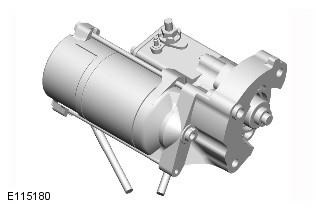

Starter

To increase reliability, taking into account the increased starting requirements, the starter has undergone the following modifications:


  • The seals have been modernized.
  • Wear-resistant contact material is used to reduce wear on the starter solenoid.
  • The drive gear is made of a stronger grade of steel.

Flywheel ring gear


Due to increased starting requirements, the flywheel ring gear is made from stronger steel with a 25% higher carbon content, increasing the strength of the unit.

Double flywheel


As in previous diesel models, a dual flywheel is installed, which allows for smoother operation when starting, stopping and running the engine at low speeds.

To ensure even smoother operation with increased stopping and starting requirements, a new friction disc has been developed for the TD4_e dual flywheel. The new friction disc, which can withstand seven times the pressure of a conventional disc, is made from polyetheretherketone (PEEK).

PEEK is a semi-crystalline thermoplastic that is resistant to organic and aqueous environments. It has a high melting point, making it resistant to thermal degradation. It is also one of the few plastics that can work in ultra-high vacuum. It is commonly used in bearings, piston parts, and pumps.

Battery pack with glass microfiber absorbent partitions
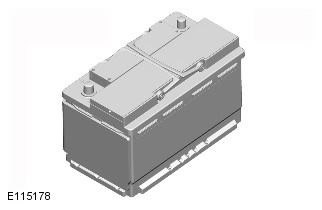

Battery pack with glass microfiber absorbent partitions


Conventional batteries lose their ability to hold a charge over time as the internal lead plates deteriorate during normal use due to constant vibration and erosion. The rate of aging depends on many factors, including charge and discharge cycles. Therefore, the high power consumption of the Stop/Start system negatively affects the service life of this type of battery.


To counteract the extended discharge and charge cycles of the Stop/Start system, a high-performance battery was developed using glass microfiber absorbent baffle technology, which helps reduce battery aging due to intensive use. The battery owes its success to the absorbent baffles, which are thin sheets of glass microfiber between lead plates. The glass absorbent baffle also absorbs battery acid, allowing for more efficient use of can space.

The glass absorbent partition ensures the correct functioning of the electrolyte and also creates mechanical support for the lead plates, reducing vibration and, accordingly, aging. This technology significantly increases the effective number of charge/discharge cycles of the battery. The battery also has an extremely low internal resistance, which ensures a faster reaction between the acid and the plate material.

The technology of batteries with glass absorbent partitions has the following advantages:
  • The battery remains completely sealed due to the absorption of the glass fibre plates.
  • Under freezing conditions, the expanding liquid cannot damage the plates because they are sealed with fiberglass gaskets; accordingly, there is almost no displacement of the plates.
  • Vibration and shock do not harm the battery.
  • Since the electrolyte is retained in the partitions, there is no need for battery maintenance.

The battery capacity is 80 Ah, meaning it can theoretically deliver 80 amps of current for one hour. During a typical engine start, a very large current is drawn for a fraction of a second, so it has little effect on the overall charge of the battery. Restarting the engine requires approximately 0.001% of the full charge of a new battery.


If a new battery is installed in the vehicle, the BMS (battery monitoring system) unit requires recalibration to take into account the increased battery capacity; this is done using Land Rover approved diagnostic equipment. If diagnostic equipment is not available, the BMS will automatically recalibrate, but this may take up to 48 hours depending on vehicle usage. The Stop/Start system will not function correctly until the BMS has been recalibrated.

If the BMS unit is replaced, it will be calibrated automatically; for more information, see the Battery Monitoring System section below.


This article is available at russian, bulgarian, belarusian, ukrainian, serbian, croatian, romanian, polish, slovak, hungarian
Article review: Roman Mitrofanov


Previous articles
Launch system specification
Description and principle of operation
Removal and installation the starter
Starter solenoid
Starter control module
Automatic stop/start system
Stop/Start System Information Panel

Current article
Reliability of the stop/start system

Next articles
Stop/Start System Control Circuit
Stop/Start System Technology
Stop interlocks, activators and start interlocks


Similar articles from Land Rover repair manuals:
• Fuel system hoses and clamps Discovery 3 (2004-2009)
• Safety precautions when working with the airbag system Range Rover 3 (2001-2012)
• Filling and bleeding the power steering system Defender 2007+ (2007-2016)

Comments on this article


No comments yet


How much will 50 + 39 =


Freelander 2 
  • General information
  • Using the manual
  • Repair technique
  • Precautionary measures
  • Road test
  • Fault codes
  • Identification codes
  • Jacking and lifting
  • Maintenance - Diesel
  • Maintenance - petrol
  • Chassis
  • Suspension
  • Front suspension
  • Rear suspension
  • Wheels and tires
  • Terrain response
  • Transmission system
  • Cardan shaft
  • Rear drive axle
  • Rear axle shafts
  • Front axle shafts
  • Brake system
  • Parking brake
  • Hydraulic brake
  • Brake booster
  • Anti-lock braking system
  • Exchange rate stability
  • Steering
  • Steering column
  • Power unit
  • Engine device
  • Engine repair
  • Description of the cooling system
  • Cooling system repair
  • Fuel supply
  • Drive units
  • Launch system
  • Ignition system
  • Exhaust toxicity
  • Air filtration
  • Fuel vapor control
  • Electronic control part
  • Automatic gearbox
  • Gearbox cooling
  • Automatic transmission controls
  • Mechanical transmission
  • Transfer case
  • Exhaust system
  • Fuel tank and lines
  • Speed control
  • Electrical equipment
  • Climate control system
  • Climate control
  • Additional climate control
  • Instrument panel
  • Sound signal
  • Information and messages
  • Assistance with parking
  • Battery and alternator
  • Information and entertainment
  • Outdoor Lighting
  • Interior lighting
  • Communication network
  • Wiring harnesses
  • Anti-theft system
  • Multifunctional modules
  • Body and coating
  • Body front panels
  • Lockable body parts
  • Interior trim
  • Rear view mirrors
  • Car seats
  • Glass, frames and mechanisms
  • Instrument panel and console
  • Handles, locks, latches
  • Windshield wipers and washers
  • Sunroof
  • Bumpers
  • Seat belt system
  • Restraint system
  • Body repairs
  • Front end repairs
  • Roof element repairs
  • Side panel repairs
  • Tailgate repairs
  • Subframe and mounts

Freelander 1 
  • General information
  • Using the manual
  • Precautionary measures
  • Technique
  • Specifications
  • Connection tightening torques
  • Maintenance
  • Power unit
  • Diesel engine Td4
  • Petrol engine K1.8
  • Piston group K1.8
  • KV6 petrol engine
  • Piston group KV6
  • Decreased toxicity
  • Motor control EDC
  • Engine management MEMS
  • Motor control Siemens
  • Fuel supply diesel Td4
  • Fuel supply for K1.8 engine
  • Fuel supply of KV6 engine
  • Cooling diesel Td4
  • Engine cooling K1.8
  • Engine cooling KV6
  • Exhaust system Td4
  • Exhaust system K1.8
  • Exhaust system KV6
  • Clutch
  • Mechanical transmission
  • Transfer case
  • Automatic gearbox
  • Chassis
  • Drive shafts
  • Rear axle and final drive
  • Steering
  • Front suspension
  • Rear suspension
  • Brake system
  • Body and coating
  • Passive safety
  • Doors, locks and glass
  • Exterior body parts
  • Interior trim details
  • Seats
  • Roof hatch
  • Roof
  • Body geometry
  • Body parts repair
  • Sealing and corrosion
  • Electrical equipment
  • Heating and ventilation
  • Air conditioning
  • Windshield wipers and washers
  • Starting engine and charging
  • Lighting and headlights
  • Control modules
  • Safety system
  • Window management
  • Entertainment systems
  • Wiring harnesses
  • Governing bodies
  • Devices


LRman.ru © 2013-2026 | Mobile version | Free Lander | Discovery | Range Rover | Defender | Contacts | | Sitemap |
Car repair and service instructions Land Rover: Freelander, Discovery, Range Rover, Defender
We use cookies to make pages load faster and provide a more user-friendly experience 🍪