Contents: Removal ⇩ Installation ⇩
Removal
1.
CAUTION: Never work on a vehicle supported only by a jack. Always support the vehicle with special stands.
Raise and support the vehicle.
2. Remove the left rear wheel.
3. Use T4 to release pressure from the air suspension. For more information, refer to Releasing and Raising Pressure in the Air Suspension System (60.50.38)
4.
CAUTION: Before disconnecting or disassembling parts, make sure the area around the contact surfaces is clean and dry. To avoid contamination of the system, plug all open connections.
CAUTION: Visually inspect the ends of the air line for damage or wear. Repair or replace the air line if necessary.
NOTE: Remember the position of the air lines.
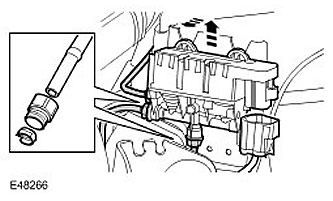
Disconnect the 3 air lines from the rear valve block.
5. Disconnect the electrical connector.
6. Remove the rear valve block. Release the three rubber valve block cushions.
7. Remove the Voss type fittings from the air lines. Remove and discard the cone bushings and couplings.
Installation
1.
NOTE: New air suspension components are supplied with Voss style nipples installed and already torqued to the correct value. If a new component is installed, it is not necessary to install new Voss style nipples.
Install new Voss type fittings to the rear valve block. Tighten the connection. (tightening torque 2.5 Nm).
2. Install the rear valve block.
- Secure the three rubber valve block cushions.
- Connect the electrical connector.
- Connect the air lines to the Voss type fittings.
- Pull on each air line to ensure it is securely seated in the Voss style fitting.
3. Use T4 to increase the pressure in the air suspension. For more information, refer to Releasing and Increasing the Pressure in the Air Suspension System (60.50.38)
4. Install the wheel. Tighten the wheel nuts. (tightening torque 140 Nm).
Comments on this article