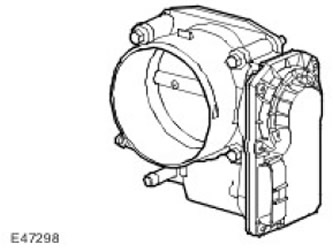
The throttle valve of the V8 engine management system is electronically controlled. The throttle pipe with the valve is located on the intake manifold in the engine compartment. The throttle control circuit consists of three main components:
- Throttle valve with electric drive and electronic control
- APP (accelerator pedal position sensor)
- ECM (engine control unit)
When the accelerator pedal is pressed, the control signals of the APP sensor change. (accelerator pedal position sensor). ECM (engine control unit) compares this change with the electronic data map and via PWM signals (pulse width modulation), proportional to the signals from the APP sensor (accelerator pedal position sensor), moves the throttle valve. The main purpose of the system is:
- Ensuring the supply of air in the quantity determined by the position of the accelerator pedal and the electronic data map.
- Control of driver commands for speed control.
- Automatic electronic throttle positioning for precise speed control.
- Control of the damper according to the requests of the driving stability control systems.
- Limiting the maximum speed and maximum crankshaft rotation frequency.
ECM Software (engine control unit) provides for calibration of the valve position in each ignition cycle. After the ignition is turned on, (oN position) ECM (engine control unit) performs self-diagnosis and calibration of the electronic throttle position by fully opening and fully closing it.
Throttle body connector pin table
| Contact No. | Purpose |
| 1 | - electric motor |
| 2 | + electric motor |
| 3 | Sensor mass |
| 4 | Sensor signal 2 |
| 5 | Sensor signal 1 |
| 6 | Power supply 5V |
[The original was published on the portal: LRman.ru]
Comments on this article