Front oxygen sensors
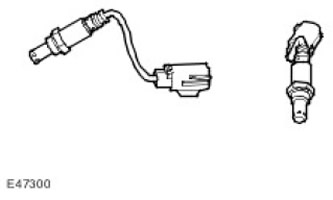
Rear oxygen sensors

Proper operation of oxygen sensors is possible only when heated to a high temperature. To achieve the required high temperatures, the sensors are equipped with PWM controlled heating elements (pulse width modulation) - signals transmitted by the ECM (the engine control unit) . The heating elements begin to work immediately after starting the engine. They also operate at low loads, when the temperature of the exhaust gases is insufficient to heat the sensors. Failure of the heater leads to an increase in the duration of the period of preparation of the sensor for operation, which delays the transition to a closed control loop and increases the release of toxic substances. PWM duty cycle (pulse width modulation) - The signals are continuously monitored to prevent thermal shock of cold sensors.
Universal heated oxygen sensors (UHEGO) have a characteristic close to linear and form a constant voltage signal with a variable current strength proportional to the oxygen content in the exhaust gas. This makes it possible to realize closed-loop control (with feedback) the composition of the working mixture, for example, in the engine warm-up mode (after warming up the oxygen sensor to readiness level). This allows more precise regulation of the release of toxic products.
Heated (not universal) oxygen sensors (HEGO) form the output voltage, which depends on the ratio of oxygen concentrations in the exhaust gas and in the atmosphere. The sensor is a galvanic cell enclosed in a porous ceramic jacket. The voltage generated by the ceramic element depends on the oxygen diffusing through the jacket. Rated voltage at stoichiometric composition of the mixture (l =1) ranges from 300 to 500 mV. When the mixture gets richer (l<1) voltage rises to 900 mV when leaner (l>1) - drops to 0 V. The sensor tip withstands heating up to 1000 degrees Celsius for no more than 100 hours.
With an increase in vehicle mileage, the sensor ages, which increases the response time when switching from a rich mixture to a lean one, and vice versa. Increased response time affects ECM closed loop operation (the engine control unit) and leads to a gradual increase in exhaust toxicity. Measurement of the response time to the transition of the composition of the mixture through the unit is used to diagnose the condition of the front sensors.
Diagnostics of the electrical circuits of the front and rear oxygen sensors is carried out continuously. Diagnostics is carried out by comparing the maximum and minimum threshold signs of open and short circuits.
Oxygen sensors require the utmost care both before and during installation. The ceramic parts of the sensor may crack if dropped, hit on the sensor, or over-torqued. The sensors should be tightened with a proven torque wrench, the tightening torque is 40-50 Nm. Protect the sensor tip from contamination with anti-seize lubricant applied to the threaded part of the sensor. A conventional oxygen sensor has tin-plated contacts, while a universal one has gold-plated contacts. Swapping sensors in places will lead to contamination of the contacts and disruption of the system.
Failure modes
- Mechanical damage to the sensor and incorrect installation.
- Open circuit/sensor disconnected.
- Short to power or ground.
- The composition of the mixture is outside the operating range.
- Sensors of a number of A and B cylinders are crossed (reversed connectors).
- Pollution («poisoning») sensor from the use of leaded fuel or for other reasons.
- Changing the characteristics of the sensor.
- Damaged wiring harness.
- Air leak into the exhaust system.
Symptoms
- Switching by default to the control of fuel supply to the cylinders of a certain row without feedback
- High CO content.
- Strong smell of hydrogen sulfide (rotten egg smell) before switching to default mode.
- Increased release of toxic substances.
Comments on this article