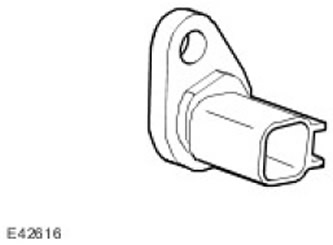
CKP sensor (crankshaft position) is located on top of the gearbox housing, slightly to the left of the centerline, with the tip of the sensor adjacent to the flywheel rim. This sensor is a magnetoelectric sensor with a resistance of 1100 Ohm +- 150 Ohm.
The sensor generates a signal that allows the ECM (engine control unit) determine the angular position of the crankshaft and its rotation speed. The position of the crankshaft determines the ignition timing, fuel injection timing, etc. If the signal circuit wires are swapped, the ignition timing will increase by 3° because the ECM (engine control unit) uses the trailing edge of the signal for each tooth to count.
The sensor generates its signal using a magnetic ring obtained by machining the diameter of the drive disk. The magnetic ring has 36 teeth, 3° wide, spaced at 10° intervals. One tooth is missing, providing a reference point at 60 degrees before TDC of cylinder No.1.
When the magnetic flux changes due to the teeth passing in front of the sensor, the sensor generates a voltage signal. The output voltage changes depending on the speed of the teeth passing the sensor. The higher the engine speed, the higher the sensor output voltage.
ECM (engine control unit) transmits engine crankshaft speed data via CAN bus (local area network of controllers).
If the CKP sensor malfunctions while the engine is running (crankshaft position), the engine will stall, run rough or misfire, and a corresponding fault code will be stored. If the fault occurs before the engine starts, the engine will not start.
Comments on this article