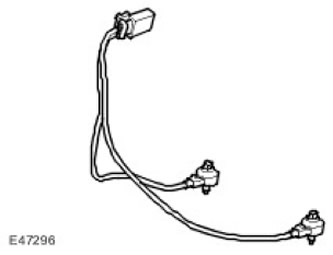
The EMS V8 includes two knock sensors (one per cylinder bank), which are located in the cylinder block collapse. The sensors are connected to the ECM (engine control unit) using twisted pair wires.
Knock sensors generate a voltage signal proportional to the level of mechanical vibration that occurs at the moment of ignition. Each sensor monitors detonation in its own bank of cylinders.
The sensitive element of the knock sensor is a piezoelectric element. When the piezoelectric element is deformed under the influence of external forces, a potential difference arises on it. The piezoelectric element is affected by the force of mechanical vibrations in the material of the cylinder block, which occur during combustion of the fuel-air mixture in the cylinders of the running engine. The signals from the knock sensors are sent to the ECM (engine control unit), where they are compared with the map data stored in memory. Based on the comparison, the ECM (engine control unit) detects the presence of detonation in each individual cylinder. When detonation is detected, the ECM (engine control unit) reduces the ignition timing for several working cycles and then gradually returns to the original value.
Knock sensors require constant careful handling, especially when removing and installing them. The requirements for surface preparation and tightening torque must be strictly observed. The tightening torque and the quality of the sensor socket preparation significantly affect the conductivity of sound waves from the cylinders to the piezoelectric element.
In combination with signals from the ECM camshaft position sensors (engine control unit) uses signals from knock sensors to determine the optimum ignition timing for each engine cylinder. Ignition timing is selected from data maps stored in the ECM (engine control unit). Default ECM (engine control unit) uses ignition data maps for premium fuel with an octane rating (RON) of 98. Once tuned, the engine can also operate on regular fuel with an octane rating of 91. If only low-grade fuel is available, or the owner decides to switch from high-grade to low-grade gasoline, then pre-ignition symptoms will be observed for a short period of time. Such short-term operation with pre-ignition will not damage the engine. Pre-ignition symptoms will be observed for the period required by the ECM (engine control unit) to train and correct data maps to compensate for changes in fuel quality. This property is called adaptation. The ECM (engine control unit) is capable of adapting its output fuel and ignition system control signals in accordance with input signals from multiple sensors.
If the signal from any of the knock sensors becomes undefined, the ECM (engine control unit) stops using feedback in control (switches to open loop control). Under such circumstances eCm (engine control unit) by default switches to using the data card (adjustment characteristics of the ignition system) from its own memory. This measure protects the engine from damage when switching to low-grade fuel. The malfunction indicator lamp (MIL) does not turn on, but the driver may hear a characteristic "knock" of the engine and notice a decrease in engine power and smoothness of its operation under certain driving conditions.
Simultaneously with recording of the ECM knock sensor fault code (engine control unit) records engine parameters at the time the fault code is registered: crankshaft speed, engine load and coolant temperature.
Comments on this article