Contents: Boost pressure regulation ⇩ Fuel Pressure Control Valve (PCV) ⇩ Fuel supply control valve ⇩
Boost pressure regulation
The boost pressure sensor is located in the intake tract behind the throttle body. The sensor sends information to the ECM (engine control unit) voltage signal corresponding to the pressure in the intake manifold. The BP sensor has a three-pin connector that is connected to the eCm (engine control unit). It supplies the 5V reference signal from the eCm. (engine control unit), signal to ECM (engine control unit) and the sensor is connected to ground.
A diaphragm type sensor is used to measure the boost pressure. ECM (engine control unit) uses the BP sensor signal for the following functions:
- Maintaining boost pressure in the intake manifold.
- Reduces exhaust smoke when driving at high altitudes.
- EGR system control (exhaust gas recirculation systems).
- Vacuum control unit control.
If the BP sensor is faulty, the ECM (engine control unit) uses a default pressure value of 1013 mbar. A failure of the boost pressure sensor may be accompanied by the following symptoms:
- The altitude corrector does not work (black smoke on the exhaust)
- Boost pressure control not working
(The publication was copied from a web resource: www.lrman.ru)
The boost pressure is regulated by a gearless electric drive. The electric drive is located on the side of the turbocharger and is connected by rods to the guide vanes. It uses a servomotor and has a built-in controller.
The electric drive can rotate the blades at an angle of 60 degrees and remember the extreme positions. The electric drive is controlled by PWM signals. (pulse width modulation), which are transmitted by the ECM (engine control unit). For more information, please visit Turbocharger (303-04D Fuel Charging and Controls - Turbocharger - 2.7L Diesel)
Fuel Pressure Control Valve (PCV)
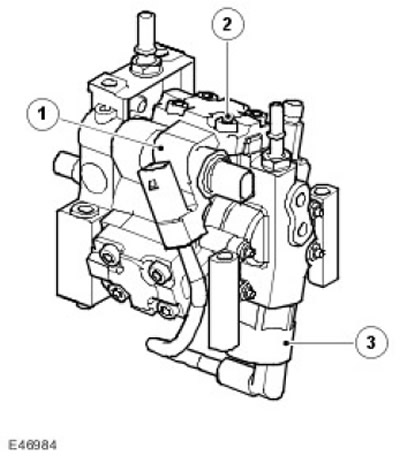
| Item name | Spare part catalog number | Description |
| 1 | - | Fuel supply control valve |
| 2 | - | High pressure fuel pump |
| 3 | - | Fuel Rail Pressure Regulator |
The fuel rail pressure regulator is built into the high-pressure fuel pump. It regulates the fuel pressure in the fuel rail and is controlled by the ECM. (engine control unit) The regulator is a PWM electromagnetic valve. (pulse width modulation) -management.
When the solenoid is de-energized, the internal spring closes the valve. When the fuel pressure equals or exceeds 100 bar, the spring force is overcome and the fuel creating the excess pressure is released into the return line. When the pressure drops to approximately 100 bar or less, the spring force, having overcome the fuel pressure, closes the valve. When the ECM (engine control unit) activates the electromagnetic valve, the valve closes, allowing the fuel pressure to rise. The pressure in the fuel rail in this state can reach approximately 1300 bar.
ECM (engine control unit) regulates the fuel pressure in the fuel rail by controlling the electromagnetic valve using PWM (pulse width modulation) -signal. By changing the duty cycle of the PWM (pulse width modulation) -signal, ECM (engine control unit) can precisely regulate the fuel pressure in the fuel rail supplied to the injectors in accordance with the engine load. This is achieved by changing the throughput of the valve, which regulates the pressure in the high-pressure circuit, changing the amount of fuel released from the rail into the return line.
The fuel rail pressure regulator receives PWM (pulse width modulation) -signal from ECM (engine control unit), changing in the range of 0-12 V. ECM (engine control unit) controls the operation of the regulator using the following information to determine the required fuel pressure:
- Fuel pressure in the fuel rail
- Engine load
- Accelerator pedal position
- Coolant temperature
- Engine crankshaft speed
If the fuel pressure regulator fails completely, the engine will not start.
In case of partial failure of the fuel rail pressure regulator ECM (engine control unit) actuates the electromagnetic valve via a minimum duty cycle signal, thereby limiting the injection volume.
Fuel supply control valve
The fuel control valve is built into the high-pressure fuel pump. The VCV valve bleeds excess fuel back into the fuel tank. (or in the low pressure circuit), or directs to the PCV. Bleeding off excess fuel allows avoiding the high-pressure pump wasting power on unnecessary compression of fuel in the rail and the associated heating of the fuel.
Comments on this article