Generator
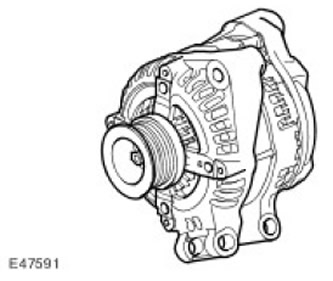
The generator has a multifunctional charging voltage regulator (14 V) and a rectifier based on zener diodes.
ECM (engine control unit) controls the electrical system load by PWM (pulse width modulation) -signals and and regulates the generator output power in accordance with the specified load. In addition, the ECM (engine control unit) monitors the battery temperature to determine the generator regulator setting. This parameter is needed to protect the battery from damage. At low battery temperatures, its charging ability is extremely low, and to compensate for this circumstance, it is necessary to increase the charging voltage as much as possible, but at high temperatures, the charging voltage must be reduced to prevent excessive gas formation and, as a result, loss of water from the electrolyte. For more information, contact Generator (414-02C Generator and Regulator - 2.7L Diesel)
The alternator circuit contains intelligent controls that reduce the load on the alternator when there is a need to maximize engine torque for other purposes. This control uses three signals to the ECM (engine control unit):
- Generator Sensor A measures voltage at the CJB (central mounting box).
- The Generator Data Transfer (Alt Com) system transmits the generator voltage setpoint from the ECM (engine control unit) into the generator.
- The generator status sensor (Alt Mon) transmits to the ECM (engine control unit) the current value in the generator load circuit. By means of the same signal in the ECM (engine control unit) data on faults is sent, resulting in the CAN bus (local area network of controllers) a request to turn on the charging indicator lamp is sent to the instrument panel.
Central mounting box
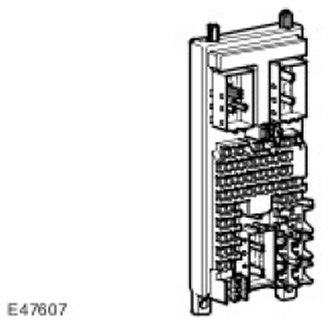
CJB (central mounting box) initiates power on and off programs in the ECM (engine control unit). When the ignition switch is turned to the ON position, 12 V is supplied to the ignition switch status sensor. The ECM then (engine control unit) starts power up routines and turns on the ECM power relay (engine control unit); power is supplied to the ECM (engine control unit) and devices of the systems associated with it. After turning off the ignition (oFF position) ECM (engine control unit) maintains power for 20 seconds while performing a shutdown procedure, then turns off the ECM power relay (engine control unit).
Terrain Response System
Road Condition Adaptation System (Terrain Response) allows the driver to select a program that adjusts traction and driving dynamics to suit prevailing road conditions.
[Original version of the article on the website: www.lrman.ru]
Part of the road adaptation system are various maps (algorithms) of throttle valve movement corresponding to different modes of the Terrain Response system. The extreme cases of these algorithms are the sand driving algorithm (rapid increase in torque when pressing the pedal) and movement on grass/gravel/snow (smooth torque build-up).
For the V8 engine management system with a positive displacement supercharger, the throttle response is selected to use a fixed duration of time for the transition from one data map to another. At one pedal position, the transition from one map (algorithm) to another occurs in a fixed period of time. This means that the transition from map to map (different grip conditions) will take the same amount of time. In this case, the change in torque (difference in torque for one pedal position in different algorithms) may be small or large. In the first case, reduced vehicle dynamics are selected, in the second - a more dynamic mode. The resulting acceleration of the car will depend on the difference in torque in the two algorithms and on the selected gears and ranges. The worst case transition is adjusted so that when using gasoline of different quality, the user does not lose the feeling of the car. For more information, see Ride and Handling Optimization (204-06 Ride and Handling Optimization)
Comments on this article