Contents: Vehicle status indication ⇩ Central locking ⇩ Inertia switch ⇩ Carrier frequency of radio signals ⇩ Remote control ⇩ Power supply replacement ⇩ Location of anti-theft system…⇩ Checking the operation of the…⇩
The anti-theft system is only needed to protect against unauthorized opening of doors and hood. The system is controlled by a key that is turned in a specific sequence. The time allotted for opening or closing the door is less than 5 seconds, otherwise a sound signal is heard and the key is blocked. At the same time, the engine starting system is blocked and the emergency stop indicators are turned on.
The anti-theft system includes a "volume sensor" based on the principle of ultrasound. The sensor is triggered when any object moves inside the car while the anti-theft system is activated.
Note: When the system is triggered by the volume sensor, it cannot be turned off by turning the key.
Vehicle status indication
The vehicle's condition is indicated by three devices: (a) a sound signal, (b) an emergency stop signal, (c) an LED on the front panel.
Setting the car to security mode is indicated by rare flashes of the LED; when disarming the car, the LED flashes once and goes out; if not, the car is not disarmed. Activation of the volume sensor is indicated by long periods of LED lighting.
Central locking
The central lock is controlled by a control unit and is activated by a key or remote control. Central locking is installed only on the driver and passenger doors.
Inertia switch
The inertia switch turns off the ignition after a vehicle collision. The control unit sends a signal to open the central lock and turn on the emergency stop signals.
Carrier frequency of radio signals
Depending on the market, four carrier frequencies are used. The control unit and control panel are color coded.
Without an active antenna, the system's performance deteriorates.
| Frequency (MHz) | Color of control unit/remote control | Region |
| 433.92 | blue/black | UK, Ireland |
| 224.5 | yellow/yellow | France |
| 433.92 | blue/red | Germany |
| 433.92 | blue/blue | Europe (except France, Switzerland, Italy, Denmark and Germany) |
| 433.92 | white/blue | Switzerland, Denmark |
| 315.0 | green/green | Rest of the world, Italy and Australia |
| 315.0 | orange/green | The Persian Gulf countries and Japan |
Remote control
When you press the remote control button once, the remote control LED will light up once. The remote control has a system of random change of control codes. The code for disarming the car changes after each press of the remote control button. If the remote control button is pressed more than 4 times in a row from a distance of more than 6 meters or after the remote control power is turned off, it is necessary to synchronize the operation of the remote control and the control unit by pressing the remote control button three times within 5 seconds.
Note: If both remote controls are lost or broken, and the vehicle is armed, both remote controls and the control unit must be replaced.
Power supply replacement
If the LED on the remote control lights continuously when you press the button once, the remote control parts need to be replaced. An additional sign of a weak signal is the hazard warning lights flashing once for three seconds instead of three times.
Location of anti-theft system components
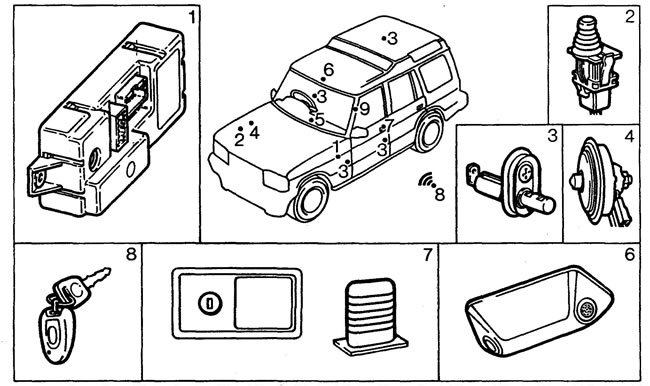
1 - control unit and relay - in the passenger compartment, 2 - switch (hood) - on the right in the engine compartment, 3 - switch (doors) - in the door pillars, 4 - horn - in the engine compartment, 5 - LED - on the front panel, 6 - ultrasonic sensor unit - ceiling panel, 7 - door lock buttons, 8 - remote control (then the remote control), 9 - antenna - stand on the passenger side.
Checking the operation of the anti-theft system
1. Turn off the ignition, open the doors, close the hood.
2. Complete steps 3-7 in 8 seconds.
3. Open the hood lock.
4. Turn on the ignition.
5. Close the doors.
6. Turn off the ignition.
7. Turn on the ignition.
If the system is operational, a beep sounds and the LED starts flashing.
The material was taken from a website: lrman.ru
8. Open and close any door - the LED will flash.
9. Close the hood - the LED will flash.
10. Check that it is not possible to start the engine; do not turn the key until the ignition is turned off.
11. Check that the volume sensor is turned on from the remote control - the LED will flash for 5 seconds and will continue to blink if there is someone in the car.
12. Turn off the ignition or press the button on the remote control - a sound signal will indicate the end of the test.
Comments on this article