Checking the charging system
1. Check the battery charge level (voltage at the terminals is not less than 12.6 V), charge if necessary.
2. Check the condition of the generator drive belt.
3. Check the condition of the battery terminals and the reliability of the cable connections.
4. Check the reliability of the generator wire connections.
5. Make sure that there is no water on the battery (for example, from under the hood).
6. Connect the diagnostic equipment according to the manufacturer's instructions.
7. Start the engine and bring it up to 3000 rpm. All electrical loads must be turned off.
8. Rotate the rheostat knob until the voltage drops to 12 V. The current strength should correspond to the generator's data sheet minus 10%.
9. At 3000 rpm, set the diagnostic equipment selector to the voltage regulator test mode: the output voltage should be 13.6-14.4 V.
10. Set the diagnostic equipment selector to the rectifier test mode, turn on the headlights. Bring the engine to 3000 rpm: the voltmeter needle of the diagnostic equipment should be in the OK zone (normal).
Check on the car
1. Connect the voltmeter to the "B+" terminal of the generator and the "+" terminal of the battery.
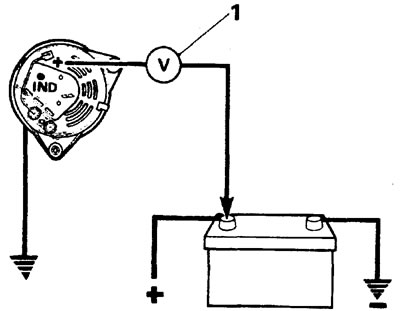
2. Turn on the headlights, start the engine. Bring the engine to 3000 rpm and record the voltmeter readings.
3. Connect the voltmeter to the generator body and the battery, record the voltmeter readings.
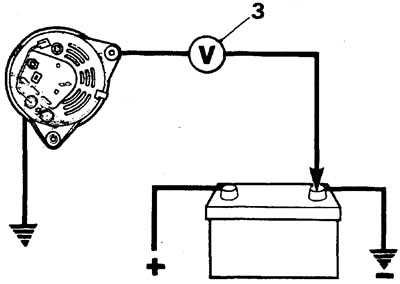
4. If the voltage on the positive side is greater than 0.5 V, and on the negative side it is greater than 0.25 V, there is increased resistance in the charging system, and the fault must be found and corrected.
Comments on this article