car logo Ford
car logo Volkswagen
car logo BMW
car logo Opel
car logo Audi
car logo Toyota
car logo Peugeot
English Русский
Български
Беларускі
Український
Српски
Hrvatski
Română
Polski
Slovenský
Magyar


Main
Freelander
Discovery
Range Rover
Defender
Contacts
Articles

Valve block (Freelander 2)

 
  • Main
  • Freelander
  • Freelander 2
  • Power unit
  • Automatic gearbox
  • Valve block
 
        0  
Contents: Solenoid valves ⇩ Speed sensors ⇩ Transmission Fluid Temperature Sensor ⇩
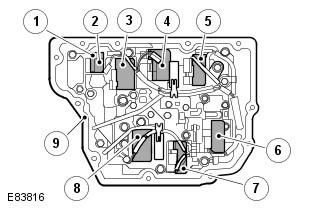
The valve block is located vertically at the front of the main transmission housing, under a sealed cover. The valve block contains the solenoids, dampers and spool valves that control the operation of the transmission. The solenoids are controlled by the TCM, providing gear shifting and smooth transitions between ranges.

Solenoid valves


Solenoid valves


Pos.Spare part numberName
1-3-way solenoid valve - S1
2-3-way solenoid valve - S2
3-Solenoid valve for line pressure control - SLT
4-Shift Control Solenoid Valve - SLC2
5-Shift Control Solenoid Valve - SLC1
6-Solenoid valve for lock control - SLU
7-Shift Control Solenoid Valve - SLC3
8-Solenoid valve for switching control - SLB1
9-Valve block

Shift Control Solenoid Valves - SLC1, SLC2, SLC3, SLB1


The shift control solenoids (SLC1, SLC2, SLC3 and SLB1) are mounted on the front valve body. The solenoids respond to input signals from the TCM and control the hydraulic pressure supplied to the clutches (C1, C2 and C3) and brake B1 to ensure smooth shifting. The TCM uses these solenoids individually or in combination to provide shifting from 1st to 6th gear.


If the solenoid valve fails, the TCM interrupts the current supply to the shift control solenoid valves and, to prevent damage, the transmission goes into emergency mode.

Solenoid valve for line pressure control - SLT


See the source on the website [LRMAN.ru]
The line pressure control solenoid (SLT) is mounted on the front valve body. The solenoid is controlled linearly by the TCM, which uses throttle position signals and engine torque information from the Engine Control Module (ECM) to calculate solenoid valve operation parameters. The solenoid controls line pressure supplied to the clutches and brakes to ensure smooth shifting.

If the solenoid valve fails, the TCM will stop supplying current to it. Maximum pressure will be supplied to the clutches and brakes, unless the failure is caused by a stuck solenoid valve, which can cause low pressure in the line.

Solenoid valve for lock control - SLU


The lock-up control solenoid valve is mounted on the front valve body. The solenoid valve is controlled linearly by the TCM, which uses engine speed, throttle opening degree, and transmission speed sensor signals to calculate solenoid valve operation parameters. The solenoid valve controls the degree of lock-up or slippage required by the torque converter lock-up clutch.

If the solenoid valve fails, the TCM stops supplying current to it, which results in the torque converter not locking up.

3-way solenoid valve - S1, S2


The 3-way solenoid valve (S1) is located on the center valve body and the solenoid valve (S2) is located on the front valve body. The solenoids are two-position solenoids controlled by the TCM. The combination of the 2 solenoids is used to either control engine braking in 1st gear or to shift gears.


If a solenoid valve fails, the TCM stops supplying current to both solenoid valves.

Speed sensors

Speed sensors


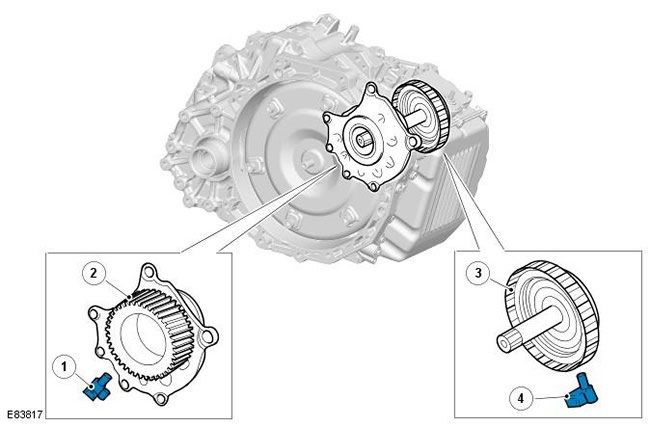
Pos.Spare part numberName
1-Speed sensor (SP) - output shaft speed
2-Reverse pinion gear
3-Clutch drum C2
4-Speed sensor (NIN)

The transmission uses two speed sensors (NIN and SP) located in the transmission case. The speed sensor (SP) is located near the reverse pinion gear and reads the gear teeth to generate an output signal indicating the output shaft speed. The speed sensor (NIN) is located near the clutch drum "C" and reads the teeth on the outer circumference of the drum to generate an output signal indicating the input shaft speed. Both speed signals are received by the TCM, which uses the two signals to calculate engine output torque, shift timing, and torque converter lockup.

Transmission Fluid Temperature Sensor


The transmission fluid temperature sensor is located on the internal wiring harness in the transmission. It detects the temperature of the transmission fluid in the hydraulic pressure control circuit and transmits a temperature-related signal to the TCM. The TCM monitors the temperature and ensures smooth gear shifting over a wide temperature range.


This article is available at russian, bulgarian, belarusian, ukrainian, serbian, croatian, romanian, polish, slovak, hungarian
Article review: Roman Mitrofanov


Previous articles
Automatic transmission specification
Elements arrangement and description
Transmission
Torque converter

Current article
Valve block

Next articles
Drive couplings
Planetary gear
Power flows
Transmission Control Module (TCM)
Control chart
Instrument panel
Control Area Network (CAN)
Driving modes


Similar articles from Land Rover repair manuals:
• Receiver valve block Discovery 3 (2004-2009)
• Oil temperature control valve (thermostat) Discovery 1 (1989-1998)
• Automatic transmission valve block Range Rover 3 (2001-2012)
• Brake pressure control valve Defender 2007+ (2007-2016)

Comments on this article


No comments yet


How much will 21 + 17 =


Freelander 2 
  • General information
  • Using the manual
  • Repair technique
  • Precautionary measures
  • Road test
  • Fault codes
  • Identification codes
  • Jacking and lifting
  • Maintenance - Diesel
  • Maintenance - petrol
  • Chassis
  • Suspension
  • Front suspension
  • Rear suspension
  • Wheels and tires
  • Terrain response
  • Transmission system
  • Cardan shaft
  • Rear drive axle
  • Rear axle shafts
  • Front axle shafts
  • Brake system
  • Parking brake
  • Hydraulic brake
  • Brake booster
  • Anti-lock braking system
  • Exchange rate stability
  • Steering
  • Steering column
  • Power unit
  • Engine device
  • Engine repair
  • Description of the cooling system
  • Cooling system repair
  • Fuel supply
  • Drive units
  • Launch system
  • Ignition system
  • Exhaust toxicity
  • Air filtration
  • Fuel vapor control
  • Electronic control part
  • Automatic gearbox
  • Gearbox cooling
  • Automatic transmission controls
  • Mechanical transmission
  • Transfer case
  • Exhaust system
  • Fuel tank and lines
  • Speed control
  • Electrical equipment
  • Climate control system
  • Climate control
  • Additional climate control
  • Instrument panel
  • Sound signal
  • Information and messages
  • Assistance with parking
  • Battery and alternator
  • Information and entertainment
  • Outdoor Lighting
  • Interior lighting
  • Communication network
  • Wiring harnesses
  • Anti-theft system
  • Multifunctional modules
  • Body and coating
  • Body front panels
  • Lockable body parts
  • Interior trim
  • Rear view mirrors
  • Car seats
  • Glass, frames and mechanisms
  • Instrument panel and console
  • Handles, locks, latches
  • Windshield wipers and washers
  • Sunroof
  • Bumpers
  • Seat belt system
  • Restraint system
  • Body repairs
  • Front end repairs
  • Roof element repairs
  • Side panel repairs
  • Tailgate repairs
  • Subframe and mounts

Freelander 1 
  • General information
  • Using the manual
  • Precautionary measures
  • Technique
  • Specifications
  • Connection tightening torques
  • Maintenance
  • Power unit
  • Diesel engine Td4
  • Petrol engine K1.8
  • Piston group K1.8
  • KV6 petrol engine
  • Piston group KV6
  • Decreased toxicity
  • Motor control EDC
  • Engine management MEMS
  • Motor control Siemens
  • Fuel supply diesel Td4
  • Fuel supply for K1.8 engine
  • Fuel supply of KV6 engine
  • Cooling diesel Td4
  • Engine cooling K1.8
  • Engine cooling KV6
  • Exhaust system Td4
  • Exhaust system K1.8
  • Exhaust system KV6
  • Clutch
  • Mechanical transmission
  • Transfer case
  • Automatic gearbox
  • Chassis
  • Drive shafts
  • Rear axle and final drive
  • Steering
  • Front suspension
  • Rear suspension
  • Brake system
  • Body and coating
  • Passive safety
  • Doors, locks and glass
  • Exterior body parts
  • Interior trim details
  • Seats
  • Roof hatch
  • Roof
  • Body geometry
  • Body parts repair
  • Sealing and corrosion
  • Electrical equipment
  • Heating and ventilation
  • Air conditioning
  • Windshield wipers and washers
  • Starting engine and charging
  • Lighting and headlights
  • Control modules
  • Safety system
  • Window management
  • Entertainment systems
  • Wiring harnesses
  • Governing bodies
  • Devices


LRman.ru © 2013-2026 | Mobile version | Free Lander | Discovery | Range Rover | Defender | Contacts | | Sitemap |
Car repair and service instructions Land Rover: Freelander, Discovery, Range Rover, Defender
We use cookies to make pages load faster and provide a more user-friendly experience 🍪