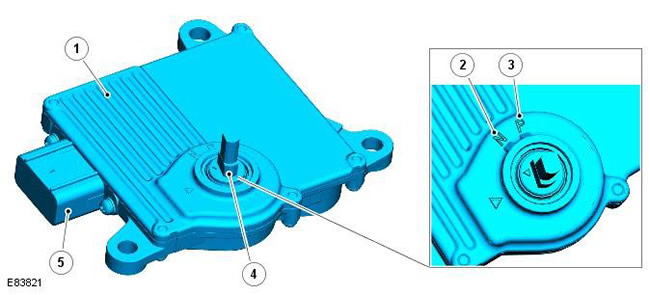
| Pos. | Spare part number | Name |
| 1 | - | TCM |
| 2 | - | Neutral position "N" |
| 3 | - | Parking position "P" |
| 4 | - | Position sensor/mechanical shaft |
| 5 | - | Electrical connector |
The TCM is located on the top of the transmission case and is connected to the high-speed CAN bus to exchange information with other vehicle systems.
The TCM generates output signals to activate the transmission solenoid valves designed to control the hydraulic operation of the transmission.
Engine control data is transmitted to the ECM via the high-speed CAN bus. To effectively control the transmission, the TCM requires engine data such as crankshaft torque, crankshaft speed, accelerator pedal angle, engine temperature, etc.
The TCM processes signals from the transmission temperature and speed sensors, the ECM and other vehicle systems. Based on the signals received and the data stored in memory, the module calculates the required gear, torque converter clutch operating mode and optimum pressure values for gear shifting and torque converter clutch control.
The steering angle sensor and ABS module also transmit data to the TCM via the high-speed CAN bus. The TCM uses this data to suspend gear shifts during cornering and when the anti-lock brake system (ABS) module controls braking or regulates traction.
The TCM is located above a mechanical shaft that projects through an oil seal on the top surface of the main case. The shaft is located in the rotation position sensor and rotates the sensor in the desired direction when commanded by the gear selector lever. The rotation position sensor is a Hall sensor that outputs a specific voltage in accordance with the selected position of the selector lever.
The selector lever is connected to the automatic transmission and the rotary position sensor via a Bowden cable. The movement of the selector lever is transmitted via the Bowden cable to the position sensor, which informs the TCM of the selected position (P, R, N or D). The selection of sport or manual mode is communicated to the TCM via the LIN bus by the Sport/Manual +/- "CommandShift™" switch. The TCM sends the corresponding information via the high-speed CAN bus to the instrument cluster, which displays the selected range information on the information center display.
If the TCM or transmission requires replacement, a setup procedure must be performed using a Land Rover approved diagnostic system to ensure that the new TCM learns the transmission neutral position. The TCM uses the neutral position as a reference point for each of the P, R, N and D positions.
Comments on this article