Contents: Dismantling ⇩ Installation ⇩
Dismantling
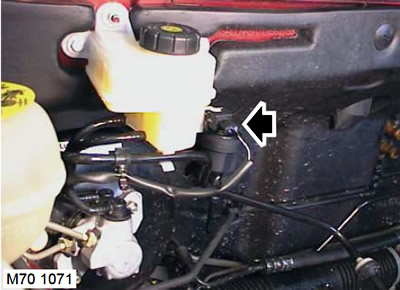
1. Disconnect the brake fluid level sensor multi-pin electrical connector.
2. Disconnect the vacuum tube of the vacuum booster from the intake manifold and release it from its mount on the master brake cylinder.
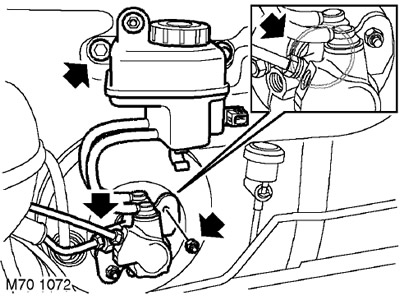
3. Place a cloth under the brake master cylinder to prevent brake fluid from splashing.
CAUTION: Brake fluid can damage paintwork. If brake fluid comes into contact with painted surfaces, remove any traces of the fluid immediately and rinse the area with water.
4. Disconnect the auxiliary brake circuit line coupling from the master cylinder.
5. Disconnect the main brake circuit line coupling from the master cylinder.
CAUTION: Always plug the fittings and holes to protect the system from dirt.
6. Unscrew the nut and 2 bolts securing the master brake cylinder reservoir.
7. Unscrew and remove the two nuts securing the master brake cylinder to the vacuum booster and remove the master cylinder.
8. Remove and discard the sealing ring.
Installation
1. Clean the mating surfaces of the master cylinder and vacuum booster.
2. Install a new O-ring onto the master cylinder.
3. Align the push rod with the master cylinder and install the cylinder onto the vacuum booster.
4. Install new nuts and tighten them to 25 Nm.
5. Install the reservoir on the master cylinder, tighten the nut and bolts and tighten them to a torque of 6 Nm.
6. Clean the brake line connections and line ends.
[The article was taken from this resource: www.lrman.ru]
7. Connect the main and auxiliary circuit pipelines and tighten the couplings to a torque of 17 Nm.
8. Connect the vacuum line from the brake booster to the intake manifold and attach it to the brake master cylinder reservoir.
9. Connect the multi-pin electrical connector of the brake fluid level sensor.
10. Remove air from the brake system.
BRAKE SYSTEM, ADJUSTMENTS, Bleeding the brake system.
Comments on this article