car logo Ford
car logo Volkswagen
car logo BMW
car logo Opel
car logo Audi
car logo Toyota
car logo Peugeot
English Русский
Български
Беларускі
Український
Српски
Hrvatski
Română
Polski
Slovenský
Magyar


Main
Freelander
Discovery
Range Rover
Defender
Contacts
Articles

Variable Valve Timing (VVT) (Discovery 3)

 
  • Main
  • Discovery
  • Discovery 3
  • Power unit
  • Petrol engine 4.4L
  • Variable Valve Timing (VVT)
 
        0  
The continuously variable valve timing (VVT) system controls the angular position of the intake camshaft in relation to the primary circuit to advance or retard the opening of the intake valves.

The system improves engine performance at low and high speeds, at idle, and also leads to a reduction in the content of harmful substances in exhaust gases.

The VVT system varies the opening phases of the intake valves relative to the fixed opening phases of the exhaust valves to change:
  • mass of air entering the engine cylinders;
  • engine torque and the content of harmful substances in exhaust gases.

The VVT mechanism uses a plate device that allows the angular position of the camshaft to be adjusted (see the section "Operation of the VVT system"). The maximum adjustment range is 48°, and the angular position of the camshaft can be changed in this range in either direction.

The ECM controls the VVT system by calculating the optimum camshaft position based on the following signals: engine speed, load, engine temperature, throttle position. For more information, refer to Electronic Engine Controls (303-14B Electronic Engine Controls - 4.4L).

The VVT system has the following advantages:
  • Reduced exhaust emissions and improved fuel economy through optimized valve timing, which increases internal exhaust gas recirculation (EGR) over a wider operating range.
  • Improved full-load torque by optimising valve timing at any engine speed to improve volumetric efficiency.
  • Reduced fuel consumption by optimising torque across the entire engine speed range.

This system also has additional advantages over a system without VVT, as it operates with lower oil pressure and provides faster response time.


Operation of the variable valve timing system (VVT)
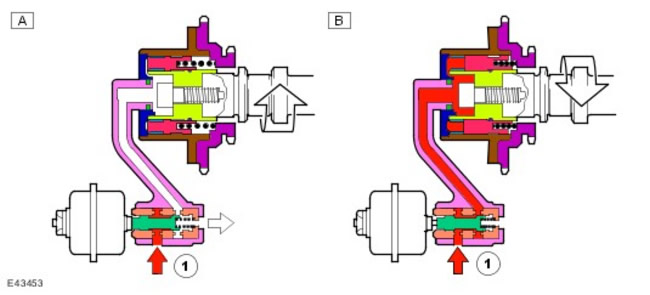

Operation of the variable valve timing system (VVT)


Item nameSpare part catalog numberDescription
A-Lag
B-Advance
1-Engine oil pressure

The VVT mechanism is a hydraulic actuator mounted in the end of the intake camshaft and changes the angular position of the camshaft relative to the crankshaft. A control solenoid valve, the operation of which is controlled by the ECM, supplies oil under pressure to the advance chamber or retard chamber, located on opposite sides of three vanes inside the mechanism housing.

The original text can be found at [lrman.ru]

The VVT mechanism is driven by the primary circuit and rotates relative to the exhaust camshaft sprocket. When the ECM sends a request to decrease the retard angle, the control solenoid valve is energized, causing the spool valve to move to the appropriate position and pressurized engine oil is supplied to the advance chamber of the VVT mechanism through the filter. When a request is sent to increase the retard angle, the control solenoid valve is energized, causing the spool valve to move to the appropriate position and pressurized engine oil is released from the advance chamber and simultaneously supplied to the retard chamber of the VVT mechanism.


When commanded by the ECM, the VVT mechanism is set to the optimum position between full advance and retard for a given engine speed and load. During this operation, the ECM sends a voltage signal to the control solenoid valve until the desired position is reached. The voltage signal is then reduced to the value required to hold the solenoid mechanism, and therefore the spool valve, in a stationary position. This function is controlled by feedback: the ECM evaluates the decrease in spool valve oil pressure based on signals from the camshaft position sensor. The ECM increases the voltage signal to maintain the spool valve in the desired position.

Engine oil properties and temperature can affect the ability of the VVT mechanism to change the camshaft angle position. At very low oil temperatures, the higher oil viscosity can slow down the VVT mechanism, and at high oil temperatures, low viscosity can affect the mechanism's operation if the oil pressure is insufficient. To maintain good VVT mechanism performance, a high-flow oil pump and an engine oil temperature sensor are used to allow the ECM to monitor the mechanism's operation. VVT control is normally closed loop except under extreme temperature conditions, such as cold starting below 32°F (0°C). At extremely high oil temperatures, the ECM can limit the advance of the VVT mechanism to prevent the engine from stalling when returning to idle speed.

The VVT mechanism does not operate at oil pressures below 1.25 bar, as this pressure is not sufficient to release the internal locking pin of the VVT mechanism. This usually occurs when the engine is turned off and the VVT mechanism returns to the retarded position. The locking pin locks the VVT mechanism to the camshaft to stabilize the shaft the next time the engine is started.


This article is available at russian, bulgarian, belarusian, ukrainian, serbian, croatian, romanian, polish, slovak, hungarian
Article review: Saveliy Ushakov


Previous articles
4.4l engine specification
Device and technical description
Cylinder Block Parts
Engine Information Location
Connecting rods and pistons
Crankshaft position sensor and knock sensor
Starter and engine cooling system
Crankshaft and oil pan parts

Current article
Variable Valve Timing (VVT)

Next articles
Lubrication system
Exhaust manifold
Disassembling the 4.4L engine
4.4L Engine Assembly
Removal the 4.4L Engine
Installing a 4.4L Engine
Variable Camshaft Control (VCT) Unit
Floppy disk


Similar articles from Land Rover repair manuals:
• Elements of the valve timing adjustment mechanism Freelander 2 (2006-2014)
• Valve timing — checking and adjustment Freelander 1 (1997-2006)
• Valve timing — checking and adjustment Range Rover 3 (2001-2012)
• Brake pressure control valve Defender 2007+ (2007-2016)

Comments on this article


No comments yet


How much will 39 + 28 =


Discovery 3 
  • General information
  • Using the manual
  • Precautionary measures
  • Service Information
  • Technique
  • Health protection
  • Road test
  • Identification codes
  • Jacking and lifting
  • Maintenance - diesel
  • Maintenance - petrol
  • Chassis
  • Suspension
  • Front suspension
  • Rear suspension
  • Wheels and tires
  • Dynamic suspension
  • Cardan shaft
  • Rear drive axle
  • Front drive axle
  • Front axle axles
  • Rear axle axles
  • Brake system
  • Parking brake
  • Hydraulic brake
  • Vacuum brake booster
  • Anti-lock braking system
  • Steering
  • Steering column
  • Power unit
  • Petrol engine 4.0L
  • Petrol engine 4.4L
  • Diesel engine 2.7L
  • Engine cooling
  • Fuel supply
  • Drive units
  • Launch system
  • Ignition system
  • Emission reduction
  • Air filtration
  • Fuel vapor control
  • Electronic control part
  • Car gearbox
  • Clutch
  • All-wheel drive systems
  • Transfer case
  • Exhaust system
  • Fuel tank and lines
  • Acceleration control
  • Electrical equipment
  • Climate control
  • Instruments and control lamps
  • Battery and charging system
  • Information system
  • Lighting and headlights
  • Power distribution
  • Electronic Function Group
  • Body and coating
  • Body elements
  • Interior and body trim
  • Mirrors and glasses
  • Seats
  • Instrument panel and console
  • Handles and locks
  • Windshield wipers and washers
  • Sunroof and bumpers
  • Safety system
  • Body repairs
  • Repair of front end elements
  • Repair of back elements
  • Side panel repair
  • Frame and body mount

Discovery 1 
  • General information
  • Technical specifications
  • Introduction to manual
  • Troubleshooting
  • Power unit
  • Diesel engine Tdi
  • Petrol engine V8i (3.9 l)
  • Petrol engine V8i (4.0 l)
  • Petrol engine Mpi
  • Reducing harmful emissions
  • Fuel system Tdi
  • Fuel system MFi
  • Fuel system SFi
  • Fuel system MPi (MEMS)
  • Cruise control
  • Cooling system (Tdi)
  • Cooling system (V8i)
  • Cooling system (MPi)
  • Exhaust system
  • Transmission
  • Clutch
  • Manual gearbox R380
  • Manual gearbox LT 77
  • Transfer case LT230T
  • Automatic gearbox
  • Cardan shaft
  • Rear axle
  • Front axle
  • Chassis
  • Steering system
  • Front suspension
  • Rear suspension
  • Brake system
  • Wheels and tires
  • Body and interior
  • Passive safety
  • Doors, locks and windows
  • Exterior body parts
  • Interior trim details
  • Seats
  • Electrical equipment
  • Heating and ventilation
  • Air conditioning
  • Windscreen wipers
  • Starting and charging system
  • Equipment and devices
  • Lighting and headlights


LRman.ru © 2013-2026 | Mobile version | Free Lander | Discovery | Range Rover | Defender | Contacts | | Sitemap |
Car repair and service instructions Land Rover: Freelander, Discovery, Range Rover, Defender
We use cookies to make pages load faster and provide a more user-friendly experience 🍪