


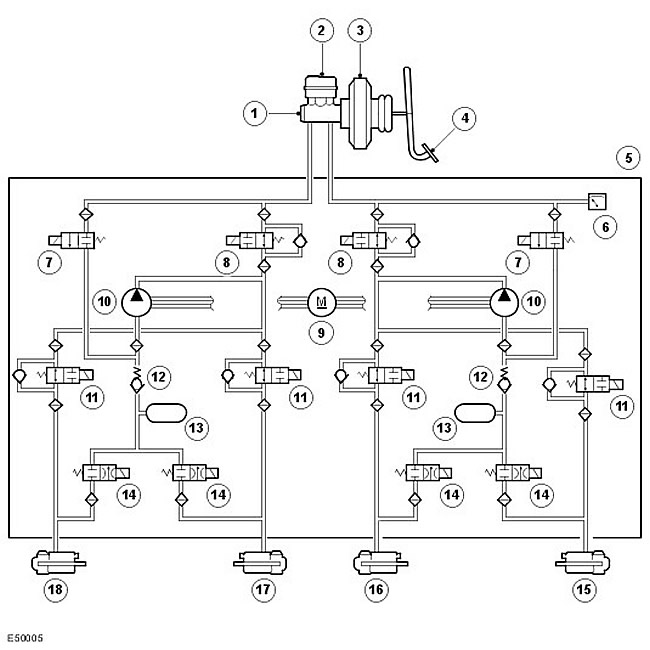
| Item name | Spare part catalog number | Description |
| 1 | - | Master cylinder |
| 2 | - | Tank |
| 3 | - | Brake booster |
| 4 | - | Brake pedal |
| 5 | - | HCU (hydraulic control unit) |
| 6 | - | Pressure sensor |
| 7 | - | Filling valve |
| 8 | - | Control valve |
| 9 | - | Return pump electric motor |
| 10 | - | Return pump |
| 11 | - | Inlet valve |
| 12 | - | Bypass valve |
| 13 | - | Receiver |
| 14 | - | Exhaust valve |
| 15 | - | Left front wheel brake mechanism |
| 16 | - | Right front wheel brake mechanism |
| 17 | - | Right rear wheel brake mechanism |
| 18 | - | Left rear wheel brake mechanism |
HCU Block (hydraulic control unit) has three operating modes: Normal braking/EBD (electronic Brakeforce Distribution), braking with ABS (anti-lock braking system) and active braking.
Normal braking mode/EBD
Initially, no voltage is supplied to any electromagnetic valve. When the brake pedal position changes, the pressure in the brake mechanisms increases or decreases through the open control and inlet valves. If the ABS module (anti-lock braking system) determines that EBD needs to be enabled (electronic Brakeforce Distribution), it supplies voltage to the rear axle brake inlet valves to prevent further increase in hydraulic pressure in them.
ABS braking mode
If the ABS module (anti-lock braking system) determines that ABS braking is required (anti-lock braking system), it supplies voltage to the inlet and outlet valves of the corresponding brake mechanism and turns on the return pump. The inlet valve closes to isolate the brake mechanism from the brake fluid pressure; the release valve opens to release pressure from the brake mechanism into the receiver and the return pump circuit; reducing the pressure allows the wheel to increase its rotation speed. The ABS module then (anti-lock braking system) controls the intake and exhaust valves, regulating the pressure in the brake mechanism to ensure maximum braking force without locking the wheel. The valves of each wheel are controlled separately.
Active braking mode
Active Braking mode is used to generate and regulate hydraulic pressure in the brake mechanisms for functions other than ABS braking. (anti-lock braking system), such as DSC, EBA (emergency braking assistance system), ETC, HDC and dynamic parking brake activation.
For active braking, the ABS module (anti-lock braking system) supplies voltage to the control valves and filler valves, turns on the return pump and supplies voltage to all inlet valves. Brake fluid, taken from the reservoir through the master cylinder and filler valve, is supplied under pressure by the return pump to the inlet valves. Then the ABS module (anti-lock braking system) controls the intake and exhaust valves, regulating the pressure in individual brake mechanisms. Noise may be heard during active braking.
Comments on this article