NOTE: This procedure is performed if new parking brake shoes, new rear brake rotors have been installed, or if the vehicle has been driven in deep mud (not water) for more than 50 miles.
NOTE: If adjustment is required as part of the maintenance checklist, perform steps 1-14 only. The brake shoe bedding procedure is not required in this case.
1. Check that the parking brake is working properly.
2.
CAUTION: When the vehicle is in the "set position", the red indicator light on the instrument cluster will flash. This indicates that the parking brake actuator is in the "set position". This does not indicate a malfunction of the vehicle.
Using the Land Rover approved diagnostic system, set the parking brake to the 'set position'.
3. CAUTION: Never work on a vehicle supported only by a jack. Always support the vehicle with special stands.
Raise and support the vehicle.
4. Remove the wheels.
5. Locate the parking brake shoe adjuster.
- Remove the access plug.
- Turn the brake disc.
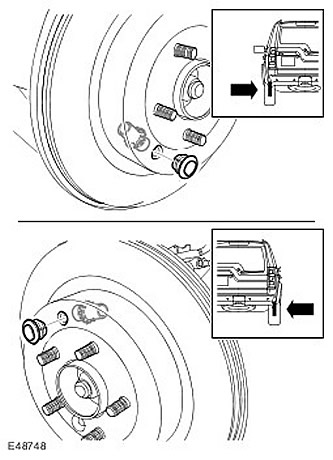
6.
CAUTION: Rotation must always be forward.
[The text of the article was taken from the website: LRman.ru]
CAUTION: If less than 40 Nm of torque is required, tighten the adjuster one click at a time.
Using a slotted screwdriver and a torque wrench fitted to the axle nut, rotate the parking brake shoe adjuster to reduce the clearance until the force required to turn the brake disc increases to 40 Nm.
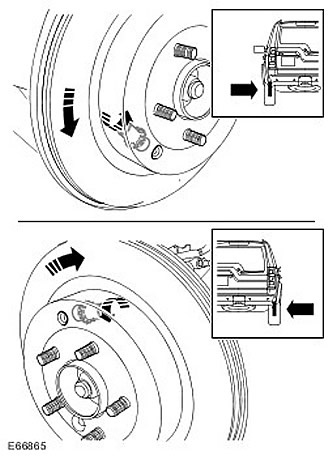
7.
CAUTION: Rotation must always be forward.
CAUTION: The force required to turn the brake disc must be less than 90 Nm.
NOTE: The force required to turn the brake disc by the axle nut should be 40-90 Nm.
Using a torque wrench fitted to the axle nut, ensure that the brake disc still rotates forward before 90 Nm is reached.
8.
CAUTION: The parking brake adjuster must then be turned back EXACTLY 8 clicks. Failure to follow this instruction may result in damage to the parking brake system.
Turn the parking brake adjuster back 8 clicks.
9. Loosen the slack adjuster Allen screw by half a turn.
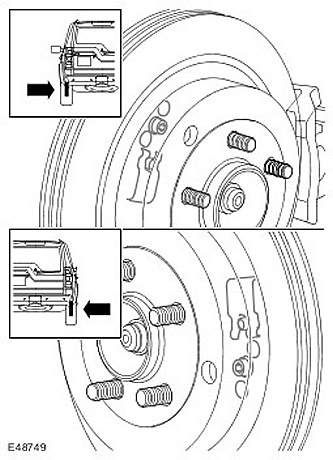
10. Using a soft-faced mallet, apply several light blows to the brake disc around the parking brake shoe.
11. Tighten the slack adjuster hex screw (tightening torque 6 Nm).
12. Install the access plug.
13. Repeat the above procedure on the other side.
14. Remove the vehicle from the 'parking position' by applying the parking brake twice.
15. Perform the bedding procedure for the parking brake shoes. Bedding in the parking brake shoes (70.40.12). If the parking brake shoes or brake discs have not been removed to gain access to other components, the bedding procedure DOES NOT NEED to be performed.
Comments on this article