Examination
1. Place an absorbent cloth to prevent splashing of the working fluid.
2. Loosen the bolt securing the high pressure pipe clamp to the power steering pump.
3. Loosen the high pressure pipe from the power steering pump and remove the pipe.
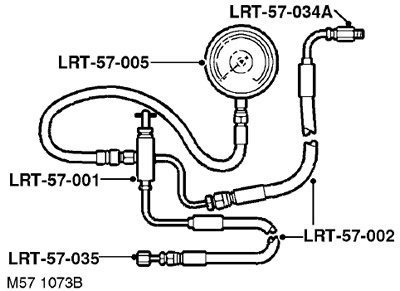
4. Models with K1.8 engine: Install the LRT-57-034A adapter to the high pressure nipple of the power steering pump.
5. Models with KV6 and Td4 engines: Install the LRT-57-042 adapter onto the high pressure nipple of the power steering pump.
6. Connect the LRT-57-035 adapter to the existing high pressure pipeline.
7. Attach the LRT-57-002 tube to each adapter.
8. Attach the LRT-57-005 pressure gauge to the LRT-57-001 test valve
9. Connect the LRT-57-002 hoses to the LRT-57-001 valve and tighten the connections.
10. Check for any leaks of power steering fluid from the power steering system and test equipment connections.
11. During testing, maintain the required level of working fluid in the power steering reservoir.
12. Open the test valve and start the engine.
13. The pressure at idle speed of the engine should be within 5-7 bar.
14. With the engine idling, slowly turn the steering wheel to the full lock position and hold it.
15. Repeat the operation by turning the steering wheel in the opposite direction.
16. During the test, when turning the steering wheel, the working fluid pressure should increase sharply and continue to increase until the steering wheel is turned to the extreme position. For information on the value of the working fluid pressure at the extreme position of the steering wheel, refer to the section on main technical characteristics.
TECHNICAL SPECIFICATIONS, Steering.
17. With the engine idling, release the steering wheel. For information on the working fluid pressure when the engine is idling, refer to the main technical characteristics section.
TECHNICAL SPECIFICATIONS, Steering.
18. If the pressure is higher than the permissible value, this indicates a malfunction.
19. To determine if there is a fault in the pump or in the steering gear assembly, close the valve for a maximum of 5 seconds.
CAUTION: Keeping the valve closed for longer may damage the power steering pump.
20. If the dial indicator shows that the pressure is not normal, then the pump may be faulty.
[The text of the article was taken from the website LRman.ru]
21. If the pressure at the outlet of the power steering pump is normal, and the steering wheel turns with difficulty when the engine is idling and becomes "easier" when the crankshaft speed increases, then the pump characteristics may not be normal.
22. If the maximum pressure at the pump outlet is normal, then the steering mechanism may be faulty.
23. After completing the test, stop the engine and remove the test equipment.
24. Clean the power steering pump and the pipe fitting.
25. Install a new sealing ring on the high-pressure pipe end, connect the pipe to the pump and tighten the union nut to a torque of 25 Nm.
26. Tighten the high pressure pipe clamp mounting bolt to 8 Nm.
27. Check the level of the working fluid in the power steering reservoir and, if necessary, top it up to normal.
MAINTENANCE, Intermediate Drive (IRD) - For vehicles not sold in the USA and Canada.
Comments on this article